1099 Tax Calculator: Estimate What You'll Owe in 2026
Disclaimer: This article is for general educational purposes only and is not tax, legal, or financial advice. Tax rules change, your situation is unique, and rounded numbers in examples will not match your actual return. Consult a licensed CPA or enrolled agent before making filing or payment decisions.
You opened an envelope (or an email) with a 1099-NEC, did some quick mental math on the total, and felt your stomach drop. That is the reaction a lot of freelancers, gig workers, and side hustlers have every spring, because unlike a W-2 job, nothing was taken out for taxes. The number on the form is the number that hit your bank account, and the IRS still expects its cut.
This guide is itself a 1099 tax calculator. Instead of plugging numbers into a black box, you will walk through the same math a self-employed tax estimator runs behind the scenes: totaling income, subtracting business expenses, applying the 15.3% self-employment tax on 92.35% of net earnings, layering on federal income tax with the 2026 brackets, and adding any state tax. We will also cover quarterly deadlines, the QBI deduction, and how better expense tracking directly lowers your bill.
How 1099 Taxes Differ From W-2 Taxes
A W-2 employee sees a big gap between gross pay and net deposit. That gap is not lost money, it is prepaid tax. The employer withholds federal income tax, state tax, and the employee half of Social Security and Medicare (7.65%), then matches the other 7.65% on your behalf.
With a 1099, none of that happens. You receive the full amount, and you are responsible for:
- Federal income tax at your marginal bracket
- Self-employment (SE) tax of 15.3%, which is both halves of Social Security and Medicare
- State and local income tax, if your state has one
- Quarterly estimated payments to the IRS four times a year, instead of per paycheck withholding
The self-employment tax is the part that surprises people. Even if your income tax bracket is only 12%, the SE tax stacks on top of that, which is why many freelancers set aside 25 to 30 percent of each payment. For a side-by-side on how the two forms work, see W-2 vs 1099 explained.
How to Calculate 1099 Taxes: Step by Step
The calculation has six steps. Work through each one with your own numbers, then we will run a full example at the end.
Step 1: Total Your 1099 Income
Add every 1099-NEC, 1099-K, and 1099-MISC you received, plus any untracked cash or invoiced work. The IRS expects all self-employment income reported on Schedule C, not just what appears on a 1099 form. Clients only issue a 1099-NEC when they pay you $600 or more, so small jobs can slip through if you do not track income yourself.
If you invoice clients, cross-check totals against your bank deposits. Missed income is the most common audit trigger for small filers.
Step 2: Subtract Business Expenses
Every ordinary and necessary business expense reduces both your income tax and your self-employment tax. Common Schedule C categories include:
- Advertising and marketing
- Car and truck expenses (mileage at the 2026 standard rate, or actual costs)
- Contract labor
- Depreciation (equipment, computers)
- Home office (portion of rent, utilities, internet)
- Insurance (business, liability)
- Legal and professional fees
- Office expenses and supplies
- Software and subscriptions
- Travel, meals (50% deductible), and lodging
- Utilities (business portion)
- Health insurance premiums (as an adjustment, not on Schedule C)
Gross income minus expenses equals net self-employment income. This is the number that drives the rest of the calculation.
Step 3: Calculate Self-Employment Tax
Multiply net self-employment income by 0.9235 to get the portion subject to SE tax. Then multiply that by 15.3%.
SE taxable = Net earnings x 0.9235
SE tax = SE taxable x 0.153
The 15.3% breaks down as 12.4% Social Security and 2.9% Medicare. Social Security stops applying once your combined wages and self-employment earnings hit the 2026 wage base of $184,500, while Medicare applies to all earnings. An additional 0.9% Medicare surtax kicks in above $200,000 single or $250,000 married filing jointly.
Half of your SE tax is then deductible as an adjustment to income, which flows into Step 4.
Step 4: Calculate Federal Income Tax (2026 Brackets)
Start with net self-employment income, subtract the deductible half of SE tax, subtract the standard deduction (or itemize), and then apply the 2026 brackets. For tax year 2026 the standard deduction is $16,100 for single filers and $32,200 for married filing jointly, based on IRS Revenue Procedure 2025-32.
The 2026 federal brackets for single filers are (approximately, confirm with current IRS tables):
| Rate | Taxable income (single) |
|---|---|
| 10% | $0 to $12,400 |
| 12% | $12,401 to $50,400 |
| 22% | $50,401 to $105,700 |
| 24% | $105,701 to $201,775 |
| 32% | $201,776 to $256,225 |
| 35% | $256,226 to $640,600 |
| 37% | $640,601 and above |
Remember: brackets are marginal. A single filer with $60,000 of taxable income pays 10% on the first $12,400, 12% on the next slice, and 22% only on the amount above $50,400, not 22% on the whole thing. For a refresher, read what is a tax bracket.
Step 5: Add State and Local Tax
Nine states have no individual income tax on earned income (Alaska, Florida, Nevada, New Hampshire, South Dakota, Tennessee, Texas, Washington, Wyoming). The rest range from flat rates near 3% to graduated brackets over 10% in California, New York City, and a few others. Look up your state department of revenue for current rates, or use a state-specific calculator like Keeper's state pages.
Some cities (New York City, Philadelphia, San Francisco with its business tax) add local layers. Do not forget these.
Step 6: Subtract Credits and the QBI Deduction
If your business qualifies, you can take the Qualified Business Income (QBI) deduction of up to 20% of your net business income. The One Big Beautiful Bill Act made the QBI deduction permanent, and for 2026 added a minimum deduction of $400 for filers with at least $1,000 of QBI. Phase-in thresholds for 2026 are $201,775 for single filers and $403,500 for married filing jointly, with specified service businesses facing limits above those amounts.
Then apply any refundable or nonrefundable credits you qualify for (Child Tax Credit, Earned Income Credit, Saver's Credit, etc.) and subtract federal income tax withheld or prior estimated payments.
Worked Example: $75,000 Gross, $15,000 Expenses, Single
Let's run a realistic example for a freelance designer, single, no dependents, working in a no-income-tax state.
Gross 1099 income:                         $75,000
Business expenses (Schedule C):           -$15,000
Net self-employment income:                $60,000

SE taxable (60,000 x 0.9235):              $55,410
SE tax (55,410 x 0.153):                   $8,478
  Half of SE tax (deductible):             $4,239

Taxable income base:
  Net SE income:                           $60,000
  Minus 1/2 SE tax:                        -$4,239
  Minus standard deduction (single):      -$16,100
  Minus QBI (approx 20% of lesser amount): -$7,932  (illustrative)
  Taxable income:                          $31,729

Federal income tax (2026 brackets):
  10% on first $12,400:                    $1,240
  12% on $12,401 to $31,729 ($19,329):     $2,319
  Federal income tax:                      $3,559

Total federal tax:
  SE tax:                                  $8,478
  Federal income tax:                      $3,559
  Total:                                   $12,037
Effective rate on gross: about 16%. Effective rate on net: about 20%. Most online 1099 tax estimators land within a few hundred dollars of this for similar inputs. State tax, if any, adds on top.
Why Tracking Deductions All Year Saves Thousands
Look at the example again. Every extra $1,000 in legitimate business expenses saves roughly $153 in SE tax plus 12 to 22 percent in federal income tax, so about $270 to $370 per $1,000 for a typical filer. Miss $5,000 of deductions and you have handed the IRS well over $1,000 that could have stayed in your account.
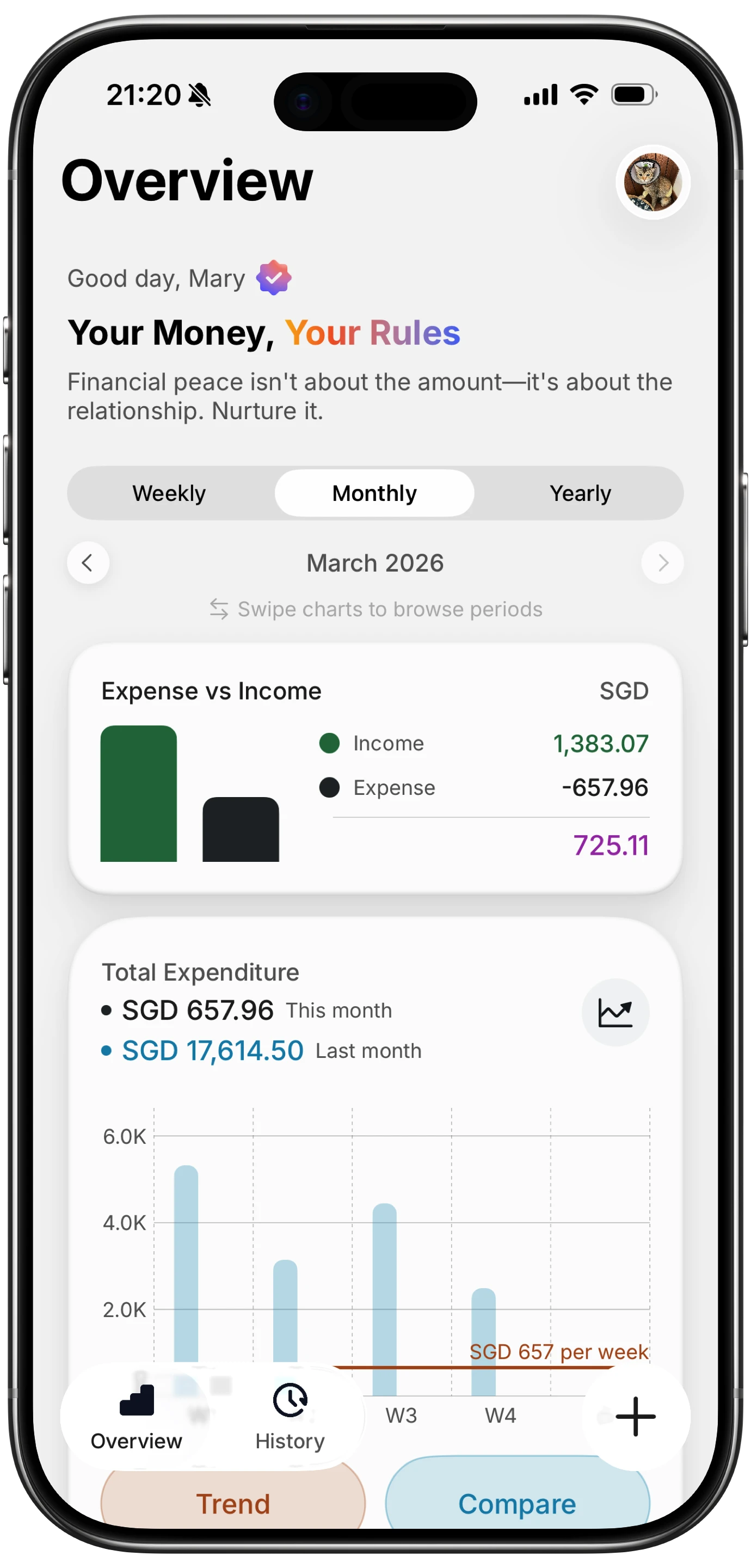
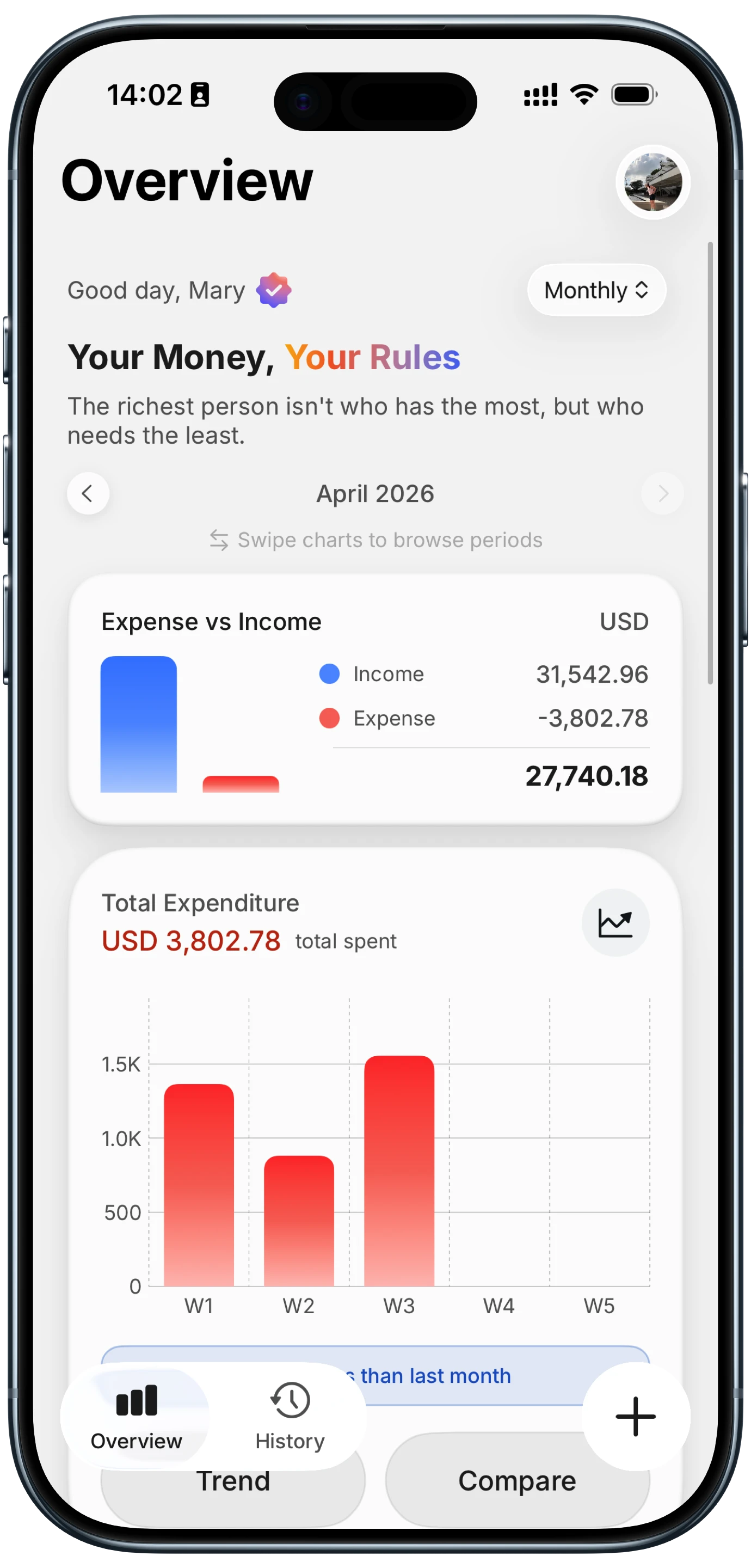
Finny app's Overview feature
The problem is that most freelancers reconstruct expenses in April from a pile of bank and credit card statements, which almost guarantees missed deductions. Mileage, cash tips to service providers, home office utilities, software subscriptions buried in personal accounts, and small Amazon orders all tend to get overlooked.
A better approach is to log each expense in the moment: snap the receipt, categorize it, and move on. Finny is one tool that can help here. It is not a tax product, but it lets you capture receipts, text, or voice notes into Schedule C style categories throughout the year, then export a clean list when you sit down with a CPA or a dedicated tax app. For more on the workflow, see how to track expenses and our roundup of expense trackers that don't require bank login.
Quarterly Estimated Taxes: 2026 Deadlines and How to Pay
If you expect to owe at least $1,000 in federal tax after withholding and credits, the IRS expects quarterly payments. Miss a payment and you owe interest (currently around 8% annualized) on the shortfall.
The 2026 estimated tax deadlines are:
| Quarter | Covers income from | Payment due |
|---|---|---|
| Q1 | Jan 1 to Mar 31 | April 15, 2026 |
| Q2 | Apr 1 to May 31 | June 15, 2026 |
| Q3 | Jun 1 to Aug 31 | September 15, 2026 |
| Q4 | Sep 1 to Dec 31 | January 15, 2027 |
Pay through IRS Direct Pay, EFTPS, the IRS2Go app, or by check with a Form 1040-ES voucher. A safe-harbor rule lets you avoid penalty by paying either 90% of this year's tax or 100% of last year's tax (110% if your prior AGI was over $150,000), whichever is smaller.
A practical rule of thumb: transfer 25 to 30 percent of every 1099 payment to a separate savings account the day it lands. When the quarterly deadline hits, the money is already set aside. For worked examples by income bracket and a quick estimate of what to set aside, see our 1099 tax calculator estimate guide for 2026.
Free 1099 Tax Calculators Online
If you want a second set of numbers to sanity-check the math above, these tools are widely used by freelancers:
Keeper Tax 1099 Calculator
Keeper's free calculator walks you through income, expenses, filing status, and state in a few screens, then shows your estimated federal and SE tax. They also offer state-specific pages and a quarterly tax estimator.
FlyFin A.I. Tax Calculator
FlyFin is aimed at freelancers and uses an AI layer to scan expenses for deductions. The 1099 calculator is free and separates federal, SE, and state estimates clearly.
Bonsai Self-Employed Tax Calculator
Bonsai is a contractor operations platform, so its tax calculator ties into invoicing and expense tools. Useful if you already use Bonsai for client work.
Use any of these as a directional estimate. None of them replace a CPA for complex situations like an S-corp election, multi-state income, or significant capital gains.
Calculators only turn tracked numbers into a tax estimate. The tracking part is where most freelancers lose money. Three guides pair well with this post: the self-employed expense tracker for iPhone 2026 guide covers apps that map to Schedule C categories, the how to track business expenses and income on iPhone guide walks through the capture workflow, and the free business expense tracker apps for freelancers roundup is the right starting point if budget is the constraint.
Frequently Asked Questions
How much should I set aside for 1099 taxes?
A common guideline is 25 to 30 percent of each 1099 payment, moved to a separate savings account as soon as the money lands. That buffer covers SE tax (about 14.1% of net after the 92.35% adjustment), federal income tax (often 10 to 22 percent at freelance income levels), and a cushion for state tax. High earners, high-tax states, or filers with other income should lean toward 35 percent. Run the step-by-step math above with your real numbers at least once a year to fine-tune the percentage.
Do I pay both self-employment tax and income tax?
Yes. Self-employment tax and federal income tax are two separate layers and both apply to the same net earnings. SE tax is a flat 15.3% on 92.35% of net earnings up to the Social Security wage base, and it funds Social Security and Medicare. Federal income tax is then calculated on taxable income (net earnings minus half of SE tax, minus the standard or itemized deduction, minus QBI and other adjustments) using marginal brackets. State income tax, if any, is a third layer on top.
Should I pay quarterly or just once at year-end?
Quarterly, in almost every case. The IRS charges an underpayment penalty (currently around 8% annualized) if you owe $1,000 or more at filing and did not meet safe-harbor thresholds. Paying quarterly also forces you to sit with your numbers four times a year, which catches mistakes early. The safe harbor is the smaller of 90% of this year's tax or 100% of last year's (110% if your prior AGI exceeded $150,000).
What if I can't pay what I owe?
File on time anyway. The failure-to-file penalty is ten times larger than the failure-to-pay penalty. The IRS offers online payment plans for balances under $50,000, and short-term plans under $10,000 usually approve automatically. Interest still accrues, but setting up an installment agreement stops most penalty escalation. Ignoring the bill is the worst option because wage garnishment and liens follow eventually.
Can I take the standard deduction if I'm a 1099 filer?
Yes. The standard deduction ($16,100 single, $32,200 married filing jointly for 2026) is available to everyone who does not itemize, regardless of whether your income comes from W-2 wages, 1099 contracts, or both. Business expenses on Schedule C are separate from the standard deduction, meaning you subtract expenses to get net self-employment income and then still claim the standard deduction against that. You do not have to itemize to write off business costs.
Final disclaimer: The numbers, brackets, and rules in this article reflect publicly available 2026 guidance as of April 2026 and are simplified for clarity. They are not a substitute for a qualified tax professional. Before you file, pay, or make any decision based on a calculator output, confirm your situation with a licensed CPA, enrolled agent, or tax attorney and check the most recent IRS publications.
Want cleaner numbers at tax time? Tracking income and expenses throughout the year makes every 1099 tax calculator more accurate. Apps like Finny let you log expenses with receipts, text, or voice in seconds, so when April comes you are plugging in real figures instead of guessing.