What Is an Index Fund? How It Works and Why Fees Matter
Investing advice often sounds complicated until you learn about index funds. An index fund is one of the simplest, lowest-cost, and most reliable ways to build wealth over time. It requires no stock-picking skill, no market timing, and minimal ongoing attention.
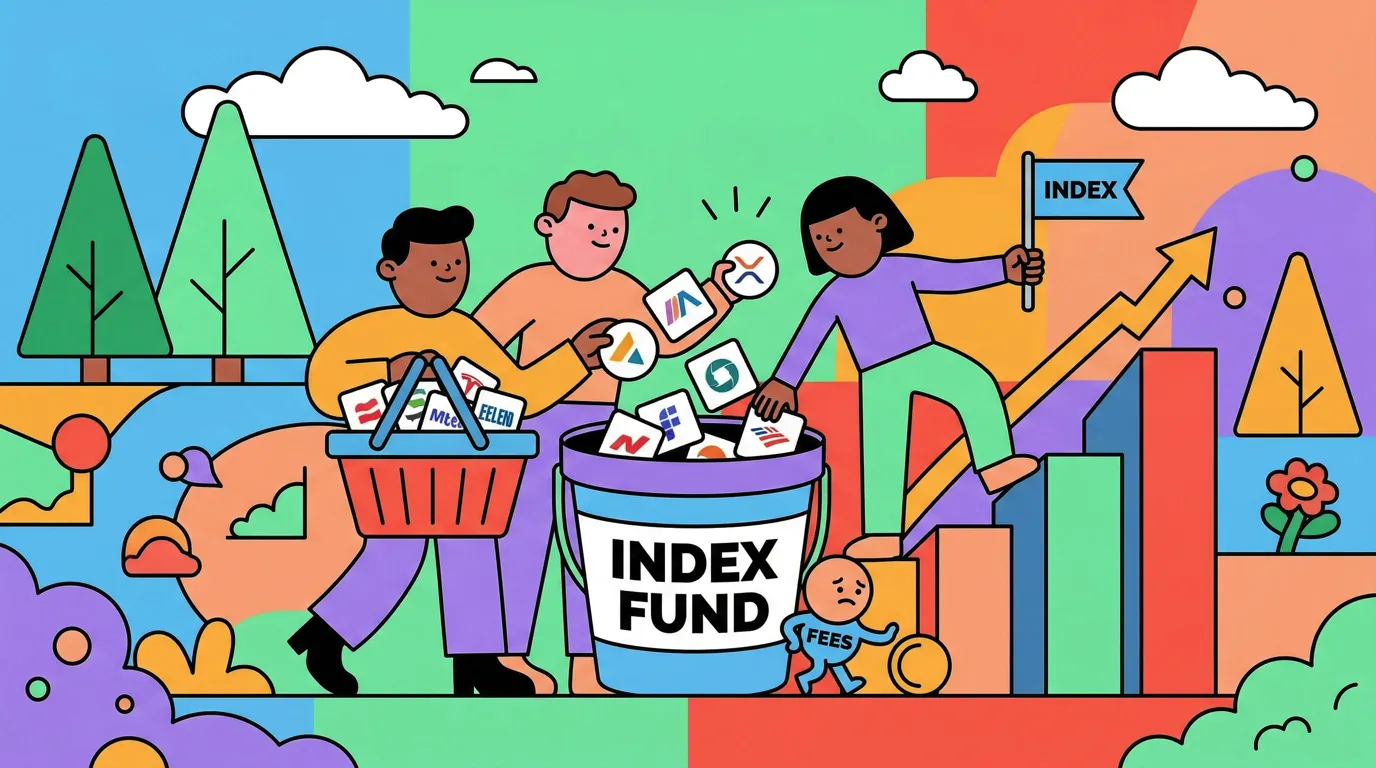
An index fund is an investment fund designed to track the performance of a specific market index, such as the S&P 500, the total US stock market, or a bond index. Instead of a fund manager choosing which stocks to buy and sell, the fund simply holds all (or a representative sample of) the securities in the index it tracks. For a broader look at personal finance fundamentals, see our complete guide.
How Index Funds Work
A market index is a measurement of a section of the financial market. The S&P 500, for example, tracks the 500 largest publicly traded companies in the United States. The index itself is just a number that goes up or down based on the combined performance of those companies.
An index fund replicates that index by holding the same securities in the same proportions. When the S&P 500 goes up 10%, an S&P 500 index fund goes up approximately 10% (minus a small fee). When it drops, the fund drops by the same amount.
This passive approach eliminates the need for a fund manager to research, analyze, and trade individual stocks. That simplicity is what makes index funds so inexpensive.
Key Characteristics
- Diversification: A single S&P 500 index fund gives you exposure to 500 companies across all major industries.
- Low fees: Expense ratios typically range from 0.02% to 0.20%, compared to 0.50% to 1.50% for actively managed funds.
- Transparency: You always know what the fund holds because it mirrors a published index.
- Tax efficiency: Less trading within the fund means fewer taxable events.
Index Fund vs Mutual Fund vs ETF
These terms overlap, which causes confusion. Here is how they relate:
| Type | What It Is | Trading | Minimum Investment |
|---|---|---|---|
| Mutual fund | A pooled investment fund (can be index or active) | Once per day at market close | Often $1,000-$3,000 |
| ETF | A fund that trades on stock exchanges like a stock | Throughout the day at market price | Price of one share |
| Index fund | A strategy (track an index), available as either a mutual fund or ETF | Depends on structure | Varies |
An index fund is a strategy, not a fund type. You can buy an S&P 500 index fund as a mutual fund (e.g., Vanguard's VFIAX) or as an ETF (e.g., Vanguard's VOO). The underlying holdings are identical. The difference is in how you buy and sell.
For most individual investors, index ETFs are the most accessible option because they have no minimum investment beyond the price of a single share. If you want a closer look at how ETFs work and how they differ from mutual funds, see our guide on what an ETF is.
Why Low Fees Matter
The difference between a 0.03% expense ratio and a 1.00% expense ratio sounds trivial. Over decades, it is not.
| Scenario | Annual Return | Expense Ratio | Value After 30 Years ($10,000 initial, $500/month) |
|---|---|---|---|
| Low-cost index fund | 10% | 0.03% | $1,130,000 |
| Average active fund | 10% | 1.00% | $948,000 |
| High-fee active fund | 10% | 1.50% | $880,000 |
That 0.97% difference in fees costs you approximately $182,000 over 30 years on a modest investment plan. The money does not disappear. It goes to the fund company. For a deeper dive into how investment fees compound, see our guide on expense ratios.
Historical Performance
Over any 20-year period in US market history, the S&P 500 has delivered positive returns. The long-term average annual return is approximately 10% before inflation (about 7% after inflation).
More importantly, index funds consistently outperform the majority of actively managed funds. Studies show that over a 15-year period, roughly 85-90% of active fund managers fail to beat their benchmark index after fees.
This is the core argument for index investing: if most professionals cannot beat the index, paying higher fees for active management is unlikely to improve your results.
Common Types of Index Funds
| Index | What It Tracks | Use Case |
|---|---|---|
| S&P 500 | 500 largest US companies | Core US stock exposure |
| Total US Stock Market | Entire US stock market (3,000+ companies) | Broader US diversification |
| Total International | Non-US developed and emerging markets | Global diversification |
| Total Bond Market | US investment-grade bonds | Fixed income, lower volatility |
| Small Cap | Smaller US companies | Higher growth potential, higher risk |
A simple portfolio of a total US stock market fund, a total international fund, and a total bond fund covers the entire global investment landscape. This three-fund approach is one of the most commonly recommended strategies for individual investors because it provides broad diversification across asset classes and geographies.
How to Start Investing in Index Funds
- Open a brokerage account or use your 401k. Major brokerages (Fidelity, Vanguard, Schwab) offer commission-free index fund and ETF trades.
- Choose your index fund(s). For simplicity, a single total US stock market fund is a reasonable starting point.
- Decide how much to invest. Even small, consistent contributions compound significantly over time. For more on this approach, see our guide on dollar cost averaging.
- Set up automatic contributions. Automate monthly purchases so investing happens without requiring a decision each time.
- Leave it alone. Index investing works best when you do not react to short-term market movements.
How Expense Tracking Helps You Invest Consistently
The most common reason people do not invest enough is not knowing how much they can afford to invest. When your spending is unclear, any amount feels risky to commit.
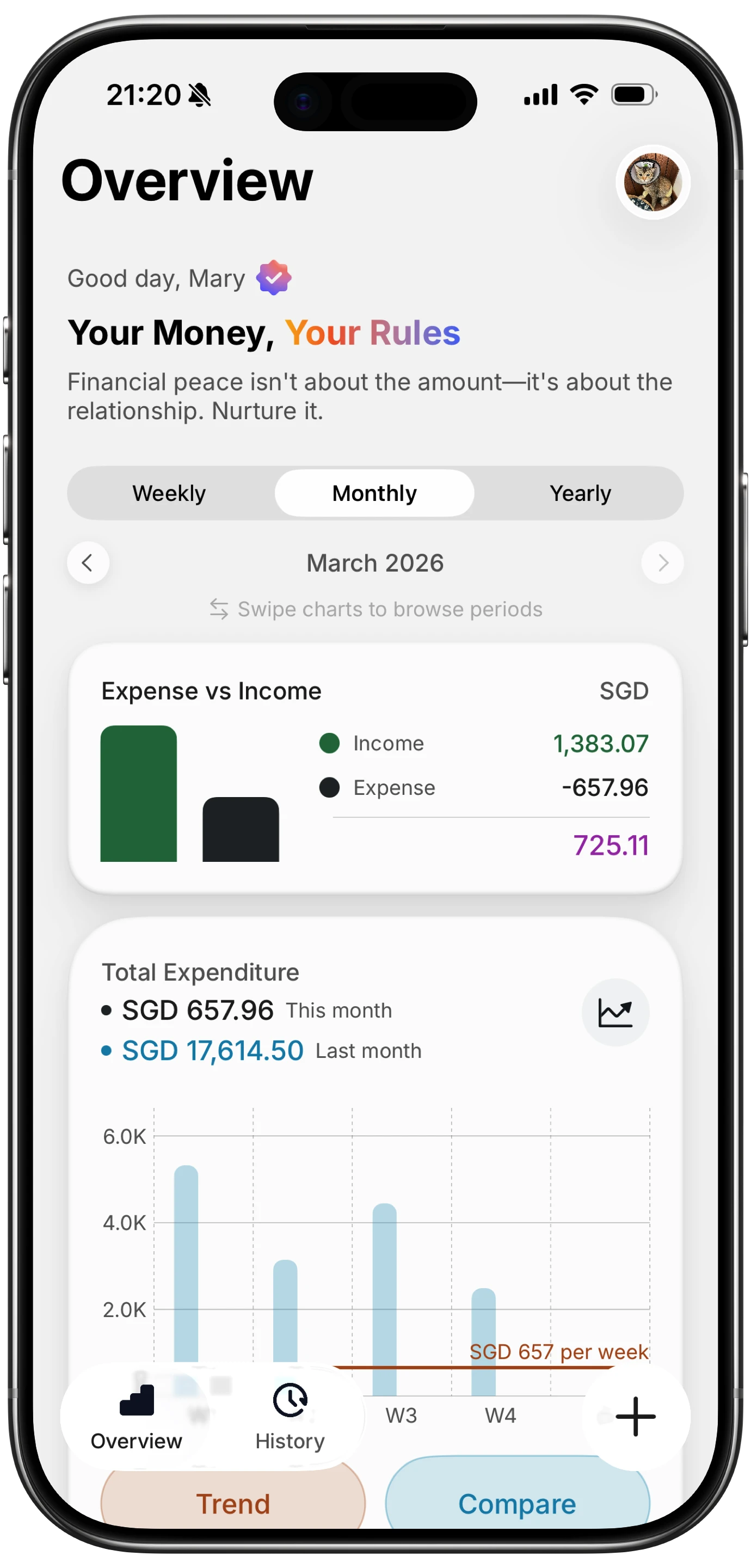
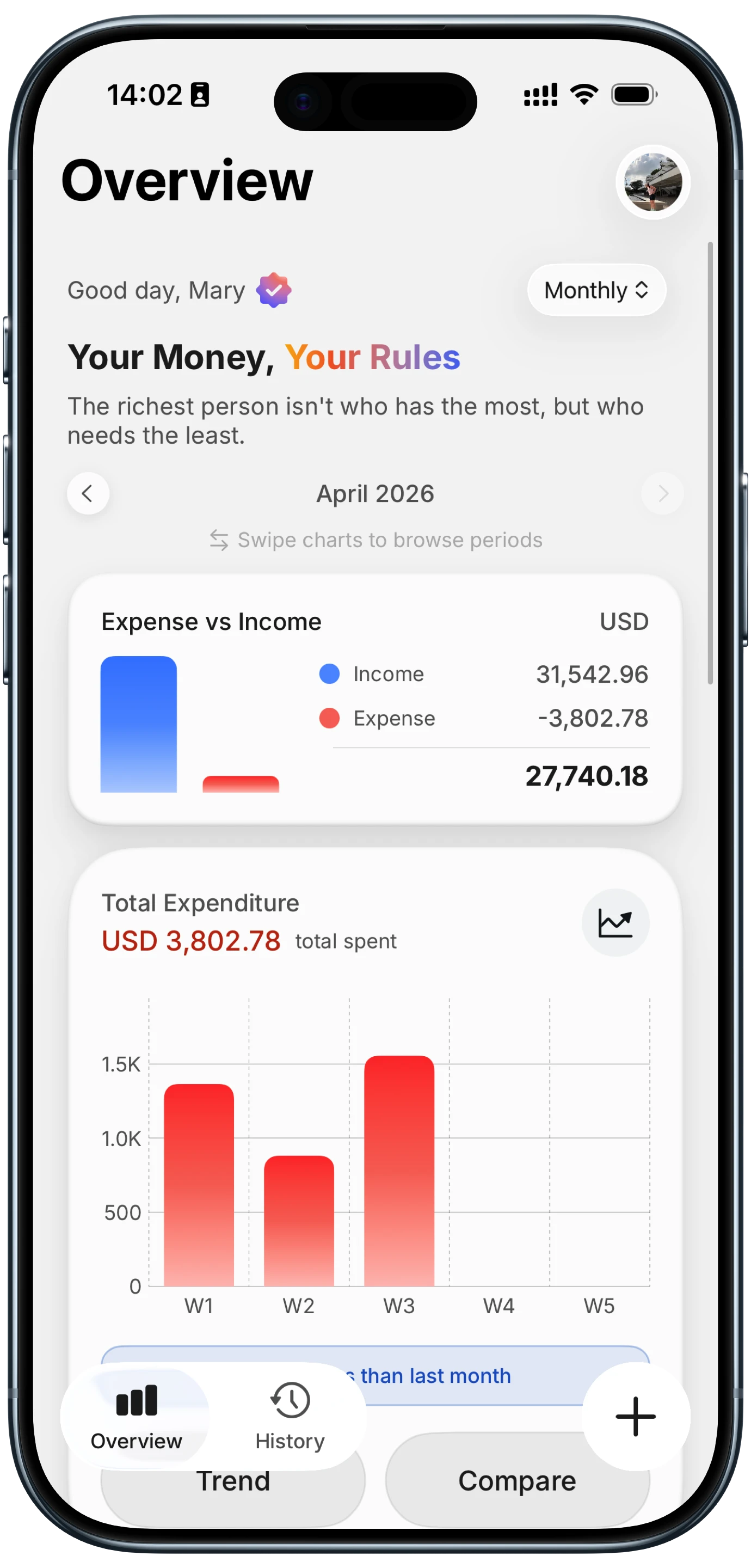
Finny app's Overview feature
Tracking your expenses for even one month reveals your actual spending patterns. You can see exactly how much remains after necessities, identify discretionary spending you could redirect, and set a realistic investment amount.
The connection is direct: people who track spending save more because they make decisions based on data rather than guesses. If you find $200 per month in reducible expenses, that is $2,400 per year invested, which grows to approximately $180,000 over 30 years at market average returns.
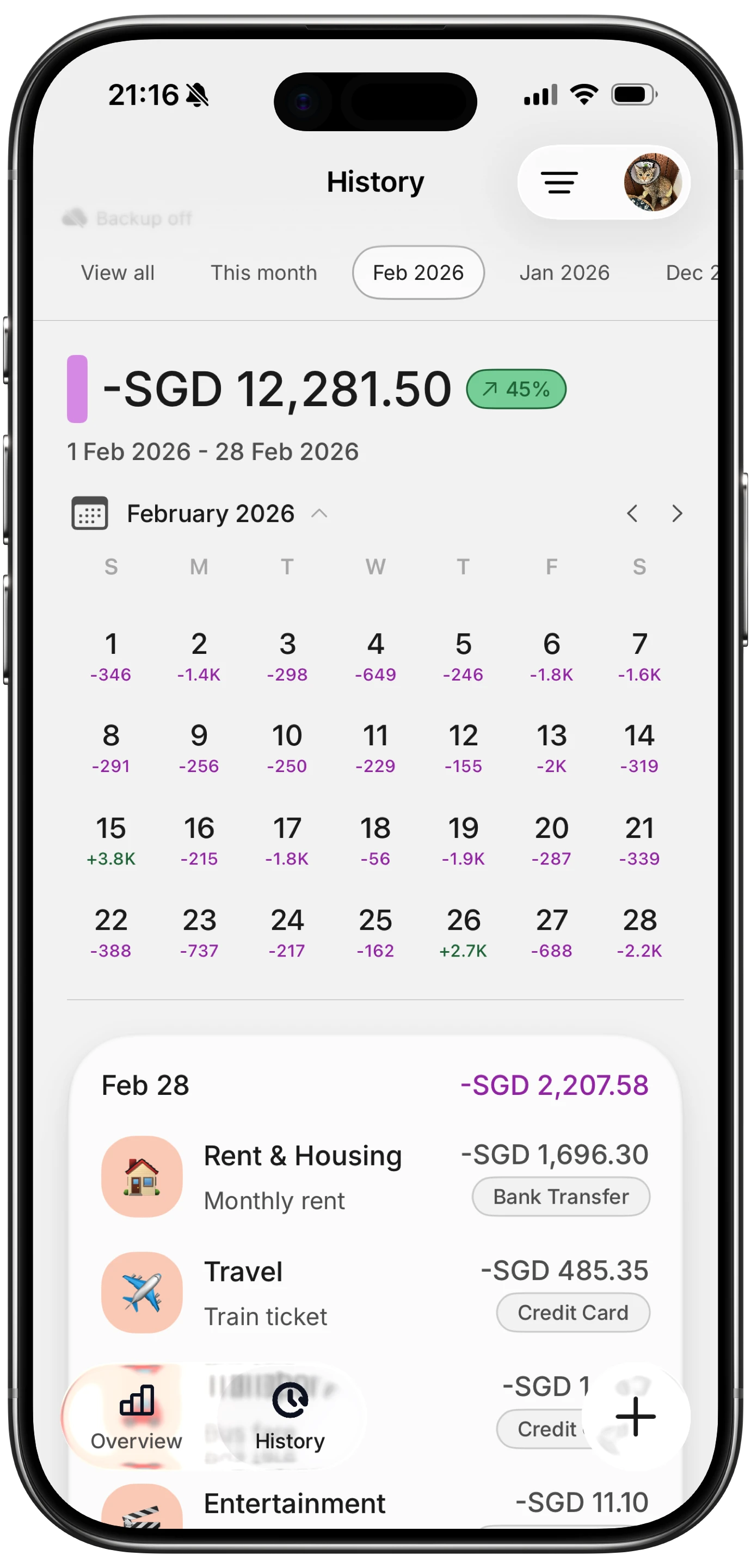
Finny app's History calendar feature
For more strategies on building the tracking habit, see our guide on how to track expenses.
Common Mistakes With Index Funds
Trying to time the market. Selling when the market drops and buying when it rises is the opposite of what works. Time in the market consistently beats timing the market.
Checking too frequently. Daily portfolio checks lead to emotional decisions. Monthly or quarterly reviews are sufficient.
Ignoring international diversification. US stocks have performed well recently, but concentrating everything in one country adds unnecessary risk.
Paying high fees for index-like returns. Some funds charge active management fees while closely mimicking an index. Always check the expense ratio before investing.
The Bottom Line
An index fund is the simplest path to long-term wealth building. It requires no expertise, charges minimal fees, and historically outperforms most alternatives. The key is starting, contributing consistently, and not reacting to short-term noise.
The practical challenge is finding money to invest regularly. That starts with understanding your spending. When you track expenses and see where your money goes, you can make intentional choices about how much to direct toward investing each month.
Common Questions About Index Funds
What is the best index fund for beginners?
A total US stock market index fund or an S&P 500 index fund is the most common starting point. Both provide broad diversification at very low cost. Major providers include Vanguard (VTI/VOO), Fidelity (FSKAX/FXAIX), and Schwab (SWTSX/SWPPX).
How much money do I need to start investing in index funds?
With ETFs, you need enough to buy one share, which can be as little as $30-$50 depending on the fund. Many brokerages now offer fractional shares, so you can start with any amount.
Are index funds safe?
Index funds carry market risk. They can and do lose value during market downturns. However, over long time horizons (15+ years), broad market index funds have historically always recovered and delivered positive returns. They are not risk-free, but they are well-diversified.
Should I invest in index funds or individual stocks?
For most people, index funds are the better choice. They provide instant diversification, require less research, and historically outperform the majority of individual stock pickers. Individual stocks can complement an index fund portfolio, but should not replace it.
How often should I invest in index funds?
Monthly contributions aligned with your paycheck are the most practical approach. This is dollar cost averaging, and it removes the temptation to time the market. Set up automatic investments so it happens without effort.
Want to find money to invest every month?
Download Finny to track daily expenses with AI-assisted input. See where your money goes, cut what does not matter, and redirect savings toward building long-term wealth.