Best Expense Tracker Apps in India 2026
If your spending lives across a dozen UPI apps, two bank accounts, and a credit card, keeping a running tally in your head is impossible. That is why so many people search for the best expense tracker apps India 2026 has to offer: an app that captures every chai, every Swiggy order, and every Amazon checkout without endless manual entry.
India is a special case. Banks here text you an SMS for nearly every transaction, and UPI has made even ten-rupee payments cashless. The right app turns that flood of alerts into a clear picture of where your money goes.
This guide breaks down what to look for, how SMS-based tracking actually works, the apps worth trying, and a privacy-first path for anyone who would rather not hand over inbox or bank access.
What to Look For in an Expense Tracker in India
Indian spending habits are different from the West, so the features that matter are different too. Before you download anything, weigh these factors.
- SMS auto-parsing. On Android, apps can read your bank's transaction SMS and log expenses automatically. This is the single biggest time-saver in India, where almost every debit triggers a text.
- UPI coverage. UPI now drives a huge share of everyday payments. A good tracker should capture UPI debits, whether through SMS alerts or a linked-account feed, and ideally tag the merchant or VPA.
- INR and multi-currency. Tracking in rupees is table stakes. If you travel or shop in foreign currencies, look for an app that handles multiple currencies and converts back to INR cleanly.
- RBI Account Aggregator vs. manual. Some apps pull data through India's RBI-regulated Account Aggregator framework, a consent-based system that lets you share financial data with explicit, revocable permission. Others rely on SMS, and the simplest rely on manual entry.
- Privacy. Automation has a cost. SMS access and bank linking mean granting broad permissions. Decide how much access you are comfortable trading for convenience.
One platform note worth knowing up front: Apple does not let third-party apps read your SMS inbox on iPhone. Pure SMS-based tracking is therefore an Android feature. iPhone users in India usually rely on manual entry, notification-based capture, or bank-linked feeds instead. Keep that in mind as you read the roundup below.
How SMS-Based Expense Tracking Works in India
SMS tracking is the backbone of automatic expense apps in India, so it helps to understand it. Your bank sends a message like this for every transaction:
INR 1,250.00 debited from A/c XX4532 on 26-Jun-26. UPI Ref: 409876123456. Avl Bal: INR 23,400.50
An SMS-based tracker reads that text and uses pattern matching to pull out the amount, whether it was a debit or credit, the account, the date, and sometimes the remaining balance. It then creates an expense entry and tries to categorize it. Because the message often includes a UPI reference or merchant name, the app can sort it into "Food," "Shopping," or "Bills" with reasonable accuracy. We cover the mechanics in depth in our guide to how an SMS expense tracking app parses transactions.
The appeal is obvious: months of spending reconstructed in seconds, with zero typing. If your phone already holds hundreds of bank texts, the app can build your history instantly.
The trade-off is privacy. To work, these apps request permission to read your entire SMS inbox, which can contain OTPs, personal messages, and other sensitive content. Most reputable apps say they only parse financial messages, but you are still granting broad access. Parsing accuracy also varies by bank and message format, so the occasional transaction gets missed or mislabeled. If you mostly pay through UPI apps, our guide to tracking e-wallet and UPI spending covers the gaps SMS alone can leave.
Best Expense Tracker Apps in India 2026
Here are the apps Indian users turn to most, from automatic SMS trackers to simple manual tools. Feature sets and pricing shift often, so treat this as a starting point and confirm the current details in each app before committing.
Money View
Money View is one of the most established names for SMS-based tracking in India. With your permission, it reads transaction messages and updates spending reports automatically, then layers on budgets and bill reminders. It is a strong all-in-one pick if you want tracking and broader money management in one place.
Axio (formerly Walnut)
Axio grew out of the popular Walnut app and keeps a lean, focused tracking experience built on SMS parsing. It also surfaces BNPL purchases and credit-related insights. Axio was acquired by Amazon in 2025, and its expense tracker remains an Android-centric tool.
ET Money
ET Money combines expense tracking with one of India's largest direct mutual fund platforms. If you want to watch your spending and route savings into SIPs in the same app, it removes a lot of friction. Its reports cover daily and weekly spending.
Jupiter
Jupiter is a neobank app whose Spend Insights feature automatically categorizes money leaving your linked accounts into buckets like Dining, Shopping, and Travel. You can set monthly budgets and get nudged before you cross them. It leans on linked-account data rather than raw SMS.
Wallet by BudgetBakers
Wallet by BudgetBakers is a polished cross-platform tracker with strong manual entry, multi-currency support, and budgets. Bank-sync coverage is strongest in Europe and can be limited for Indian banks, so many Indian users run it as a manual or notification-assisted tracker. It is a good fit if you want the same app on iPhone, Android, and the web.
Goodbudget
Goodbudget takes the opposite approach: no SMS, no bank link, no automation. It uses the digital envelope method, where you assign money to categories and enter expenses by hand. That makes it one of the most privacy-respecting options on this list, and it syncs across devices.
Here is how these apps compare at a glance:
| App | Price | SMS / UPI support | Bank link required | Platforms |
|---|---|---|---|---|
| Money View | Tracking free | SMS auto-parse; UPI via SMS | No (uses SMS) | Android |
| Axio | Tracking free | SMS auto-parse; UPI via SMS | No (uses SMS) | Android |
| ET Money | Tracking free | SMS-based tracking | No (uses SMS) | iOS, Android |
| Jupiter | Free | Linked-account spend insights | Yes (linked account) | iOS, Android |
| Wallet by BudgetBakers | Free / Premium (~€4.49/mo) | Manual; limited sync in India | Optional | iOS, Android, web |
| Goodbudget | Free / Plus $10/mo or $80/yr | None (manual) | No | iOS, Android, web |
For account-aggregation across multiple banks in one net-worth view, apps like INDmoney also use the RBI Account Aggregator framework, though their strength is consolidation rather than granular daily tracking. If you want global picks alongside these, see our roundup of the best expense tracker apps for 2026.
Manual and Privacy-First Tracking Without SMS or Bank Access
Not everyone wants to grant inbox access or link a bank. Maybe you are on an iPhone, where SMS parsing is not even possible. Maybe you simply do not want an app reading your messages. For those users, manual and privacy-first tracking is the better path, and it has come a long way from typing every entry into a spreadsheet.
The old objection to manual tracking was friction. Modern AI-assisted apps remove most of it. Instead of filling out a form, you describe a purchase in plain language, snap a receipt, or speak it aloud, and the app does the structuring. You get the privacy of manual entry with much of the speed of automation. Our guide to tracking expenses without linking a bank walks through the full approach.
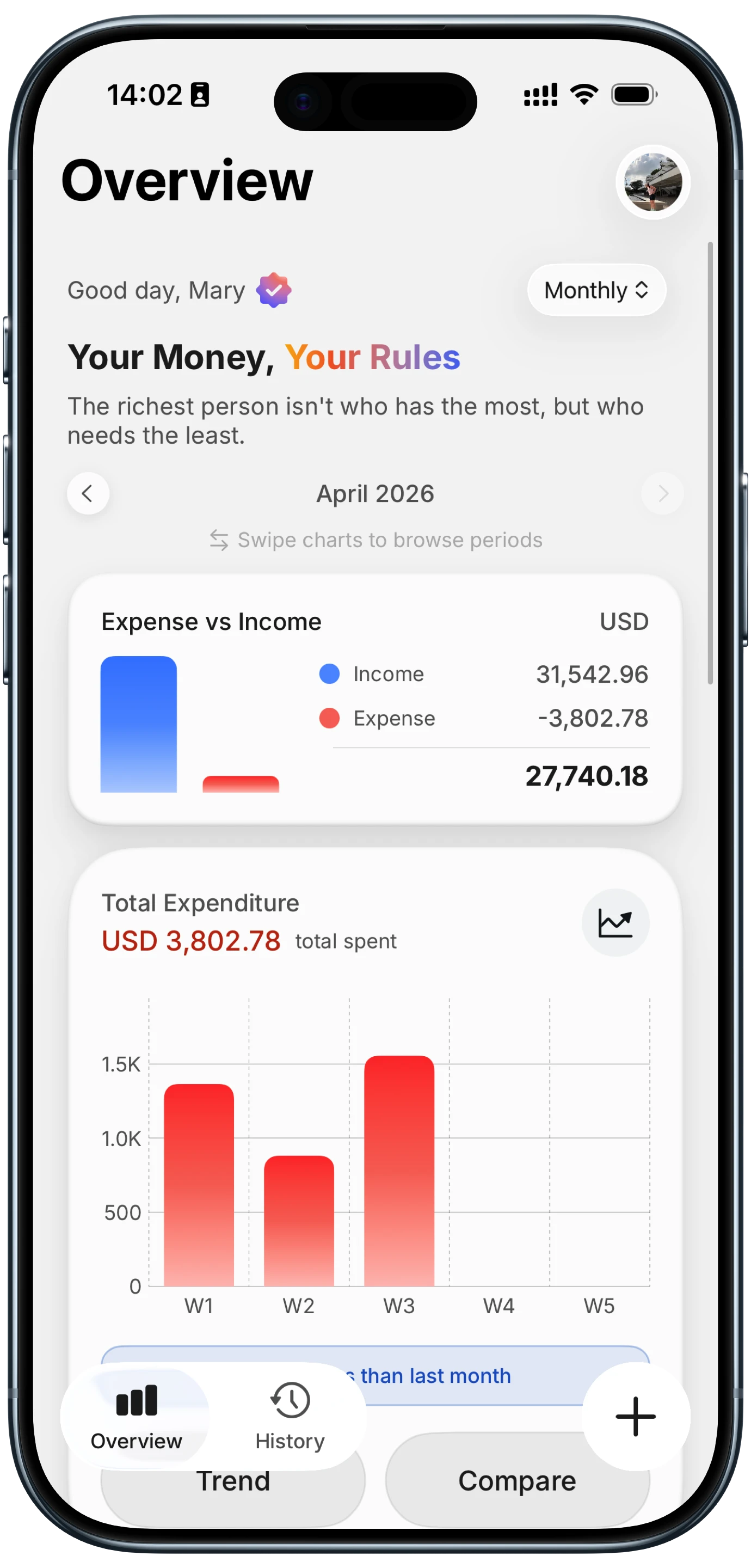
This is the niche Finny is built for. It never asks for SMS permission or a bank login, which sidesteps the biggest privacy concern with India's automatic trackers. You log expenses with AI text, voice, or receipt scanning, and a free Quick Log option lets you record an expense from Spotlight, Siri, or the Action Button in seconds.
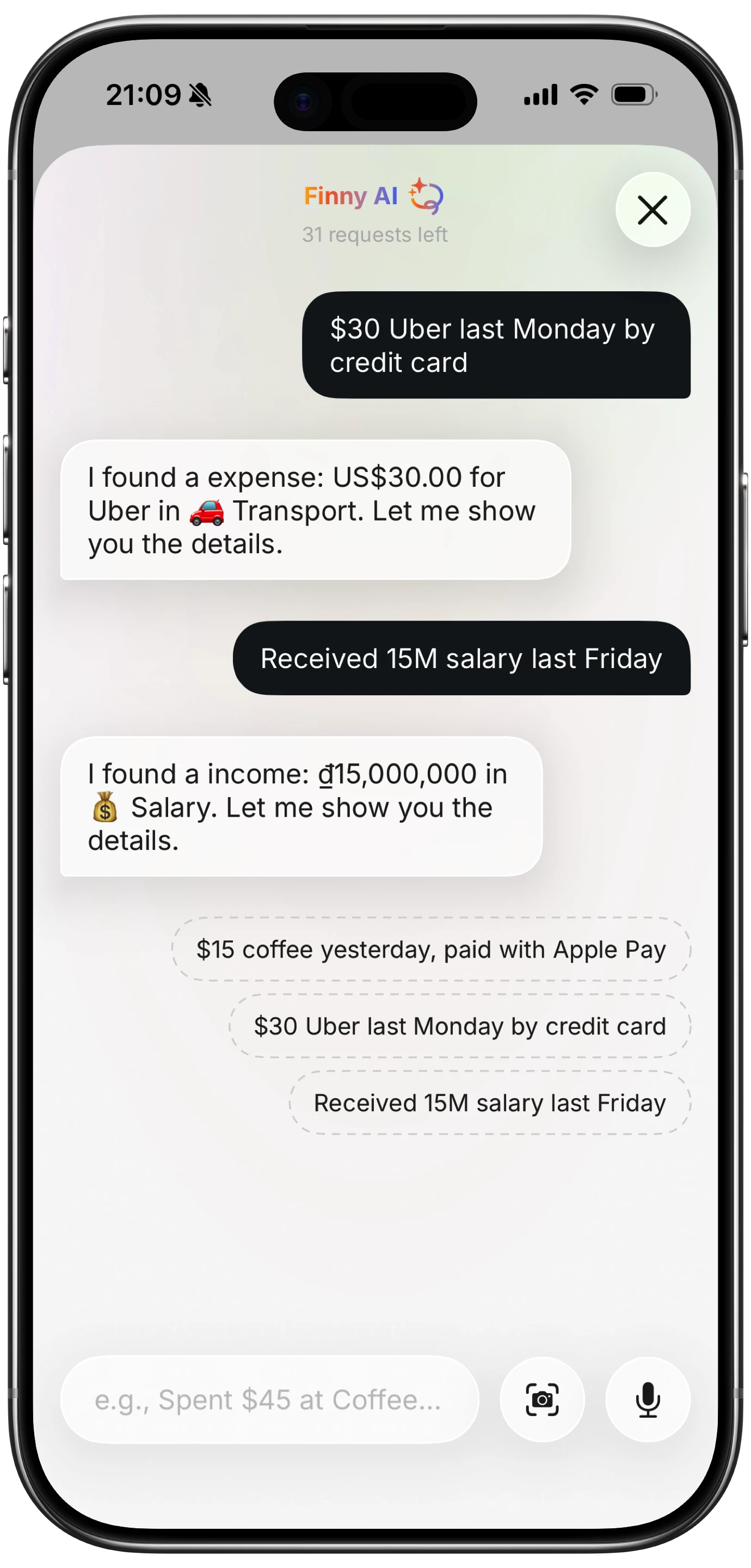
Finny is also genuinely multi-currency, which matters if you earn in INR but travel or shop abroad. Each transaction keeps its original currency, while your daily and monthly totals convert to rupees at real-time rates. The core app is free forever for unlimited manual tracking, charts, and over 150 currencies, with Finny Pro at a low monthly or yearly price unlocking the AI input and automation features. It is iOS only, so it suits iPhone users who find SMS-based Android apps out of reach.
How to Choose the Best Expense Tracker App in India
The best app depends less on rankings and more on your phone, your habits, and how you feel about access. Use this as a quick filter.
- You use Android and want maximum automation. Start with an SMS-based tracker like Money View or Axio. They reconstruct history fast and require little ongoing effort, as long as you are comfortable granting SMS access.
- You want spending insights tied to your bank. A neobank-style app like Jupiter, or an aggregator using the Account Aggregator framework, gives categorized data without touching your SMS inbox, at the cost of linking accounts.
- You are on an iPhone. Pure SMS parsing is off the table. Lean toward manual or AI-assisted apps, or notification-based trackers built for iOS.
- Privacy is your top priority. Skip SMS and bank access entirely. An envelope app like Goodbudget or a private, AI-assisted tracker like Finny keeps your financial data on your terms.
- You travel or deal in multiple currencies. Prioritize clean multi-currency handling so foreign spending still rolls up into your INR totals.
There is no single winner. The right choice is the app you will actually open every day.
Frequently Asked Questions
Which is the best expense tracker app in India?
There is no universal winner, because the best expense tracker apps India 2026 offers serve different needs. On Android, SMS-based apps like Money View and Axio lead for hands-off automation. If you want categorized spending tied to your bank, Jupiter is strong. For privacy-first, manual, or AI-assisted tracking, including on iPhone, Goodbudget and Finny are better fits. Match the app to your platform and how much access you are willing to grant.
How do SMS-based expense trackers work?
Indian banks send an SMS for nearly every transaction, including the amount, type, account, and often the merchant or UPI reference. SMS-based apps request permission to read those messages, then use pattern matching to extract the financial details and log each one as a categorized expense automatically. Because the data is structured, the app can rebuild months of spending in seconds. This works on Android; Apple does not allow apps to read SMS on iPhone.
Are SMS expense tracker apps safe?
Reputable SMS trackers state they only parse financial messages, but they still request access to your entire SMS inbox, which can hold OTPs and personal texts. That is a meaningful privacy trade-off. If you are comfortable with it and use a trusted, well-reviewed app, the convenience is real. If not, manual or AI-assisted apps that never touch your inbox, like Finny, avoid the concern entirely.
Can I track UPI spending automatically?
Yes, mostly. On Android, UPI debits trigger bank SMS alerts that automatic trackers parse just like any other transaction. Apps linked to your accounts through the RBI Account Aggregator framework can also surface UPI spending with your consent. UPI apps themselves show their own history but do not combine it across providers. On iPhone, you will typically log UPI spending manually or through notification-based tools.
The Bottom Line
The best expense tracker apps India 2026 has on offer fall into two broad camps. Automatic SMS and bank-linked apps such as Money View, Axio, ET Money, and Jupiter trade some privacy for hands-off convenience, and they shine on Android where SMS parsing is possible. Manual and privacy-first tools like Goodbudget and Finny ask you to do a little more, or let AI do it for you, while keeping your inbox and bank untouched.
Start with your platform and your comfort with access, then pick one and stick with it for a month. If you would rather skip SMS and bank permissions altogether, give Finny a try and log your first INR expense in seconds, no account linking required.