How to Calculate Your Daily Spending Allowance
Monthly budgets have a quiet flaw. A number like "$600 for the month" feels manageable on the 3rd and impossible to interpret on the 19th. You know the total, but not whether today's coffee and lunch are fine or a problem.
A daily spending allowance fixes that. Instead of one large monthly figure, you carry a single small number that tells you how much flexible money you have to spend today. It turns a vague monthly goal into a decision you can actually make at the register.
This guide shows the formula, walks through the days-in-month detail that trips people up, gives two worked examples, and connects the idea to the 50/30/20 rule. If you want a sense of typical numbers first, our look at average daily spending is a useful starting point.
What a Daily Spending Allowance Is
Your daily spending allowance is the amount of discretionary money you can spend per day after your fixed bills and savings are already accounted for. It covers the flexible part of life: dining out, coffee, entertainment, small shopping, hobbies, and impulse buys.
It does not cover everything. Rent, utilities, loan payments, insurance, and subscriptions are fixed costs that happen on their own schedule. Your savings contribution is also set aside before the allowance is calculated. The allowance is only the money that is genuinely yours to decide on each day.
This is the key distinction. A spending limit is a ceiling you set for yourself. A daily allowance is a smaller, time-based version of that ceiling, sized so you can check it constantly without effort.
The benefit is mental simplicity. You do not need to remember twelve category budgets. You remember one number, compare it to what you have spent today, and adjust. That single comparison is enough to keep most people on track.
The Formula
The math is intentionally simple. Three inputs produce your daily allowance.
- Monthly take-home income. Use the amount that actually lands in your account after taxes and deductions, not your gross salary.
- Fixed bills and planned savings. Add up rent or mortgage, utilities, insurance, loan payments, subscriptions, and the amount you commit to savings each month.
- Days in the month. The number of days you are dividing across.
The formula is:
(Monthly take-home income minus fixed bills and planned savings) divided by days in the month = daily spending allowance
The result is what you can spend per day on discretionary items. Everything fixed is already handled, and your savings is already protected, so spending up to the allowance will not break your plan.
If your income varies from month to month, use a conservative figure: your lowest typical month rather than your best one. Budgeting on the low number means a strong month becomes a pleasant surplus instead of a shortfall you have to recover from.
The Days-in-Month Nuance
Here is the detail most guides skip. Months are not the same length. February has 28 days, several months have 30, and others have 31. That difference quietly changes your allowance.
Two Valid Approaches
You can handle this in one of two ways, and both are reasonable.
- Use the real day count. Divide by the actual number of days in the current month: 30 for June, 31 for July, 28 for February. This gives you a precise allowance for that exact month.
- Use a 30-day average. Divide by 30 every month for a steady, predictable number. It is slightly generous in long months and slightly tight in short ones, but it is consistent and easy to remember.
Which to Choose
If you like precision and do not mind a small recalculation, use the real day count. If you value a stable number you can memorize, the 30-day average is fine. Neither is wrong.
What matters most: recheck the figure at the start of every month. Your income, bills, or the calendar may have shifted. A two-minute recalculation on the 1st keeps the allowance accurate for the weeks ahead.
Worked Examples
Numbers make the formula real. Here are two.
Example One: Steady Salary
Maya brings home $3,400 per month. Her fixed costs are:
- Rent: $1,300
- Utilities and internet: $200
- Phone: $50
- Car insurance: $120
- Subscriptions: $30
- Planned savings: $500
Her fixed bills and savings total $2,200. That leaves $3,400 minus $2,200, or $1,200 in discretionary money.
For a 30-day month: $1,200 / 30 = $40 per day.
For a 31-day month: $1,200 / 31 = $38.71 per day.
Maya can spend roughly $40 a day on flexible purchases. The dollar difference between a 30- and 31-day month is small, which is exactly why a 30-day average works fine for many people.
Example Two: Variable Income
Devon freelances, so his income swings. His take-home over the past year ranged from $2,800 to $4,500. He budgets on his lowest typical month: $2,800.
His fixed costs and savings total $1,900. That leaves $900 in discretionary money.
For a 30-day month: $900 / 30 = $30 per day.
When Devon earns more than $2,800, the extra is not part of his daily allowance. It goes to savings or a buffer. Budgeting on the low number means his daily allowance stays reliable no matter how the work flows.
How This Fits the 50/30/20 Rule
A daily spending allowance and the 50/30/20 rule work together rather than competing.
The 50/30/20 rule splits take-home income into three buckets: roughly 50 percent for needs, 30 percent for wants, and 20 percent for savings and debt payoff. It is a guideline for how to divide your money at a high level.
Your daily spending allowance is the 30 percent "wants" bucket, broken into a daily number. The rule tells you how big the bucket should be. The allowance tells you how to spend from it day by day without draining it early.
Consider Maya again. Her $3,400 income under a strict 30 percent split would put $1,020 toward wants. Her actual discretionary figure was $1,200, a little higher, which simply means her needs and savings run slightly under the textbook percentages. That is fine. The 50/30/20 rule is a guideline, not a contract. Use it to sanity-check the size of your allowance, then let the daily number do the everyday work.
How to Track Spending Against Your Allowance
A daily allowance only works if you compare it to reality. The number on its own is just a target.
- Write down the allowance. Keep it somewhere you see often, so the comparison is automatic.
- Log discretionary purchases as they happen. The moment of spending is when the entry is accurate and the habit sticks.
- Check your running daily total. Before a non-essential purchase, ask whether it fits within today's allowance.
- Roll unspent money forward. A quiet day adds to tomorrow. Spend $25 against a $40 allowance and you carry $15 forward. This rollover is what makes the system humane: a single splurge is survivable.
- Reset at the start of each month. Recalculate with current numbers and the correct day count.
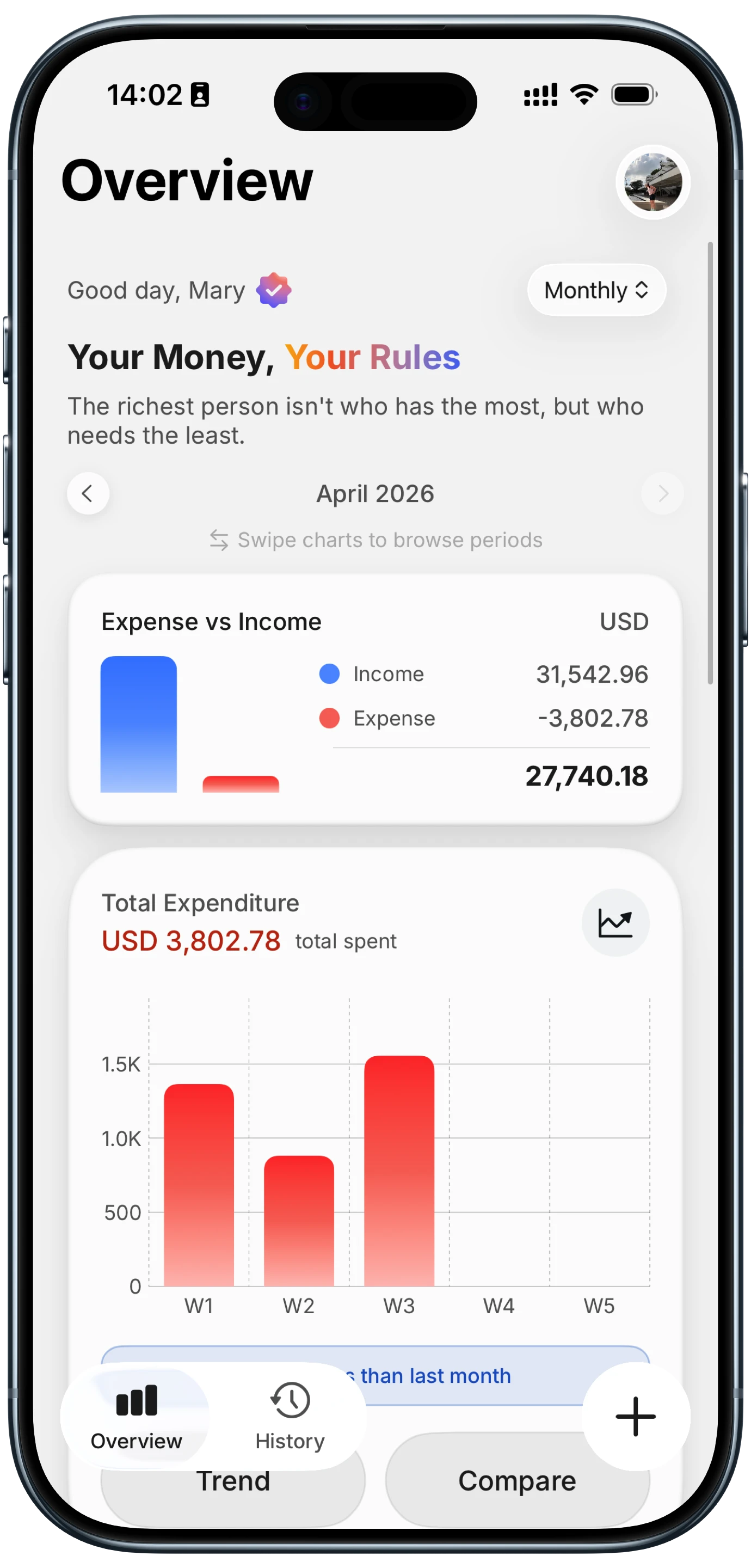
Logging is the part that fails most often, so it should be effortless. An app like Finny lets you record a purchase by typing, voice, or receipt photo in seconds, and its charts show how your week is tracking against plan. The daily expense reminder nudges you to log before you forget, which is the difference between a system that works and one you abandon by week two.
What to Do When You Go Over
You will go over some days. That is expected, not a failure.
The fix is the rollover and the monthly view. If you overspend by $20 today, you can trim the next day or two to absorb it, or accept that a future quiet day will balance it out. One day rarely matters. A pattern of overspending every day does, and the running total will show you that early.
If you are consistently over, the allowance itself may be wrong. Maybe a "fixed" cost was understated, or the discretionary number was optimistic. Recalculate honestly. An allowance you cannot live on is not a budget, it is a wish, and it will not survive contact with a normal month.
Treat the allowance as a steering tool, not a verdict. The goal is awareness and gentle correction, not guilt.
The Bottom Line
A daily spending allowance turns an abstract monthly budget into one small, usable number. Calculate it by subtracting fixed bills and planned savings from your take-home income, then dividing by the days in the month.
Decide whether you want the real day count or a steady 30-day average, and recheck the figure on the 1st of each month. Use the 50/30/20 rule to confirm the size is reasonable, log your spending as it happens, and let unspent days roll forward. Go over occasionally and adjust. Go over constantly and recalculate.
Frequently Asked Questions
How much should I spend per day?
There is no universal number. Your daily spending allowance depends on your take-home income, your fixed bills, and your savings goal. Subtract fixed costs and planned savings from monthly income, then divide by the days in the month. The result is your personal figure. Someone earning more with lower bills will have a higher allowance, and that is expected.
Should I divide my budget by 30 or by the actual days in the month?
Both work. Dividing by the actual day count (28, 30, or 31) gives a precise allowance for that specific month. Dividing by 30 every month gives a steady, easy-to-remember number that is slightly generous in long months. Pick whichever you will stick with, and recheck the figure at the start of each month either way.
Does my daily allowance include rent and bills?
No. Your daily spending allowance covers only discretionary spending: dining out, entertainment, coffee, and small purchases. Rent, utilities, insurance, loan payments, and subscriptions are fixed costs handled separately. Your planned savings is also set aside before the allowance is calculated. The allowance is purely the flexible money left after fixed obligations are covered.
What happens if I do not spend my full allowance?
Unspent money rolls forward. If your allowance is $40 and you spend $25, the remaining $15 carries into the next day. This rollover is a core strength of the system. It lets you save up for a larger purchase or absorb an occasional overspend, as long as your monthly total stays within the discretionary amount you calculated.
How is a daily allowance different from the 50/30/20 rule?
The 50/30/20 rule is a high-level split of income into needs, wants, and savings. A daily spending allowance is the "wants" portion broken into a per-day number. The rule tells you how big your discretionary bucket should be. The allowance tells you how to spend from it each day without running out early. They work together.
Conclusion
A daily spending allowance is one of the simplest budgeting tools you can adopt. One number, checked daily, keeps you aware without forcing you to track every category in your head.
If you want that number to stay current and easy to follow, Finny lets you log spending by typing, voice, or receipt photo in seconds, shows your progress in clear charts, and reminds you daily so logging becomes a habit. It works offline and keeps your data private with no bank connections. Calculate your allowance, then start tracking it today at getfinny.app.