Best Privacy-Focused Subscription Tracker Apps (2026)
Most subscription trackers ask for one thing before they do anything useful: your bank login. The pitch is convenient. Connect your accounts, and the app scans every transaction to find recurring charges automatically. You see your subscriptions without typing a single thing.
The tradeoff is rarely spelled out. To scan for subscriptions, these apps route your full banking history through a third-party aggregator. That means your salary, your rent, your medical co-pays, and every coffee you bought last quarter all pass through systems you did not choose and cannot audit. For many people that is a fair trade. For privacy-conscious users, it is a dealbreaker.
A privacy-focused subscription tracker takes a different path. It never touches your bank. You add recurring charges yourself, or import them from a screenshot or email, and the app keeps that list organized on your device. This guide compares the realistic options for 2026 and is honest about what you give up. If you want the broader landscape first, our roundup of the best subscription tracker apps covers both bank-scanning and manual tools side by side.
What "Privacy-Focused" Actually Means
The phrase gets used loosely, so it helps to define it. A genuinely privacy-focused subscription tracker meets a few concrete criteria, not just a marketing promise.
- No bank connection required. The app works fully without ever asking for banking credentials or routing data through an aggregator like Plaid.
- Data stored on your device. Your subscription list lives locally rather than on a company server that could be breached or subpoenaed.
- No transaction history exposure. Because nothing scans your account, the app never sees your income, rent, or unrelated purchases.
- Minimal account requirements. The best options let you start without even creating an account or handing over an email address.
Bank-scanning apps can still be secure in the engineering sense. Most use encryption and read-only access. But "secure" and "private" are different ideas. Security is about whether your data is protected. Privacy is about how much data exists in the first place. A manual tracker simply has far less to protect, because it never collects your financial history. That smaller footprint is the entire point.
How Bank-Scanning Trackers Find Your Subscriptions
To understand the privacy cost, it helps to know how the convenient apps work. Take Rocket Money, the most popular bank-scanning option. When you sign up, you connect your financial institutions through Plaid, a third-party service that links apps to more than 12,000 banks.
Once connected, Rocket Money analyzes every incoming charge by merchant name, amount, and frequency to decide which transactions are recurring. That is how it surfaces a forgotten gym membership or a streaming trial that quietly converted. It is genuinely useful, and for some users worth it.
But the mechanism requires visibility into everything. The app cannot find your Netflix charge without also seeing your paycheck, your mortgage, and your pharmacy visits. Plaid receives an encrypted token rather than your password, and Rocket Money uses read-only access, so neither can move money. Still, your complete transaction stream now flows through two extra companies. If either suffers a breach, or changes its data policy, or gets acquired, your history is part of that exposure. Our deeper look at finance app security and privacy explains how aggregator access works in detail.
Comparing Privacy-Focused Subscription Trackers
Here is how the main no-bank-link options stack up against a typical bank-scanning tracker. Prices reflect 2026 figures and can change, so confirm before subscribing.
| App | Bank link required | How it finds subscriptions | Platform | Price |
|---|---|---|---|---|
| Bobby | No | Manual entry, built-in service icons | iOS only | Free, optional one-time IAP |
| Subby | No | Manual entry | iOS | Free with paid upgrade |
| Finny | No | Manual entry plus AI input from text, voice, or screenshot | iOS | Free tier, Pro a low monthly or yearly price |
| Rocket Money | Yes | Automatic bank transaction scanning via Plaid | iOS, Android, web | Free tier, paid plan with variable pricing |
The pattern is clear. Manual trackers keep your bank out of the picture entirely, while bank-scanning trackers trade that privacy for automatic discovery. The right pick depends on which you value more.
The Manual-Entry Trackers
Bobby is the long-running favorite for manual subscription tracking on iOS. You add each service yourself, choose its billing cycle, and get reminders before renewals. It includes icons for popular services and has held a high App Store rating across thousands of reviews. There is no bank access at all, and the pricing model is a free download with an optional one-time purchase rather than a recurring fee.
Subby follows a similar approach with a clean, focused interface for logging recurring payments and viewing monthly totals. Both apps prove that a useful tracker does not need your banking credentials.
Where Finny Fits
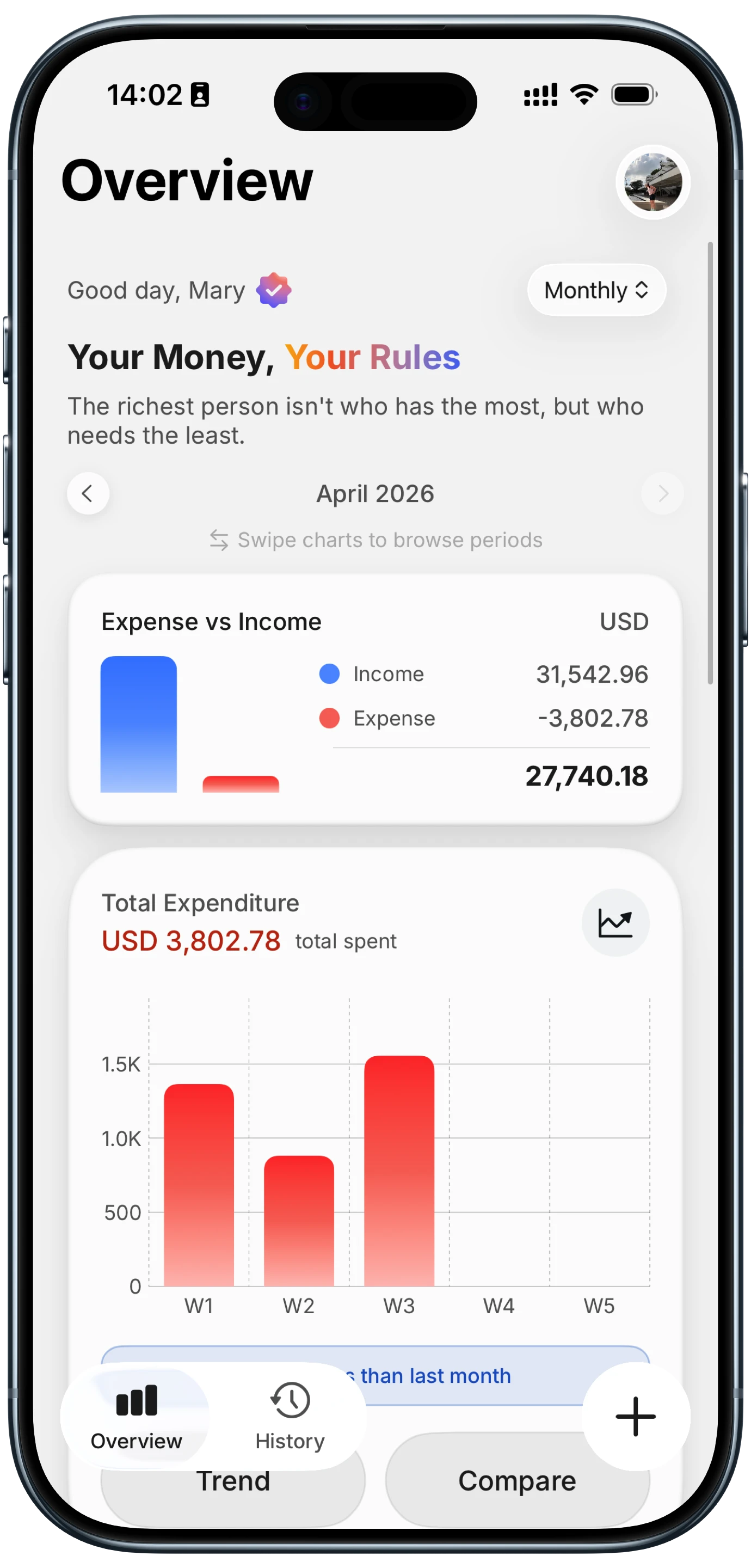
Finny is an AI-powered expense tracker, and it handles subscriptions as a built-in case of recurring expenses rather than a separate bank-scanning feature. You log a subscription once, mark it recurring, and it appears in your monthly totals automatically going forward, all without a bank login.
The friction that usually makes manual tracking annoying is reduced through AI-assisted input. Instead of tapping through fields, you can type "Spotify 11.99 monthly," speak it, or photograph a billing email or receipt, and Finny structures the entry for you. It is offline-first and privacy-first by design: your data stays on your device, and there is no aggregator in the loop.
Because Finny also tracks all your other spending, you see subscriptions in the context of your full budget rather than in isolation. The free tier covers unlimited manual tracking and charts, and Finny Pro costs a low monthly or yearly price. For a structured approach to reviewing what you find, our guide to the best subscription management apps pairs well with this workflow.
The Honest Privacy Tradeoff
A privacy-focused subscription tracker has one real limitation, and pretending otherwise would be dishonest. It cannot discover a subscription you have forgotten about.
Bank-scanning apps shine precisely here. If a free trial converted six months ago and you never noticed, Rocket Money will surface that charge because it sees the transaction. A manual tracker only knows about subscriptions you tell it about. If it is not on your radar, it will not be on your list.
There are practical ways to close that gap without giving up your bank login:
- Do one thorough audit. Review your last few bank and card statements once, by hand, and write down every recurring charge. Our walkthrough on how to cancel subscriptions on your iPhone covers where to look, including the Apple subscription screen.
- Check your iPhone subscription settings. Many subscriptions billed through the App Store appear in one place under your Apple Account.
- Scan billing emails. Search your inbox for words like "receipt," "renewal," and "invoice" to catch services you pay for outside of Apple.
After that initial sweep, maintaining the list manually is simple. You add new subscriptions when you sign up for them. The one-time audit is the price of keeping your bank out of the equation permanently.
How to Choose the Right Approach
The decision comes down to a single honest question: do you trust yourself to do one careful audit, or do you want a machine to do the discovery for you forever?
Choose a manual, privacy-focused tracker if:
- You do not want your transaction history routed through a third-party aggregator.
- You are willing to spend an hour once reviewing statements to build your starting list.
- You prefer apps that store data on your device rather than a company server.
- You want predictable, low or one-time pricing.
Choose a bank-scanning tracker if:
- Automatic discovery of forgotten charges matters more to you than data minimization.
- You are comfortable with aggregator access and read-only bank connections.
- You want the app to also handle cancellations and bill negotiation.
There is no universally correct answer. Both can be the right tool. The mistake is choosing without knowing the tradeoff, and connecting your bank by default simply because the app asked.
Frequently Asked Questions
Can I track subscriptions without linking my bank account?
Yes. Manual-entry apps like Bobby, Subby, and Finny let you log every recurring charge yourself and view monthly totals without any bank connection. You enter each subscription once, set its billing cycle, and the app tracks renewals from there. The tradeoff is that the app only knows about subscriptions you add, so it cannot surface charges you have already forgotten.
Is it safe to connect my bank to a subscription tracker?
Bank-scanning apps generally use encryption and read-only access through aggregators like Plaid, so they cannot move your money. That makes them reasonably secure. The concern is privacy rather than theft: connecting your bank exposes your full transaction history, including income and unrelated spending, to extra companies. If that exposure worries you, a manual tracker avoids it entirely.
Will a manual tracker find subscriptions I forgot about?
No, and this is the honest limitation. A privacy-focused tracker only knows what you tell it. To catch forgotten charges, do one thorough audit of recent bank statements and your iPhone subscription settings, then add everything to the app. After that initial sweep, keeping the list current is easy because you simply add new services as you sign up.
Does Finny require a bank connection to track subscriptions?
No. Finny is offline-first and never asks for banking credentials. You add a subscription once, mark it recurring, and it appears in your monthly totals automatically. AI-assisted input lets you log entries by typing, voice, or a photo of a billing email, and your data stays on your device rather than on a server.
The Bottom Line
A privacy-focused subscription tracker asks a little more of you upfront and gives you something valuable in return: control over your financial data. You do the discovery once, by hand, instead of handing a permanent window into your accounts to apps and aggregators you cannot audit.
If that tradeoff appeals to you, Finny tracks subscriptions as recurring expenses with no bank login required, alongside the rest of your spending. AI-assisted input keeps manual entry fast, and everything stays on your device. Start tracking privately at getfinny.app.