Most people assume early retirement is reserved for high earners, tech founders, or trust fund recipients. The FIRE movement challenges that assumption. It argues that anyone with a reasonable income and disciplined spending habits can reach financial independence decades earlier than the traditional retirement age.
FIRE (Financial Independence, Retire Early) is a personal finance strategy built on aggressive saving, intentional spending, and investing the difference. The goal is to accumulate enough wealth that investment returns cover your living expenses indefinitely. Whether you plan to stop working entirely or simply want the freedom to choose how you spend your time, understanding FIRE starts with understanding where your money goes. For a broader look at building wealth over time, see our guide on what net worth is and why it matters.
What FIRE Actually Means
FIRE is not about deprivation or extreme frugality for its own sake. At its core, the movement is about reaching the point where work becomes optional. Financial independence means your invested assets generate enough returns to cover your annual expenses without you needing to earn a paycheck.
The "Retire Early" part is somewhat misleading. Many FIRE practitioners do not stop working entirely. Instead, they transition to work they find meaningful, take on part-time roles, or pursue projects without worrying about income. The freedom to walk away from a job you dislike is the real goal for most people in the movement.
The concept gained mainstream attention through blogs and online communities in the 2010s, though the underlying math draws from decades of retirement research. The foundational idea is simple: if you can live on a fraction of your income and invest the rest, you can compress the traditional 40-year career into 10 to 20 years.
The Math Behind FIRE
Two core calculations drive every FIRE plan: the 25x rule and the savings rate.
The 25x Rule
The 25x rule states that you need roughly 25 times your annual expenses saved and invested to retire. This is based on the 4% rule, which suggests that withdrawing 4% of your portfolio annually has historically sustained a retirement lasting 30 or more years. For a deeper look at where that number comes from and when to adjust it, see our guide on the 4% rule explained.
Here is how it works in practice:
| Annual Expenses | FIRE Number (25x) |
|---|---|
| $30,000 | $750,000 |
| $40,000 | $1,000,000 |
| $50,000 | $1,250,000 |
| $60,000 | $1,500,000 |
| $80,000 | $2,000,000 |
Notice something important: your FIRE number is determined by your expenses, not your income. Two people earning $100,000 per year will have wildly different FIRE numbers if one spends $40,000 annually and the other spends $70,000. The lower spender needs $1,000,000. The higher spender needs $1,750,000.
This is why expense tracking is the foundation of any FIRE plan. You cannot calculate your target without knowing what you actually spend.
Savings Rate
Your savings rate, the percentage of take-home income you save and invest, determines how quickly you reach financial independence. The relationship is not linear. Small increases in savings rate create outsized reductions in your timeline.
| Savings Rate | Approximate Years to FIRE |
|---|---|
| 10% | 51 years |
| 20% | 37 years |
| 30% | 28 years |
| 40% | 22 years |
| 50% | 17 years |
| 60% | 12.5 years |
| 70% | 8.5 years |
These estimates assume a 5% real return after inflation and starting from zero. The takeaway is clear: moving from a 20% to a 50% savings rate cuts your timeline nearly in half. And every dollar you cut from expenses helps twice, because it both increases your savings rate and lowers the total amount you need.
Types of FIRE
The FIRE community has developed several variations to reflect different lifestyles and comfort levels. No single approach works for everyone.
Lean FIRE
Lean FIRE targets annual expenses below $40,000 per year (for an individual or couple). This approach requires significant lifestyle simplification: modest housing, minimal dining out, limited travel, and careful spending in every category.
The advantage is a lower FIRE number, often under $1,000,000. The tradeoff is less margin for unexpected costs and fewer lifestyle comforts. Lean FIRE works best for people who genuinely prefer a minimalist life, not those forcing frugality to hit a number.
Fat FIRE
Fat FIRE aims for a more comfortable post-work lifestyle, typically with annual expenses of $80,000 to $120,000 or more. This requires a larger portfolio, often $2,000,000 to $3,000,000 or higher, and generally demands higher income or longer accumulation periods.
Fat FIRE appeals to people who want financial independence without giving up travel, dining, hobbies, or a comfortable home. The math still works; it just takes longer or requires higher earnings.
Barista FIRE
Barista FIRE is a hybrid approach where you accumulate enough investments to cover most of your expenses but continue working part-time to fill the gap. The name comes from the idea of taking a low-stress job at a coffee shop, though any flexible part-time work qualifies.
This approach is popular because it lowers the required portfolio size while providing structure, social connection, and benefits like employer-sponsored health insurance. Someone who needs $40,000 annually but earns $15,000 from part-time work only needs investments to cover the remaining $25,000, bringing their FIRE number down to roughly $625,000.
Coast FIRE
Coast FIRE means you have invested enough that compound growth alone will carry your portfolio to a full retirement number by a traditional retirement age (say, 60 or 65), without any additional contributions. You still work to cover current expenses, but you no longer need to save aggressively.
For example, a 35-year-old with $250,000 invested might reach $1,000,000 by age 60 through compound growth alone, assuming average market returns. At that point, they have "coasted" to FIRE and can choose lower-paying, more fulfilling work without worrying about retirement savings. To understand how compound growth powers this approach, see our guide on what compound interest is and how it works.
Building a Realistic FIRE Timeline
A common mistake is treating FIRE as a fixed destination with a rigid deadline. In practice, the path involves ongoing adjustments.
Step 1: Know Your Current Spending
You cannot plan FIRE without accurate spending data. Guessing your expenses almost always leads to underestimation. Track every dollar for at least three months to establish a baseline. Include irregular expenses like car maintenance, annual subscriptions, and holiday spending.
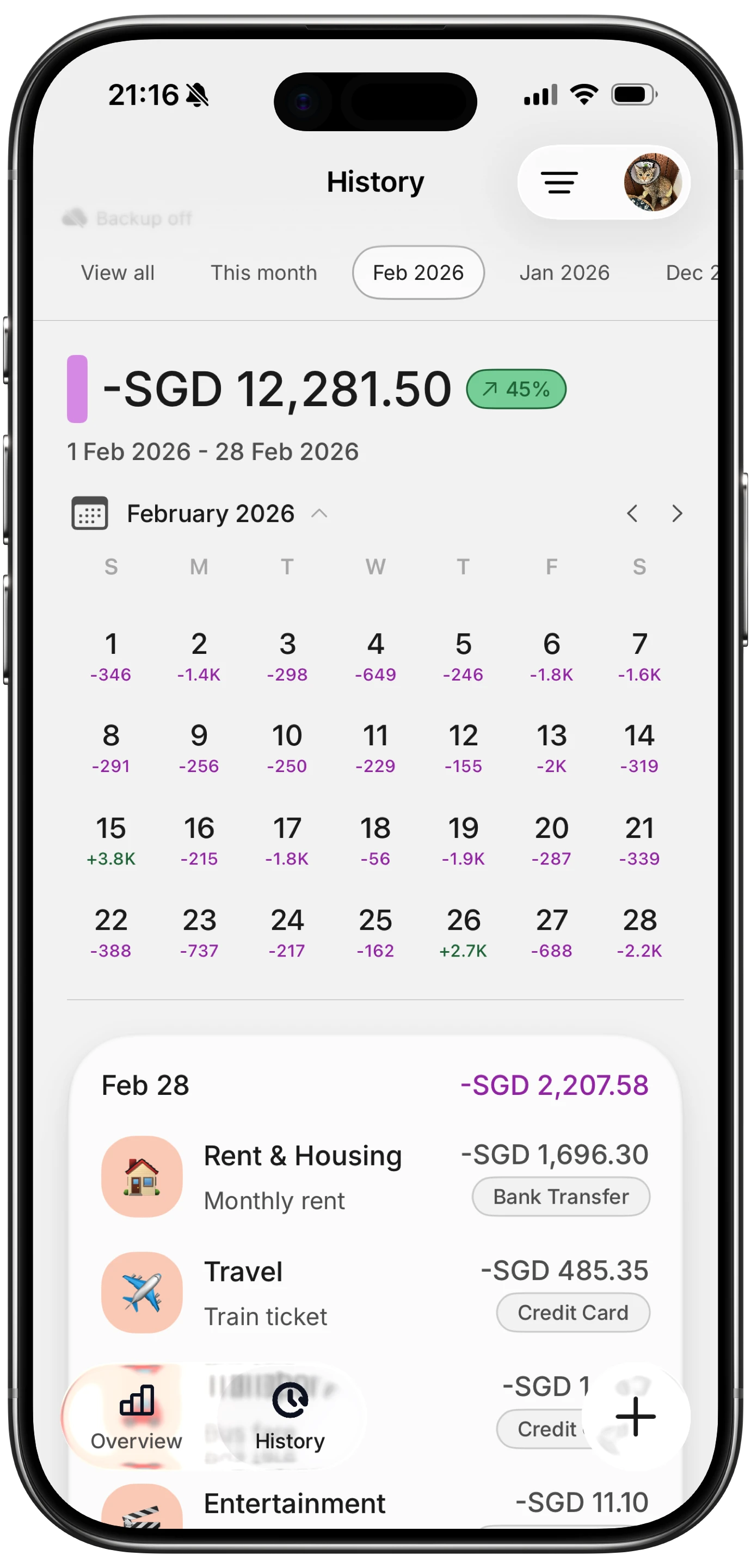
Finny app's History calendar feature
An expense tracking app makes this manageable. Finny lets you log expenses through text, voice, or receipt scanning, so capturing every transaction takes seconds rather than minutes. The goal is complete visibility into where your money goes.
Step 2: Calculate Your FIRE Number
Multiply your annual expenses by 25. If you spend $45,000 per year, your target is $1,125,000. Add a buffer of 10-15% if you want extra margin for healthcare costs, inflation surprises, or lifestyle changes.
Step 3: Determine Your Savings Rate
Subtract your annual expenses from your after-tax income, then divide by your after-tax income. If you earn $80,000 after taxes and spend $45,000, your savings rate is 43.75%. Based on the table above, you are looking at roughly 20 years to reach financial independence.
Step 4: Invest the Difference
Most FIRE practitioners invest in low-cost index funds that track the broad stock market. The strategy is simple: maximize contributions to tax-advantaged accounts (401k, IRA, HSA) first, then invest additional savings in taxable brokerage accounts. Keeping investment fees low is critical, since even small percentage differences compound into large amounts over decades.
Step 5: Optimize Over Time
As you track spending and review your financial data, you will find areas to optimize. Maybe subscriptions have crept up. Maybe dining out costs more than you assumed. Maybe you are paying for insurance you do not need. Continuous expense monitoring reveals these leaks.
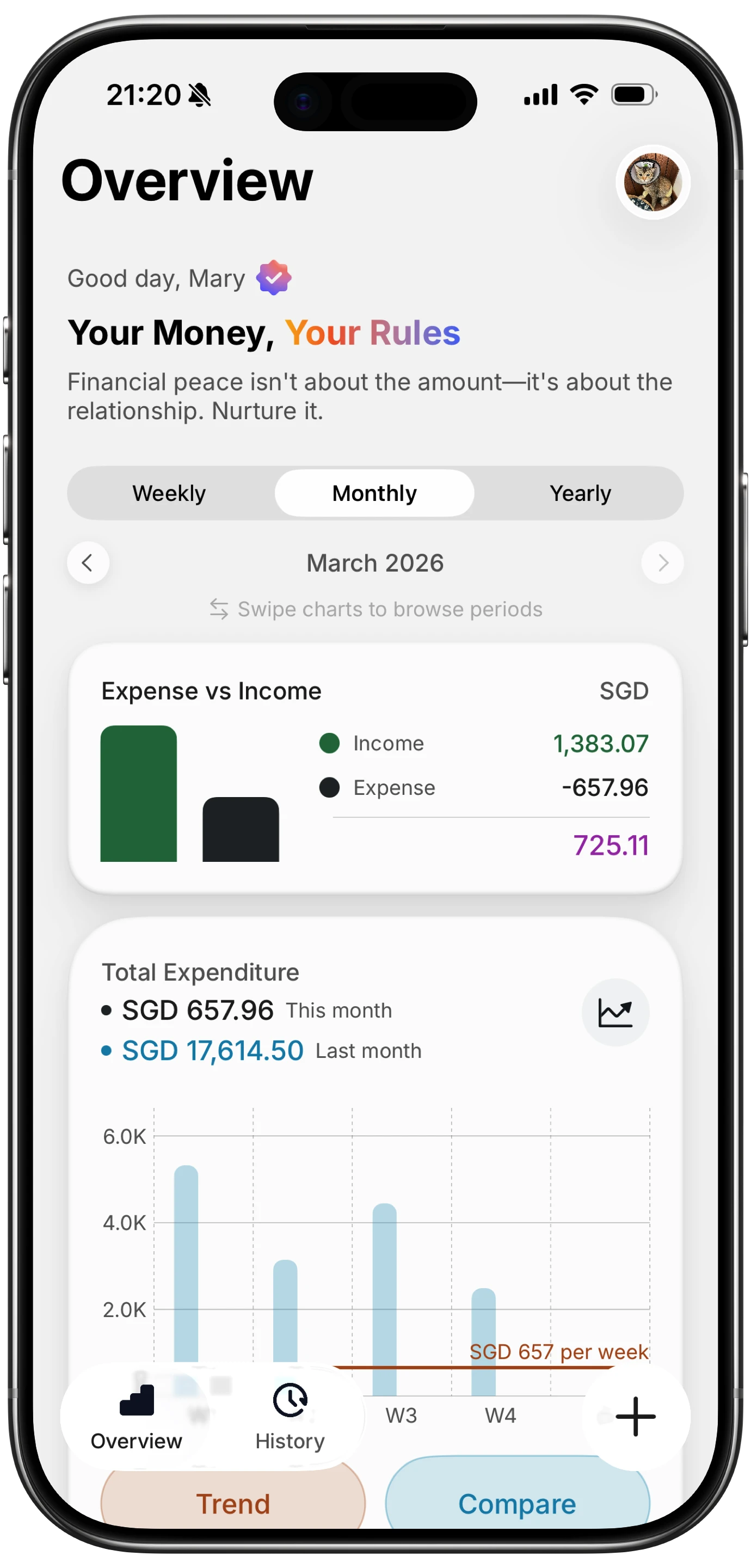
Finny app's Overview feature
Spending analytics help you visualize trends month over month. When you can see that your grocery spending increased 20% over the past quarter, you can investigate and adjust before it derails your savings rate.
Why Expense Tracking Is the Foundation of FIRE
Every FIRE calculation depends on one variable you control directly: your expenses. Your income matters, but expenses determine both your savings rate and your FIRE number. A $10,000 reduction in annual spending has a double effect. It increases the amount you invest each year and reduces the total portfolio you need.
This is why the most successful FIRE practitioners are obsessive about tracking spending. Not to deprive themselves, but to make intentional choices. Knowing that you spend $400 per month on dining out is not a judgment. It is information. You might decide that amount is worth it to you, or you might redirect $200 of it toward investments.
The key is awareness. People who do not track spending often have no idea where 20-30% of their income goes. That invisible spending is the difference between reaching financial independence in 15 years versus 30 years. For more on building income streams that accelerate your FIRE timeline, read our guide on what passive income is and how to build it.
Common Criticisms of FIRE
The FIRE movement is not without valid criticism. Understanding these objections helps you build a more realistic plan.
It Favors High Earners
Someone earning $40,000 per year will struggle to achieve a 50% savings rate regardless of how frugal they are. FIRE is mathematically easier with a higher income. This does not make it impossible at lower incomes, but it does mean timelines will be longer and lifestyle tradeoffs more significant.
Healthcare Is a Major Gap
In countries without universal healthcare, early retirees face expensive insurance premiums. Employer-sponsored health insurance is a significant benefit that disappears when you stop working. This cost must be factored into your FIRE number, and it can add $10,000 to $20,000 per year to your expenses.
Market Returns Are Not Guaranteed
The 4% rule is based on historical market performance. Future returns may differ. Sequence of returns risk, where a market downturn early in retirement depletes your portfolio faster, is a real concern. Many FIRE planners use a more conservative 3.5% withdrawal rate or maintain flexible spending to account for this.
Life Changes Are Unpredictable
Having children, health issues, career shifts, or caring for aging parents can dramatically change your expenses. A FIRE plan built on current spending may not survive major life transitions. Building flexibility into your plan, through buffer savings and adaptable withdrawal strategies, helps address this.
Burnout During Accumulation
Aggressively saving 50-70% of your income for a decade can lead to burnout if it requires constant sacrifice. A sustainable FIRE plan balances saving with living. Spending on things that genuinely improve your quality of life is not a failure. It is part of a plan you can actually maintain.
Making FIRE Work in Practice
The most practical approach to FIRE combines several principles:
- Track every expense so your calculations are based on real data, not estimates
- Automate savings and investments so discipline is built into the system
- Review quarterly to catch spending creep and adjust your plan
- Build multiple income streams to accelerate savings and reduce risk
- Stay flexible on your timeline and lifestyle expectations
FIRE is not an all-or-nothing proposition. Even if you never fully "retire early," the habits of intentional spending, consistent investing, and financial awareness will leave you in a stronger position than most people reach by traditional retirement age. For strategies on reducing unnecessary spending along the way, see our guide on how to stop overspending.
Common Questions About FIRE
What does FIRE stand for in personal finance?
FIRE stands for Financial Independence, Retire Early. It is a movement focused on saving and investing aggressively so that investment returns can cover living expenses, making traditional employment optional.
How much money do you need for FIRE?
Multiply your annual expenses by 25. If you spend $40,000 per year, you need approximately $1,000,000 invested. Your FIRE number depends entirely on your spending, which is why accurate expense tracking is essential.
Is FIRE realistic for average income earners?
FIRE is possible at average incomes, but timelines will be longer. A savings rate of 25-30% is achievable for many households through intentional spending. Barista FIRE and Coast FIRE offer more accessible variations that do not require extreme frugality.
What is the difference between Lean FIRE and Fat FIRE?
Lean FIRE targets annual expenses under $40,000 with a minimalist lifestyle. Fat FIRE targets $80,000 or more in annual expenses, allowing for a more comfortable post-work life. The core math is the same; only the spending level differs.
Can you pursue FIRE with debt?
Yes, but high-interest debt (credit cards, personal loans) should be eliminated first. The interest rate on debt often exceeds expected investment returns, making debt repayment the better mathematical choice. Low-interest debt like a mortgage can coexist with a FIRE plan.
Ready to build the foundation of your FIRE plan?
Download Finny to track every expense, monitor your savings rate, and get clear visibility into the spending patterns that determine your path to financial independence. No bank connections required, full privacy, and AI-assisted logging that makes daily tracking effortless.