2G Is Being Shut Off, and Your Local Store's Payment Terminal Is on the Clock
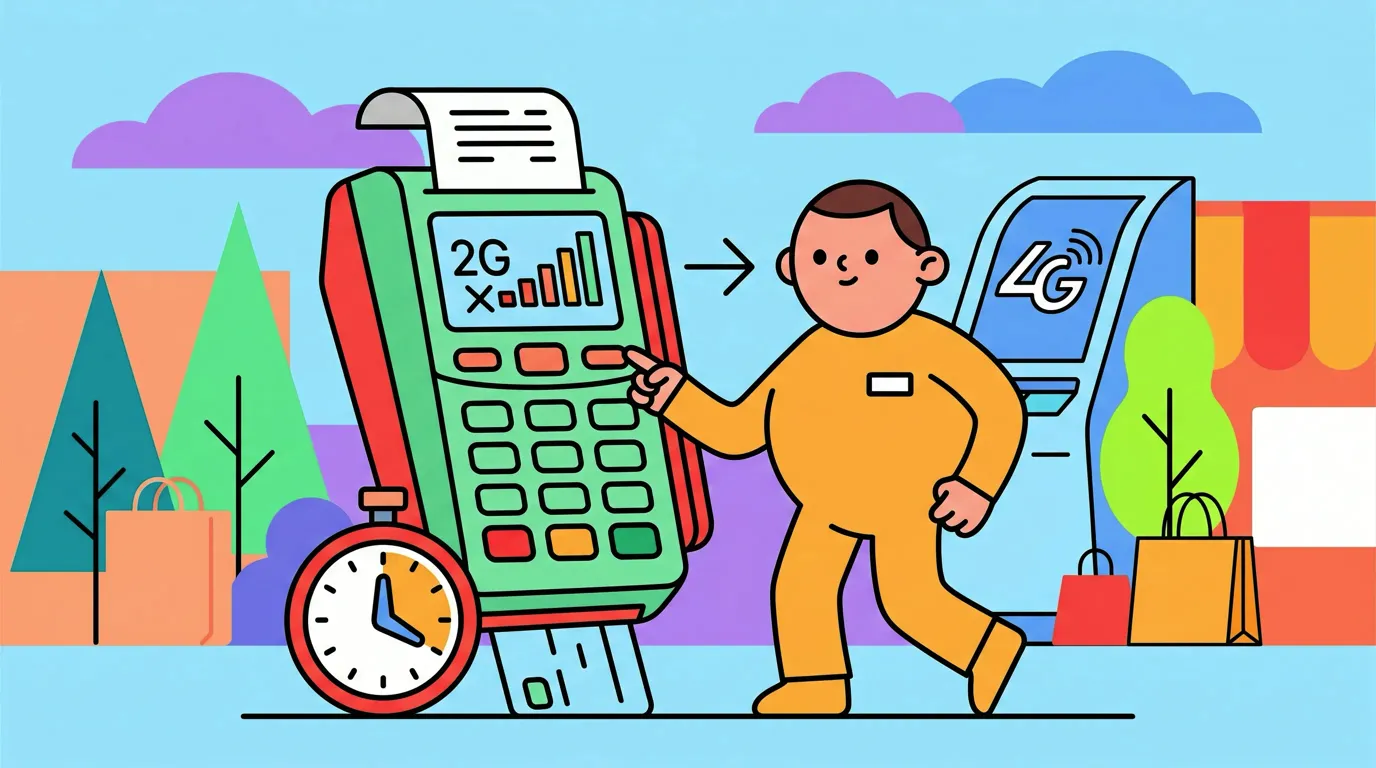
There is a quiet industrial transition happening behind every cash register. The cellular networks that power a large slice of the world's payment terminals are being retired by their carriers. The terminals that rely on those networks are going dark with them. Merchants who have run the same hardware for ten or fifteen years are being told, often via a letter from their acquirer, that the box is about to stop working and they need a replacement by a deadline.
For most consumers this is invisible. For anyone who tries to track their spending automatically, it is unexpectedly relevant. The reason is simple. The terminals being forced into retirement are the same legacy models that report Apple Pay transactions unreliably, and the replacements are almost always modern Android units that report cleanly. The 2G shutoff payment terminals story is, for tracking-app users, mostly good news arriving on a schedule.
This post explains what is actually happening, with verified carrier dates where we have them, what it means for the kinds of small merchants you visit every week, and why your tap tracking is likely to get noticeably better over the next few years for purely industrial reasons.
What Is Actually Being Shut Off
Cellular networks come in generations. 2G was rolled out in the 1990s. 3G followed. 4G LTE became dominant in the 2010s. 5G is the current rollout. Each new generation needs spectrum, and carriers eventually reclaim spectrum from the older generations by switching them off. That is the sunset.
A lot of older payment terminals were designed to use 2G GPRS as their backhaul. The terminal would dial out over GPRS to authorise each transaction with the acquirer. That worked well for a decade because GPRS was cheap, low power, and available almost everywhere. When the carrier turns 2G off, those terminals lose their connection. They cannot authorise payments. The merchant has to swap them out.
Most of the affected hardware lives in the legacy generation we catalogue in the POS terminal field guide. PAX S90 portables, Verifone VX 520 countertops, Ingenico iWL 220 and iWL 250 wireless units, and a long tail of similar gear from other vendors. These terminals do accept Apple Pay taps at the payment layer but, as we explain in why Tap to Track works at some stores and not others, they often do not push the transaction event into Apple Pay's backend reporting network.
The Verified Carrier Dates
The shutoff is not a single date. Each carrier in each country sets its own schedule. Here are the dates that are publicly verifiable as of the time of writing. The picture is uneven globally.
United States
AT&T shut down its 2G GSM network on 1 January 2017. That was one of the earliest in the world. Verizon had already wound down its 2G CDMA service by the end of 2020 and finished retiring its 3G CDMA network on 31 December 2022. T-Mobile finished shutting down the inherited Sprint 3G CDMA network on 31 March 2022 and its own 3G UMTS network on 1 July 2022. T-Mobile's remaining 2G GSM service capacity was reduced starting 1 September 2024.
The practical effect in the US is that any payment terminal still running on 2G GSM lost its AT&T path almost a decade ago and has had progressively fewer fallback options since. A merchant who has not already moved to 4G or Wi-Fi backhaul on their terminal is operating on borrowed time.
Australia
Telstra shut down its 2G network at the end of 2016. Optus followed in 2017, with regional rollouts on 3 April 2017 in WA and NT and 1 August 2017 across SA, QLD, VIC, NSW, TAS, and ACT. Vodafone Australia (now TPG Telecom) closed its 3G network in January 2024. Telstra and Optus both switched off their 3G networks on 28 October 2024.
Australia is unusual in that 2G went first by nearly a decade and 3G shut off recently in a coordinated wave. Any merchant who had a 2G-only terminal was forced to upgrade in 2016 or 2017. Anyone running a 3G fallback model had until late 2024. Today a small merchant running a legacy portable in Australia is almost certainly on a 4G unit or has replaced the hardware entirely.
Switzerland
Swisscom switched off its 2G GSM network in mid-April 2021. Sunrise completed its 2G shutdown in 2023. Both Swisscom and Sunrise have announced that they will decommission their 3G networks by the end of 2025.
Switzerland is one of the fastest movers in Europe. Merchants there have been on the upgrade treadmill for years and the legacy terminal population is already small.
United Kingdom and Germany
The picture in the UK and Germany is slower. Vodafone UK has announced it will switch off its 2G network during 2030. Vodafone Germany has set out a timeline where business and consumer 2G access ends in September 2028, with the network kept available for some IoT applications until the end of 2030. The UK government mandate is to retire 2G by 2033.
That means legacy 2G portable terminals in these markets are still operational today and will be for a few more years. The transition is real and dated, just slower than in the US, Australia, or Switzerland.
Why the Replacements Are Better for Tap Tracking
When a merchant has to swap a legacy 2G portable, the unit that goes back on the counter is almost always a modern Android smart POS. PAX A920 family, Sunmi V2 or P2, Telpo, Newland, and friends. These are the devices we describe in the third generation of the POS terminal field guide.
Three things are true about the replacements at once. They use 4G or Wi-Fi backhaul, so they survive the carrier sunsets. They run modern firmware, so the Apple Pay transaction reporting hooks are wired up correctly. And they are usually cheaper to operate than the units they replace, which is partly why acquirers have been happy to fund the upgrades.
The downstream effect for a tracking app user is direct. If your local taxi has been running a PAX S90 that pays fine but never logs a tap, the day the carrier shutdown forces a swap is the day your taxi taps start showing up in Finny. If your favourite small bakery has a Verifone VX 520 behind the counter, the same logic applies. The taps that are mysteriously missing today will, for many merchants, just start working at some point in the next few years.
For the underlying mechanics of why the new firmware matters, see what happens when you tap your phone to pay.
A quietly automatic future for your tracker
Finny is the first iOS expense tracker designed to log Apple Pay purchases automatically. As legacy terminals retire under the 2G and 3G shutoffs, the share of your taps that log themselves in Finny rises quietly, without you doing anything. Try it free at getfinny.app.
The Transition Gap
The honest version of this story includes a transition gap. Not every merchant is on the same schedule. Two things go a little sideways during the changeover.
First, some merchants in markets where 2G has not yet sunset are still buying or repairing legacy gear. A small shop that gets a refurbished PAX S90 in 2026 is buying a terminal that will lose its connection within a few years. They probably do not know this. They will get a letter eventually.
Second, some merchants swap their legacy 2G terminal for a Wi-Fi-only modern unit rather than a 4G one. That works fine for tap reporting, but it makes the terminal sensitive to the merchant's Wi-Fi. When the in-store router glitches, the terminal stops talking to the network and the reporting drops. This is one of the patterns we touch on in Tap to Track missed tap, what to do.
Third, not every replacement is a clean win. A handful of newer units run firmware variants that have known reporting bugs, usually fixed in subsequent updates. The trend is strongly toward better reporting, but it is not a straight line.
We mention these so we do not oversell the trend. The direction of travel is good. The path is uneven.
The PAX S90 in Particular
It is worth singling out the PAX S90 because it is the most common single source of missing taps that users report to us. The S90 is a 2010-2011 era handheld with GPRS, optional 3G, NFC, chip, and magstripe support. It is rugged, it is cheap to buy used, and it is genuinely everywhere. Food trucks, market stalls, taxis, mobile vendors, small independent restaurants.
The S90 sits squarely in the middle of the 2G shutoff story. Units running 2G-only firmware are dead or dying depending on the country. Units running 3G are losing service in markets like Australia where 3G has already sunset. Units running 4G modules will live longer but are still legacy firmware that reports inconsistently. Across the population, the S90 is being replaced faster than almost any other terminal, and the replacement is usually a PAX A920 or a Sunmi V2.
The dedicated piece on the PAX S90 Apple Pay tap tracking problem covers the user-facing symptoms and the workarounds while you wait for the upgrade.
What This Means for You
Three practical takeaways.
First, your tap tracking is on a quiet upgrade curve that has nothing to do with anything you do. As legacy terminals retire, your hit rate goes up. This is mostly invisible and mostly free.
Second, the upgrade is faster in some places than others. If you live in the US, Australia, or Switzerland, most of the swap-over has already happened or is happening now. If you live in the UK or Germany, the heavy lifting is still a few years out.
Third, you still need a fallback for the transition gap. Snap and Log handles any terminal regardless of what it pushes. Use it for taps that go missing, knowing that the population of stubborn merchants is shrinking on a schedule set by the carriers, not by you.
FAQ
Will every legacy terminal get replaced because of the 2G shutdown?
Not every one, but most. Some merchants in markets with slower carrier timelines will keep their legacy units for a few more years. A small number will swap for refurbished legacy units rather than modern ones, which only delays the problem. Across the population though, the trend is clearly toward modern Android smart POS hardware that reports Apple Pay transactions correctly. The carrier shutoffs are the forcing function and they are non-negotiable.
My local cafe got a new terminal last year and my taps still do not show up. Why?
A new terminal does not always mean a new generation. Some replacements are still keypad style units with modern radios, which can carry the same reporting limitations as the older portables. The most reliable signal is the form factor. A large colour touchscreen with an integrated printer almost always reports correctly. A small screen with a physical keypad often does not, even if the radio is new. The POS terminal field guide walks through how to tell.
Does the 3G shutdown matter as much as the 2G one?
Yes, sometimes more. Many terminals that fell back from 2G to 3G as a stopgap are now losing the 3G fallback too. Australia is the clearest example: 3G was switched off across all three major carriers in 2024, which forced a second wave of terminal upgrades on top of the 2G wave from 2016 and 2017. In the US, all three major carriers have already retired 3G. In Switzerland, 3G shutdown is scheduled for late 2025.
What about countries not mentioned in this post?
The picture varies. Most of the EU is scheduling 2G shutoffs in the late 2020s and early 2030s. Asia is mixed, with some markets ahead of Europe and some behind. Canada, New Zealand, and parts of Latin America have their own schedules. The shape of the story is similar everywhere though: 2G first, 3G second, payment terminals along for the ride, modern Android replacements showing up at retail.
How can I tell if my favourite merchant is on a legacy unit?
Look at the terminal next time you pay. If the screen is small and there is a physical keypad with rubber buttons, it is probably a legacy portable. If the screen is a large colour touchscreen and the cashier is tapping icons, it is a modern Android unit. The field guide covers the visual differences in detail.
Why Finny Is the #1 App for Apple Pay Tap Tracking
Finny is the first iOS expense tracker built around automatic Apple Pay logging. Most finance apps still need bank logins, manual entry, or both. Finny needs neither.
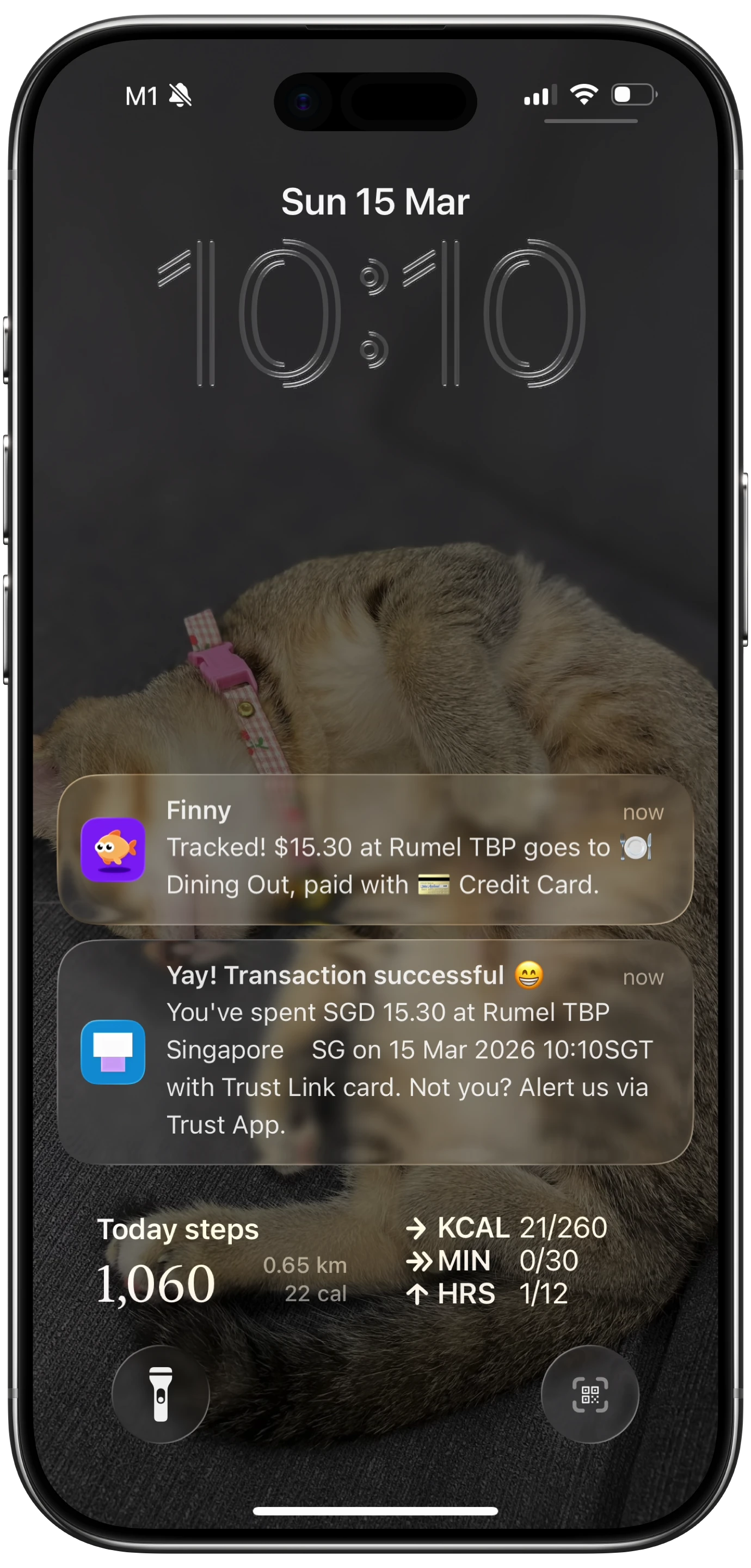
Finny app's Tap to Track feature
The product is built around the mixed terminal reality this post describes:
- Tap to Track. On modern POS hardware (the units replacing the legacy ones), Finny logs each Apple Pay purchase seconds after you tap. No app open, no typing.
- Snap and Log. When you are stuck with a legacy terminal that has not been swapped yet, photograph the receipt or batch up to five at once. Finny extracts amount, merchant, date, and category in a single pass.
- AI chat. Speak or type "coffee $4.85" and it is logged. Covers cash, online purchases, and the long tail.
Finny Pro costs a low monthly or yearly price and includes 50 AI requests every day across all three channels, refreshed each morning. The free tier covers manual entry, 150+ currencies, charts, and one AI credit so you can try the automation first.
Try Finny at getfinny.app.