"AI" gets attached to a lot of budget apps, but the actual feature varies wildly. Some apps use AI for receipt parsing only. Others lean on chatbots that explain your spending. A few are starting to do real predictive forecasting. If you are evaluating AI budget management tools in 2026, the trick is matching the kind of AI to the kind of help you actually need.
This guide compares six apps that use AI in meaningfully different ways, so you can pick the one that solves your problem rather than the one with the loudest pitch. For a primer on what AI budgeting actually is, see our AI budget planner explainer and our piece on AI financial coaches and predictive budgeting.
What "AI Budget Management" Actually Includes
A newer group builds the whole interface around a conversation rather than a dashboard, which we compared in best AI chat expense trackers.
The term covers four distinct features, often bundled but sometimes sold separately:
- AI input parsing. Type or speak "12 lunch" and the app extracts amount, category, and merchant.
- Smart categorization. Transactions auto-sort into categories using machine learning trained on transaction descriptions.
- Predictive forecasting. The app projects end-of-month totals based on current pace and historical patterns.
- Conversational coaching. A chatbot answers questions like "did I overspend on dining out this month?" and suggests adjustments.
The most useful AI tools combine input parsing and smart categorization. Forecasting and coaching are nice-to-haves that can drift toward gimmick if the underlying data is shallow.
Quick Comparison Table
| App | Price | AI Input | Smart Categorization | Forecasting | Chat Coach | Bank Required |
|---|---|---|---|---|---|---|
| Finny | a low monthly price | Text, voice, receipt | Yes | Limited | No | No |
| Cleo | Free / $5.99/mo | Chat-based | Yes | Yes | Yes | Yes |
| Copilot | $13/mo | Limited | Yes (strong) | Yes | No | Yes |
| Monarch Money | $14.99/mo | No | Yes | Yes | No | Yes |
| Rocket Money | Free / $6-12/mo | No | Yes | Yes | No | Yes |
| Mint successor (Credit Karma) | Free | No | Yes | Limited | No | Yes |
Pricing reflects April 2026 rates. Verify in the App Store before subscribing.
The Best AI Budget Management Tools in 2026
Finny: Best for AI Input and Privacy
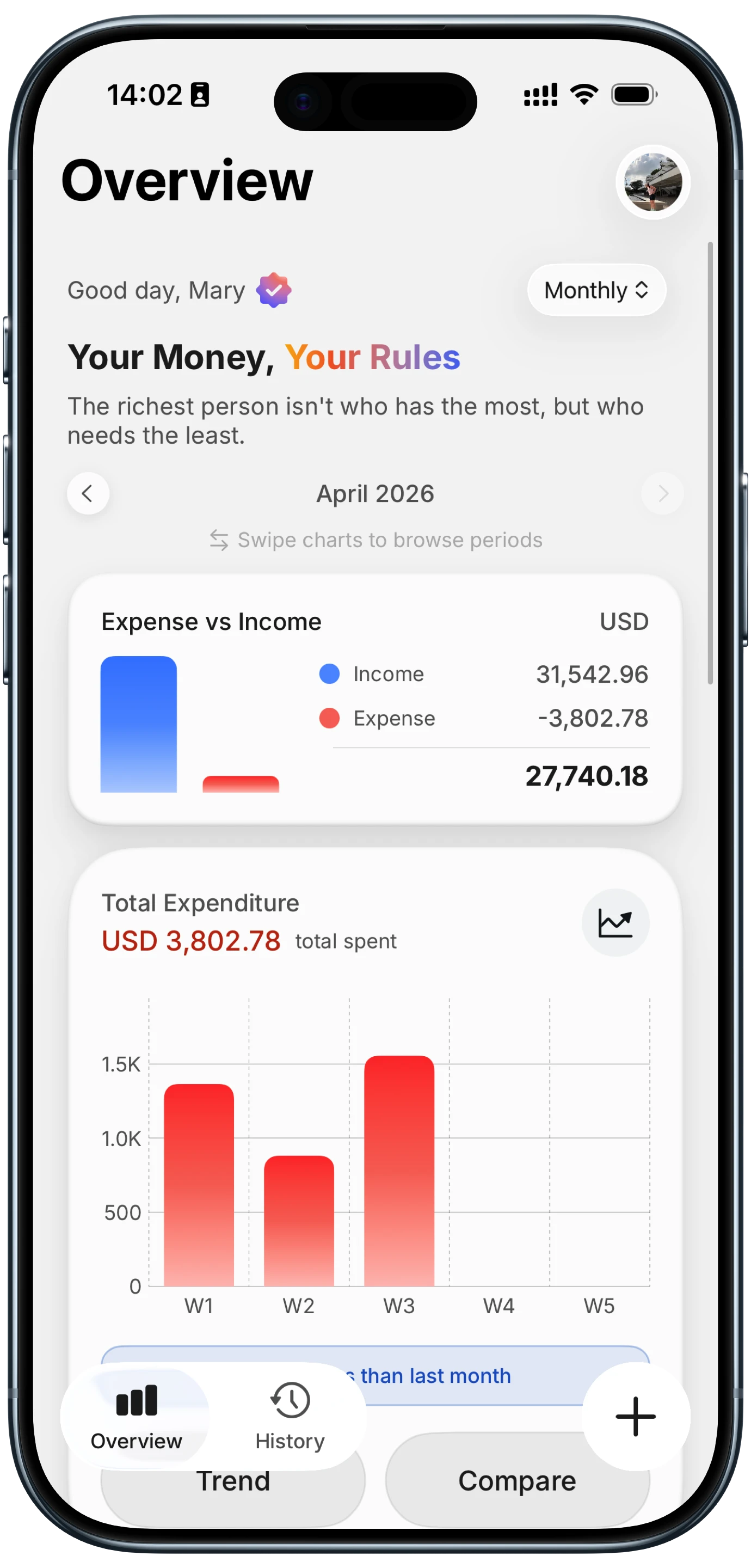
Finny's AI focus is on the input side, where most budget time is actually spent. AI text input parses natural-language entries ("75 office supplies amazon"), voice input transcribes and logs, and Snap and Log batch receipt scanning processes up to five photos at once. Categorization is AI-assisted with manual override, so you get speed without losing control.
What Finny does not do is bank linking, automatic transaction import, or chatbot coaching. The tradeoff is privacy: no aggregator stores your credentials, no third party sees your full transaction history, and the AI processing is scoped to the input you send. Pricing starts at a low monthly price for Pro with 50 AI requests per day.
Best for: users who want fast AI-assisted logging without bank linking, and who prefer to do their own analysis rather than chat with an algorithm.
Cleo: Best AI Chat Budget Coach
Cleo built its reputation on a sassy AI chatbot that roasts your spending. Beneath the personality is a real budget tool that imports transactions through bank linking, categorizes them with ML, and answers natural-language questions about your finances.
Cleo's strength is engagement. The conversational interface gets people to check their budget more often than a dashboard does. The catch is that the underlying budget engine is shallow compared to Copilot or Monarch, and Cleo Plus pushes credit-builder products that are not for everyone.
Best for: users who avoid traditional budget apps because they find them dry or boring. If you are weighing premium AI trackers instead, see our apps like Copilot Money guide.
Copilot: Best for Smart Categorization
Copilot's reputation is built on the strongest categorization engine in the consumer space. It learns from your edits aggressively, so by month two, very little needs manual recategorization. Bank linking is required, and the iOS-only design has a clean, opinionated feel.
The AI work happens behind the scenes: pattern matching on merchants, prediction of recurring transactions, and forecasting against your typical spending. There is no chat interface; the app just gets out of your way once trained.
Pricing is $13/mo or $95/yr, putting Copilot in the premium tier.
Best for: iOS users who prioritize categorization accuracy and are willing to pay for the cleanest auto-tracking experience.
Monarch Money: Best for Households With Multiple Accounts
Monarch leans on AI for transaction categorization, recurring-bill detection, and household-level budget rollups. Its strength is breadth: investments, debt, real estate, and shared accounts all live in one dashboard. AI classifies transactions and surfaces anomalies in spending patterns.
Pricing at $14.99/mo is the highest in this comparison, justified for users with complex financial pictures and multiple linked accounts. Monarch is also the most popular Mint replacement after Mint shut down.
Best for: households with several accounts, investments, and the need for a single full-picture view.
Rocket Money: Best for Subscription Cancellation
Rocket Money (formerly Truebill) blends standard budget tracking with a subscription-management AI that flags forgotten and underused recurring charges. The app can negotiate cancellations on your behalf, which is the unique angle. Categorization is solid; predictive cash-flow alerts work reasonably well.
Pricing is freemium with a $6 to $12/mo Premium tier that includes the negotiation features. The free tier is functional but pushes Premium aggressively.
Best for: users with subscription bloat who want help canceling and renegotiating recurring charges. For a focused look, see best subscription tracker apps for 2026.
Credit Karma (Mint Successor): Best Free Bank-Linked Tracker
After Mint shut down in 2024, Intuit migrated users to Credit Karma's net-worth and budgeting features. The AI here is light: categorization plus credit-score insights. There is no AI input or chat coach.
For a free tool with reasonable bank linking and basic budget tracking, it is competent. For deeper budget work, you will probably need Monarch, Copilot, or YNAB instead. For more options, see our best Mint alternatives for 2026 roundup.
Best for: former Mint users looking for a free replacement and anyone who wants light budget tracking integrated with credit monitoring.
How to Pick the Right AI Budget Tool
A few questions cut the field fast:
- Do you want AI on the input side or the analysis side? Finny is input-side. Copilot, Monarch, and Cleo are analysis-side. The input-side AI saves time daily; the analysis-side AI saves time monthly.
- Are you willing to link your bank? Cleo, Copilot, Monarch, Rocket Money, and Credit Karma require it. Finny does not.
- Do you want a conversational coach or a quiet dashboard? Cleo is conversational. The others are quiet.
- What is your budget for the budget app? Finny at a low monthly price is the cheapest. Monarch at $14.99/mo is the priciest. Free tiers exist on Cleo, Rocket Money, and Credit Karma.
For more on AI-assisted logging vs traditional methods, see our piece on AI expense tracking vs manual and the broader alternatives to manual expense tracking guide.
Common Questions
What is the best AI budget management tool?
There is no single winner. For input-side AI without bank linking, Finny leads. For categorization accuracy, Copilot. For full-household views, Monarch. For chat-based engagement, Cleo. For subscription cleanup, Rocket Money. Pick based on which slice of "AI budgeting" you actually want.
Are AI budget apps accurate?
For categorization and parsing, yes, especially after a few weeks of training on your data. For predictive forecasting, results vary; short-horizon predictions (next 30 days based on current pace) are more reliable than long-horizon ones. Always verify AI-categorized transactions before relying on the totals.
Can AI budget tools work without bank linking?
Yes, but the feature set narrows. Finny is the main option that delivers AI input parsing and smart categorization without requiring a bank login. Bank-linked AI tools (Cleo, Copilot, Monarch) get most of their value from automatic transaction import, so without linking, much of the AI value disappears.
Is an AI budget app worth paying for?
If you have struggled with manual budgeting, the time savings and consistency gains usually justify $2 to $15 per month. The clearest ROI is on input-side AI (saves daily friction) and subscription detection (often finds $20 to $50 in cancelable charges per month). Categorization-only AI is harder to value because manual categorization is fast once you build the habit.
What is the difference between AI budgeting and regular budgeting?
Traditional budget apps require manual entry or rule-based categorization. AI budget apps add machine learning to one or more steps: parsing inputs, categorizing transactions, predicting end-of-month totals, or answering natural-language questions about spending. The underlying budgeting logic (set categories, track spend, compare to limits) is the same.
The Bottom Line
AI budget management is shorthand for several different features, not a single thing. Pick the AI that solves your specific friction. If logging is your bottleneck, get an input-side AI like Finny. If categorization is the issue, Copilot. If you do not check your budget often enough, a coach like Cleo helps. If you are drowning in subscriptions, Rocket Money does the negotiation work.
The bigger principle: AI is most useful when it removes friction from a habit you already want to keep. A perfect predictor of next month's spending is less valuable than a tool that gets you to log this morning's coffee.