A financial plan sounds like something you hire an advisor for. In reality, it is a written document that answers three questions: where is your money now, where do you want it to go, and what steps will get it there.
You do not need a finance degree or a high income to build one. You need clarity about your numbers, a few specific goals, and a system to track progress. This guide walks through every step of financial planning for someone starting from scratch.
For a broader look at managing money across all areas of life, see our complete guide to personal finance.
Step 1: Assess Your Current Financial Situation
Before you can plan where to go, you need to know where you are. This step involves three exercises.
Calculate your net worth
List everything you own (assets) and everything you owe (liabilities). Assets include bank accounts, investments, retirement accounts, property value, and vehicles. Liabilities include credit card balances, student loans, car loans, mortgages, and any other debts.
Assets minus liabilities equals your net worth. If the number is negative, that is fine. It simply means debt reduction should be a priority in your plan.
Track your income and expenses
Pull your last three months of bank and credit card statements. Categorize every transaction into groups: housing, transportation, groceries, dining out, subscriptions, insurance, debt payments, and discretionary spending.
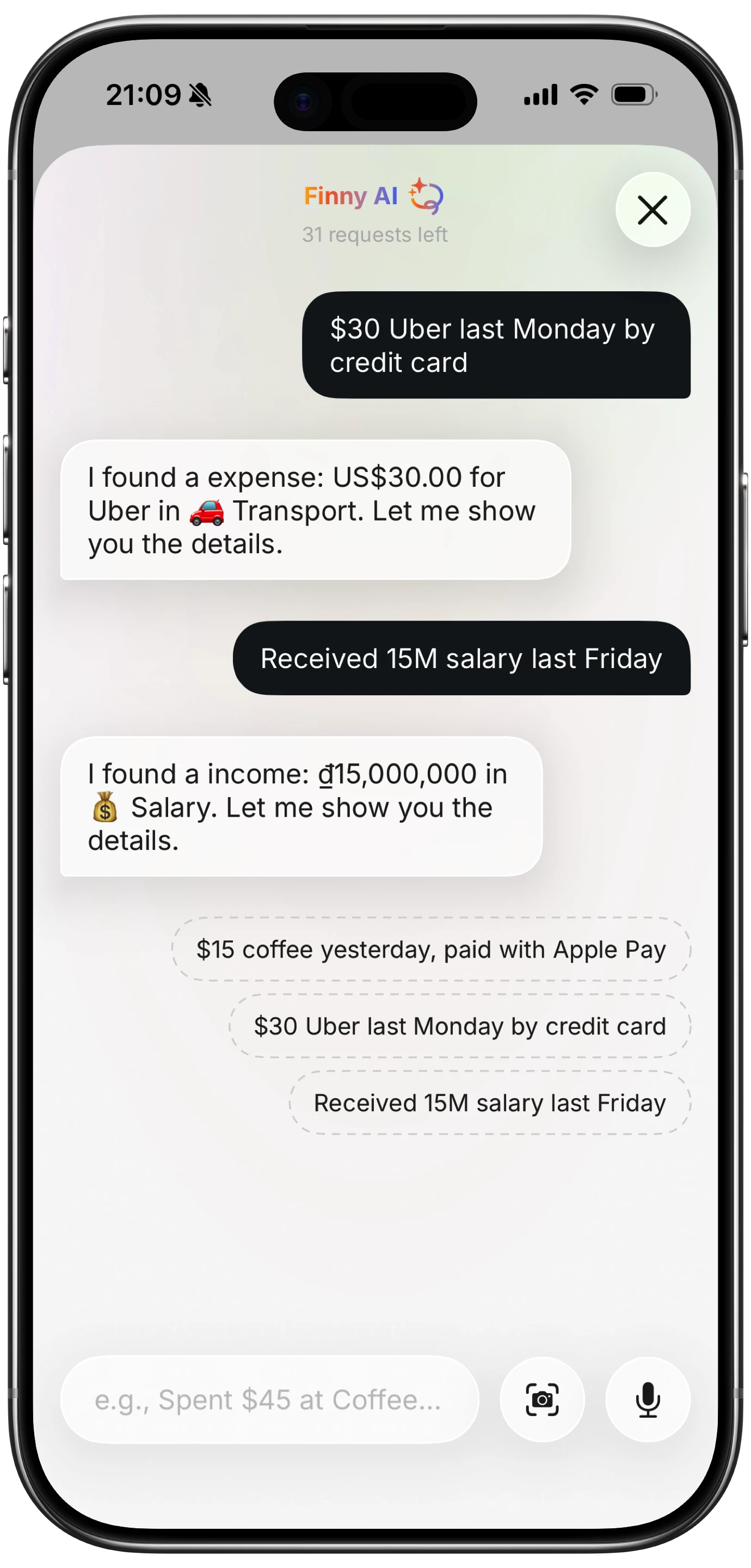
This is where most people get stuck because manual categorization is tedious. An expense tracking app simplifies this significantly. Finny lets you log transactions by typing naturally, speaking, or scanning receipts with AI, so the categorization step takes seconds instead of hours.
Identify your spending patterns
Look at your categorized expenses and ask:
- Which category takes the largest share of my income?
- Where am I spending more than I expected?
- What recurring charges am I paying for things I rarely use?
These patterns become the foundation for your budget in Step 3.
Step 2: Set Clear Financial Goals
Goals turn a vague desire to "be better with money" into measurable targets. Divide yours into three timeframes.
Short-term goals (under 1 year)
These are immediate priorities: building a starter emergency fund, paying off a specific credit card, or saving for a planned expense. Short-term goals should be specific. "Save $2,000 for an emergency fund by September" is actionable. "Save more money" is not.
Learn more about setting and tracking financial goals.
Medium-term goals (1 to 5 years)
These might include saving a down payment for a home, paying off student loans, building a six-month emergency fund, or saving for a wedding. Medium-term goals require consistent monthly contributions, which is why your budget (Step 3) matters so much.
Long-term goals (5+ years)
Retirement, children's education, financial independence. These goals benefit enormously from compound growth, which means starting early matters more than starting with large amounts.
Prioritize ruthlessly
You cannot fund every goal at once. Rank them by urgency and impact. A common order is: emergency fund first, high-interest debt second, retirement contributions third, then everything else.
Step 3: Create a Budget
A budget is the operational plan that connects your income to your goals. Without one, money flows toward whatever feels urgent in the moment rather than toward what matters most.
Choose a budgeting method
Several approaches work. Pick the one that matches your personality.
50/30/20 rule: Allocate 50% of after-tax income to needs, 30% to wants, and 20% to savings and debt repayment. Simple and flexible. Read our detailed guide to the 50/30/20 rule for implementation tips.
Zero-based budgeting: Assign every dollar a specific purpose until your income minus your budget equals zero. More hands-on but gives you maximum control. See our guide on how to budget money effectively for a step-by-step walkthrough.
Envelope method: Divide cash into physical or digital envelopes for each spending category. When an envelope is empty, spending in that category stops until the next month.
Automate what you can
Set up automatic transfers for savings, investments, and bill payments on or right after payday. This removes the decision from the process. What gets automated gets done.
Track actual spending against your budget
A budget only works if you monitor it. Review your spending weekly. This does not need to be complicated. Five minutes comparing actual spending to your plan is enough to catch overspending early.
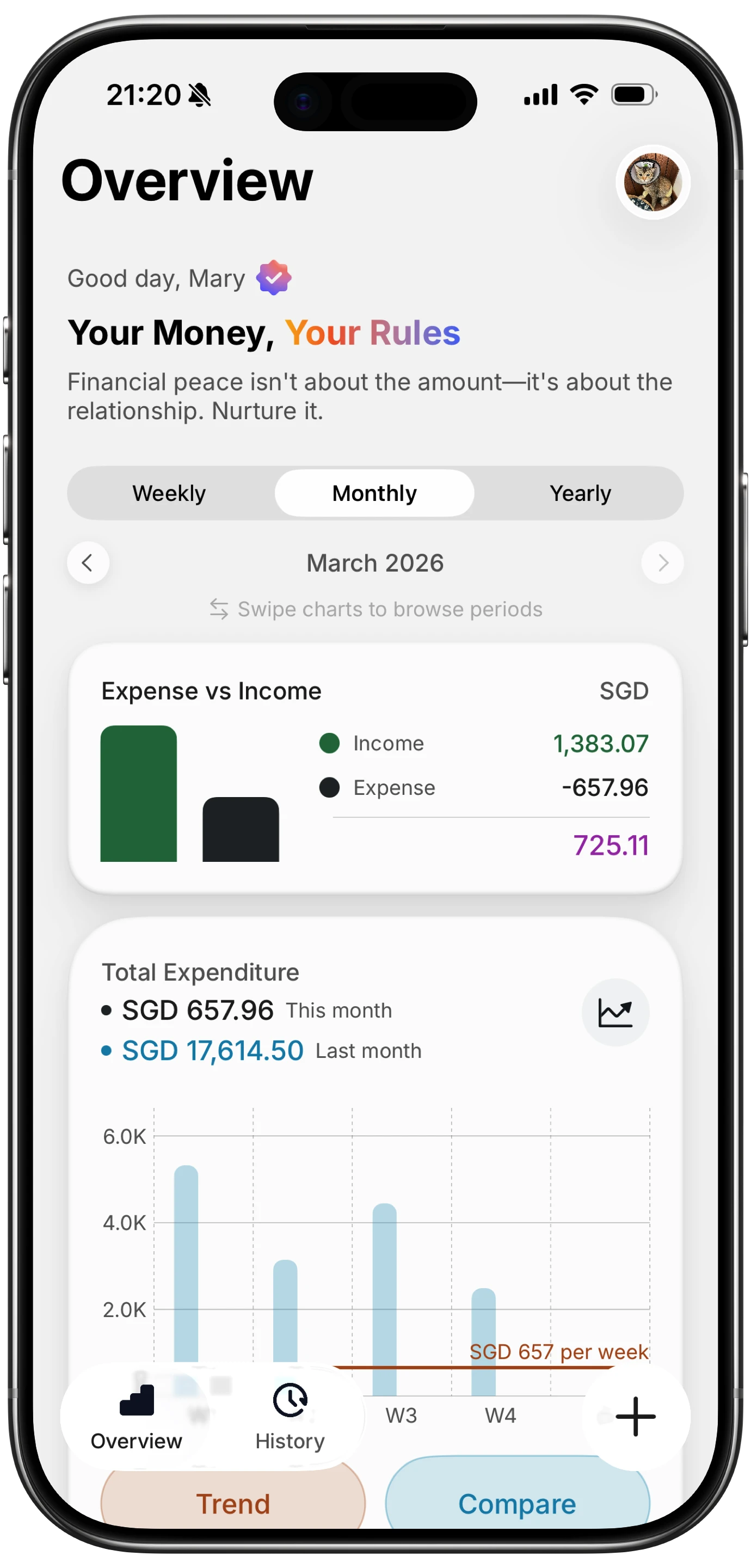
Finny's recurring transaction feature can automatically log predictable expenses like rent, utilities, and subscriptions, so your budget tracking stays current without daily manual entry.
Step 4: Build an Emergency Fund
An emergency fund is cash set aside for true emergencies: job loss, medical bills, car breakdowns, urgent home repairs. It is not for vacations, holiday gifts, or sales.
How much do you need?
The standard recommendation is three to six months of essential living expenses. If your monthly essentials (housing, food, transportation, insurance, minimum debt payments) total $3,000, your target is $9,000 to $18,000.
If that feels overwhelming, start with $1,000. That covers most single emergencies and builds the habit of saving. Our detailed guide on building an emergency fund explains how to calculate the right amount based on your specific expenses.
Where to keep it
A high-yield savings account is the standard choice. In 2026, many online banks offer around 4% APY with no minimum balance. Your emergency fund should be accessible within one to two business days but not so accessible that you dip into it casually. Learn more about high-yield savings accounts and how to choose one.
Fund it consistently
Automate a fixed amount per paycheck, even if it is small. $100 per paycheck, deposited biweekly, builds to $2,600 in a year. Increase the amount when your income grows or when you pay off a debt.
Step 5: Manage and Eliminate Debt
Not all debt is equal. The interest rate determines how urgently you should pay it off.
Categorize your debt
High-interest debt (above 7%): Credit cards, personal loans, payday loans. This debt costs you the most and should be the top repayment priority after minimum payments on everything else.
Medium-interest debt (4% to 7%): Some car loans, older student loans. Pay these down steadily but do not sacrifice retirement contributions for them.
Low-interest debt (below 4%): Mortgages, some federal student loans. These are less urgent. Making minimum payments while directing extra money to higher-interest debt or investments often makes more mathematical sense.
Choose a repayment strategy
Avalanche method: Pay minimums on all debts, then put extra money toward the highest-interest debt first. This saves the most in total interest.
Snowball method: Pay minimums on all debts, then put extra money toward the smallest balance first. This generates quick wins that build motivation.
Both work. The best method is the one you will actually follow.
Avoid adding new debt while paying off existing debt
This sounds obvious, but it is the most common reason debt payoff plans fail. If your spending exceeds your income, no repayment strategy can keep up. Your budget from Step 3 prevents this.
Step 6: Start Investing
Once you have an emergency fund and a plan for high-interest debt, investing becomes the engine that builds long-term wealth.
Understand the basics
Investing means putting money into assets that you expect to grow over time: stocks, bonds, real estate, or index funds. The key concept is compound growth, where returns generate their own returns over time.
A simple example: $300 per month invested at an average 7% annual return grows to approximately $120,000 in 20 years. Of that, only $72,000 is money you contributed. The other $48,000 is growth.
Start with tax-advantaged accounts
Maximize accounts that give you tax benefits before investing in taxable accounts.
401(k) or 403(b): If your employer offers a match, contribute at least enough to get the full match. That is an immediate 50% to 100% return. In 2026, the contribution limit is $24,500, with an additional $8,000 catch-up for those 50 and older. Learn more about how 401(k) plans work.
Roth IRA: Contribute after-tax money that grows and can be withdrawn tax-free in retirement. The 2026 limit is $7,500 ($8,600 if you are 50 or older). Income phase-outs begin at $153,000 for single filers and $242,000 for married couples filing jointly. See our Roth IRA guide for eligibility details.
HSA (Health Savings Account): If you have a high-deductible health plan, an HSA offers triple tax advantages: tax-deductible contributions, tax-free growth, and tax-free withdrawals for medical expenses. The 2026 limits are $4,400 for individuals and $8,750 for families.
Keep it simple
For most beginners, a low-cost target-date fund or a three-fund portfolio (domestic stocks, international stocks, bonds) provides broad diversification without requiring active management.
Step 7: Protect What You Have Built
Insurance exists to prevent a single event from destroying years of financial progress.
Essential coverage
Health insurance: The single most important insurance. A major medical event without coverage can create six-figure debt instantly.
Auto insurance: Required by law in most states. Make sure your liability limits are adequate, not just the state minimum.
Renters or homeowners insurance: Protects your possessions and provides liability coverage. Renters insurance typically costs $15 to $25 per month and is one of the best values in insurance.
Disability insurance: Covers a portion of your income if you cannot work due to illness or injury. Many employers offer this benefit. If yours does not, consider an individual policy, especially if others depend on your income.
Life insurance: Necessary if anyone depends on your income. Term life insurance is straightforward and affordable for most people under 50.
Review annually
Your coverage needs change as your life changes. Review all policies once per year, especially after major events like marriage, buying a home, having children, or a significant income change.
Step 8: Plan for Retirement
Retirement planning is not separate from financial planning. It is the longest-term goal within your plan.
Estimate how much you need
A common starting point: multiply your desired annual retirement spending by 25. If you want $50,000 per year in retirement, aim for $1,250,000. This is based on the 4% withdrawal rule, which suggests you can withdraw 4% of your portfolio annually with a low probability of running out of money over 30 years.
Contribute consistently
The specific amount matters less than the consistency. Contributing $500 per month for 30 years at 7% average returns yields approximately $567,000. Starting 10 years later with the same monthly amount yields only $244,000. Time is the most powerful factor.
Increase contributions with income
Every time you get a raise, increase your retirement contribution by at least 1% of your salary. You will never miss money you never saw in your paycheck.
Step 9: Review and Adjust Your Plan
A financial plan is a living document. Life changes, and your plan should change with it.
Schedule quarterly reviews
Set a calendar reminder every three months to review your budget, check progress toward goals, and adjust as needed. This takes 30 to 60 minutes per quarter.
Reassess after major life events
Marriage, divorce, a new baby, a job change, buying a home, or an inheritance all require plan adjustments. Do not wait for the next quarterly review if a major change happens.
Track your net worth over time
Your net worth is the single best measure of overall financial progress. Calculate it quarterly alongside your budget review. Watching it grow, even slowly, reinforces the behavior that got you there. For a deeper look at this, see our guide on how to track expenses effectively.

Frequently Asked Questions
What is the first step in financial planning?
Start by assessing your current situation. Calculate your net worth (assets minus liabilities), track your income and expenses for at least one month, and identify where your money actually goes. You cannot build a plan without knowing your starting point.
How much money do I need to start financial planning?
Zero. Financial planning is about organizing what you have, not about having a certain amount. You can start with any income level. The process of tracking, budgeting, and setting goals works the same whether you earn $30,000 or $300,000.
Do I need a financial advisor?
Not necessarily. Most people can handle basic financial planning, including budgeting, emergency funds, debt repayment, and index fund investing, on their own using free resources. A fee-only financial advisor becomes valuable when your situation gets complex: significant assets, business ownership, estate planning, or tax optimization across multiple income sources.
How often should I update my financial plan?
Review your budget monthly and your broader plan quarterly. Major life events like a new job, marriage, a child, or buying property should trigger an immediate review regardless of the calendar.
What is the biggest financial planning mistake beginners make?
Trying to do everything at once. People read about budgeting, emergency funds, debt payoff, investing, and insurance, then feel paralyzed by the number of steps. Start with one thing: track your spending. Then build from there, one step at a time. Progress compounds just like interest.