How to Split Rent by Room Size (With Examples)
Three roommates, one lease, and three bedrooms that are clearly not the same. Splitting the rent three ways feels simple until the person in the smallest room works out what they pay per square foot.
This guide shows how to split rent by room size with worked numbers: the equal split, a straight square-footage split, a hybrid most roommates prefer, and adjustments for a private bathroom, parking, or a couple sharing a room. Every example uses the same illustrative $2,400 three-bedroom and adds up to the total exactly. For the bigger picture on logging and settling shared costs, see our guide to tracking shared expenses with roommates.
Why Room Size Matters When You Split Rent
Rent keeps climbing. Median gross rent in the US, which the Census Bureau defines as rent plus the cost of utilities, rose 2.7 percent to $1,487 a month in 2024, according to the Census Bureau's American Community Survey release from September 2025. The same release put the median share of income going to rent at 31 percent.
Many renters share to keep that cost down. A record 6.8 million US households shared their home with unrelated housemates, roommates, or boarders in 2023, according to a National Association of Home Builders analysis of American Community Survey data published in April 2025.
Here is the example apartment used throughout this post. The numbers are illustrative, not data.
| Space | Size | Who |
|---|---|---|
| Room A (largest bedroom) | 200 sq ft | Jordan |
| Room B | 150 sq ft | Sam |
| Room C (smallest bedroom) | 130 sq ft | Riley |
| Shared space (kitchen, living room, hall, bathroom) | 720 sq ft | Everyone |
| Whole apartment | 1,200 sq ft | Rent: $2,400 a month |
Measure each bedroom (length times width) and check the listing or lease for the total square footage. The hybrid method needs both.
Method 1: Split Rent Equally
The equal split divides rent by the number of people: $2,400 ÷ 3 = $800 each. It needs no measuring and no debate about whose closet counts.
| Roommate | Bedroom | Rent | Rent per sq ft of bedroom |
|---|---|---|---|
| Jordan | 200 sq ft | $800 | $4.00 |
| Sam | 150 sq ft | $800 | $5.33 |
| Riley | 130 sq ft | $800 | $6.15 |
| Total | 480 sq ft | $2,400 |
The last column shows the problem. Riley pays about 54 percent more per square foot of private space than Jordan ($6.15 versus $4.00), for the same kitchen and living room.
An equal split still makes sense when the bedrooms are nearly the same size, when roommates rotate rooms at each lease renewal, or when the bigger room has a drawback such as street noise or no closet. Otherwise, the person in the smallest room subsidizes the largest one every month. Over a 12-month lease, paying even $50 a month more than your room is worth adds up to $600.
Method 2: Split Rent by Square Footage
The straight square-footage method divides the entire rent by bedroom size alone. Add up the bedrooms, work out a price per square foot, then multiply by each room.
- Total bedroom space: 200 + 150 + 130 = 480 sq ft
- Price per square foot: $2,400 ÷ 480 = $5.00
- Each share: room size times $5.00
| Roommate | Bedroom | Calculation | Rent | Share of rent |
|---|---|---|---|---|
| Jordan | 200 sq ft | 200 × $5.00 | $1,000 | 41.67% |
| Sam | 150 sq ft | 150 × $5.00 | $750 | 31.25% |
| Riley | 130 sq ft | 130 × $5.00 | $650 | 27.08% |
| Total | 480 sq ft | $2,400 | 100% |
This is easy to explain and check. The weakness is that it prices the shared space at zero. The kitchen, living room, and bathroom make up 720 of the apartment's 1,200 square feet, and all three people use them equally, yet Jordan pays $350 a month more than Riley for 70 extra square feet of bedroom.
A bigger bedroom is worth more, but rarely that much more. The straight method fits best when bedrooms make up most of the home and the common area is little more than a small kitchen.
Method 3: The Hybrid Split (Shared Space Equally, Bedrooms by Size)
The hybrid method treats each kind of space the way it is used. Shared space is split equally, since everyone uses it. Private space is split by size, since only one person uses each bedroom.
- Shared share of the home: 720 ÷ 1,200 = 60 percent, so $2,400 × 0.60 = $1,440 of the rent pays for shared space.
- Split shared rent equally: $1,440 ÷ 3 = $480 each.
- Private share: the other 40 percent, $2,400 × 0.40 = $960, pays for bedrooms.
- Price per bedroom square foot: $960 ÷ 480 = $2.00.
- Add the two parts for each person.
| Roommate | Shared space | Bedroom | Total rent |
|---|---|---|---|
| Jordan (200 sq ft) | $480 | 200 × $2.00 = $400 | $880 |
| Sam (150 sq ft) | $480 | 150 × $2.00 = $300 | $780 |
| Riley (130 sq ft) | $480 | 130 × $2.00 = $260 | $740 |
| Total | $1,440 | $960 | $2,400 |
Jordan now pays $140 more than Riley instead of $350. The bigger room still costs more, but everyone carries an equal share of the common space.
No total square footage? Agree on a fixed ratio instead, such as half the rent split equally and half by bedroom size: $400 each, plus $1,200 ÷ 480 = $2.50 per bedroom square foot, so Jordan pays $900, Sam $775, and Riley $725.
Adjusting for a Private Bathroom, Parking, or a Couple
An ensuite bathroom, a balcony, or a parking spot included in the lease can make one room worth more than its size suggests. The cleanest fix: put a monthly dollar value on each extra, assign it to the person who uses it, and split the rest with your chosen method.
Private Bathroom or Parking Spot
Say Jordan's room has its own bathroom, which the group values at $90 a month, and Riley uses the lease's only parking spot, valued at $60. To pick values, check what nearby listings charge for parking or an ensuite, or have each roommate name what they would pay and meet in the middle.
- Take the extras off the top: $2,400 minus $90 minus $60 = $2,250.
- Run the hybrid on $2,250: shared space is $2,250 × 0.60 = $1,350, or $450 each. Bedrooms are $2,250 × 0.40 = $900, or $900 ÷ 480 = $1.875 per square foot.
- Add each person's extras back.
| Roommate | Shared space | Bedroom | Extras | Total rent |
|---|---|---|---|---|
| Jordan | $450 | $375.00 | $90 bathroom | $915.00 |
| Sam | $450 | $281.25 | none | $731.25 |
| Riley | $450 | $243.75 | $60 parking | $753.75 |
| Total | $1,350 | $900.00 | $150 | $2,400.00 |
A Couple Sharing a Room
Now suppose Jordan's partner Casey moves into Room A. Four people now use the common space, so the shared $1,440 is split four ways, $360 per person, while the bedroom is still priced by size.
| Room | People | Shared space | Bedroom | Total rent |
|---|---|---|---|---|
| Room A | Jordan and Casey | 2 × $360 = $720 | $400 | $1,120 ($560 each) |
| Room B | Sam | $360 | $300 | $660 |
| Room C | Riley | $360 | $260 | $620 |
| Total | 4 people | $1,440 | $960 | $2,400 |
The couple pays more as a room but less per person than anyone else: they share a bedroom, but each uses the kitchen.
Which Rent Split Method Is Fairest?
The fairest split is the one everyone understands and agrees to before signing the lease. Seeing the methods side by side helps.
| Method | Jordan (200 sq ft) | Sam (150 sq ft) | Riley (130 sq ft) | Total |
|---|---|---|---|---|
| Equal split | $800.00 | $800.00 | $800.00 | $2,400 |
| Straight square footage | $1,000.00 | $750.00 | $650.00 | $2,400 |
| Hybrid, 60% shared | $880.00 | $780.00 | $740.00 | $2,400 |
| Hybrid, 50/50 shortcut | $900.00 | $775.00 | $725.00 | $2,400 |
| Hybrid with bathroom and parking | $915.00 | $731.25 | $753.75 | $2,400 |
A few rules of thumb:
- Bedrooms within about 10 percent of each other: an equal split is usually fine.
- Clear size differences and a real common area: the hybrid is the most defensible choice.
- Large bedrooms and a tiny shared area: straight square footage gets closer to reality.
- Very different incomes: room size is not the only fairness question. Our guide to splitting bills fairly on different salaries covers proportional splits, which you can combine with any method here.
Keep Utilities and Shared Supplies Separate From Rent
Rent pays for space. Utilities and supplies pay for use, which does not depend on bedroom size. Splitting them by room-size percentages overcharges the person in the large room for electricity they did not use.
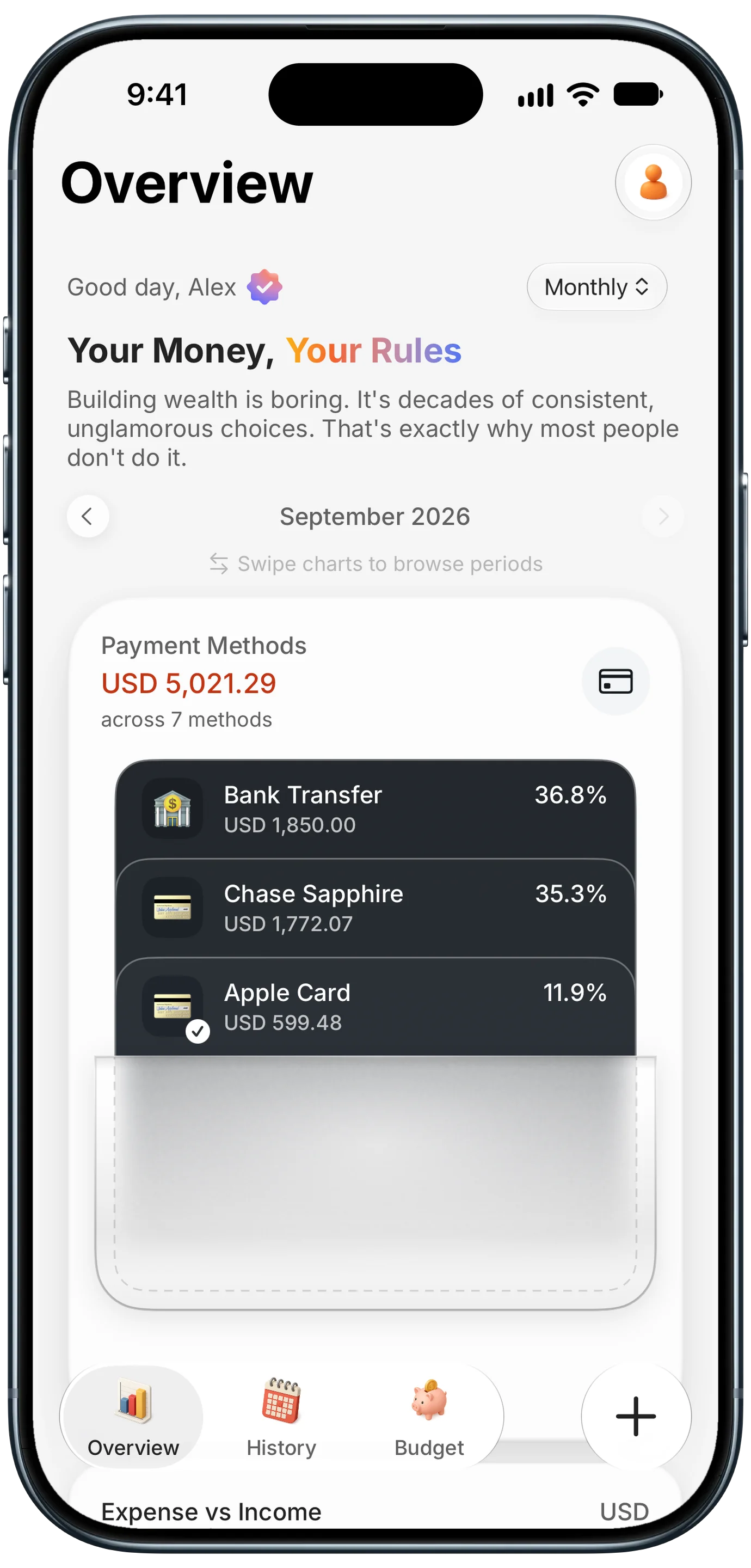
Finny app's Payment Methods feature
A simple structure works for most households:
- Rent: split by your room-size method.
- Utilities and internet: split equally per person, not per room. With the couple example, a $240 month of electricity, gas, water, and internet becomes $60 per person, so Room A pays $120.
- Shared supplies: toilet paper, dish soap, trash bags, and cleaning products go into a small monthly kitty, or whoever buys them logs it and the group settles monthly.
- Groceries: usually personal, unless you cook together.
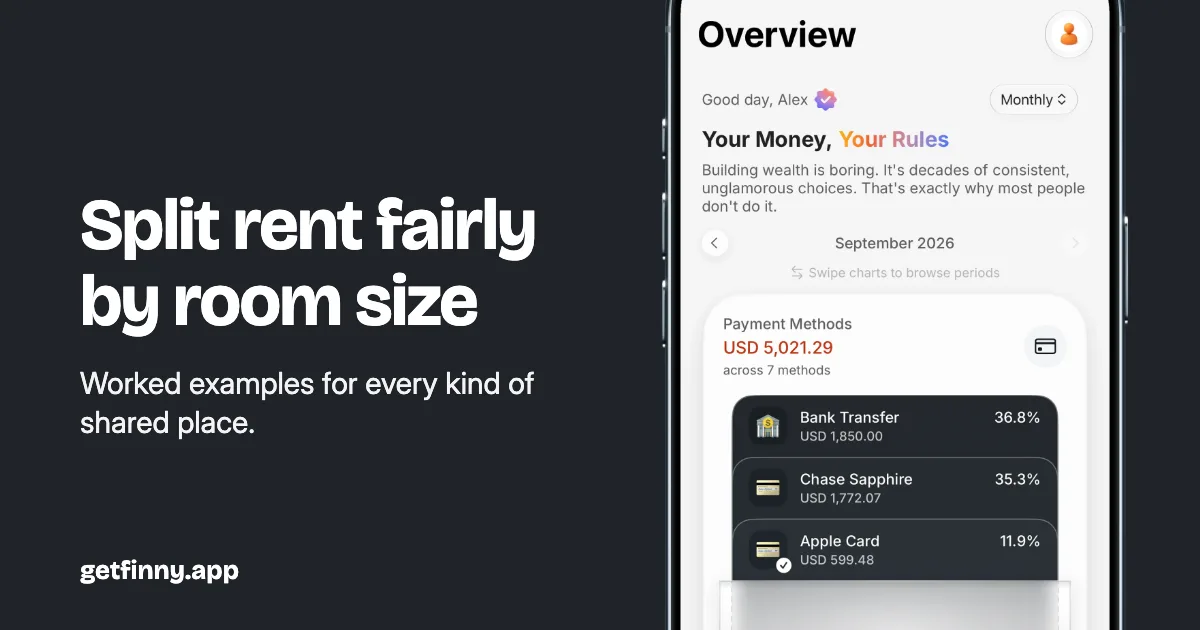
Utilities tend to land on whoever set up the account, often on their own card. In Finny, Households lets you share expenses with up to 5 other people, and each person chooses which entries to share, so the electric bill can be visible to the house while personal spending stays private. If someone pays their share by Venmo or Zelle, our guide to tracking Venmo and Zelle payments shows how to record only your portion.
This short video shows a shared household answering the classic question, did you pay the rent?
How to Put Your Split Into the Bill Split Calculator
Our free bill split calculator turns your method into exact amounts and shows who pays whom. It handles up to 12 people and four split types: Equally, Exact, Percent, and Shares.
- Add everyone. Enter Jordan, Sam, and Riley.
- Add the rent. Enter $2,400, paid by Jordan, who pays the landlord.
- Pick Shares. For straight square footage, type the room sizes (200, 150, 130) and get $1,000, $750, and $650. For the hybrid, type each total as the weight: 880, 780, 740.
- Use Exact for amounts with cents. For the bathroom and parking version, enter $915, $731.25, and $753.75.
- Add utilities as a second expense. Say Sam paid a $240 utility bill. Choose Equally, so each person owes $80.
- Read the settle-up list.
| Roommate | Paid | Owes (rent plus utilities) | Balance |
|---|---|---|---|
| Jordan | $2,400 | $880 + $80 = $960 | gets back $1,440 |
| Sam | $240 | $780 + $80 = $860 | owes $620 |
| Riley | $0 | $740 + $80 = $820 | owes $820 |
The result: Riley pays Jordan $820 and Sam pays Jordan $620. Two payments, and everyone is even.
Percent mode suits round agreements like 40/35/25, but rounded percentages can drift by cents: 41.67, 31.25, and 27.08 give $1,000.08, $750.00, and $649.92. Shares avoids that and always adds back to the exact total.
Write It Into a Roommate Agreement
A rent split stays fair only if everyone remembers why it was agreed. Write it into a one-page roommate agreement that each person signs or confirms in the group chat. It does not need to be a legal document, and it does not change what your lease says you owe the landlord.
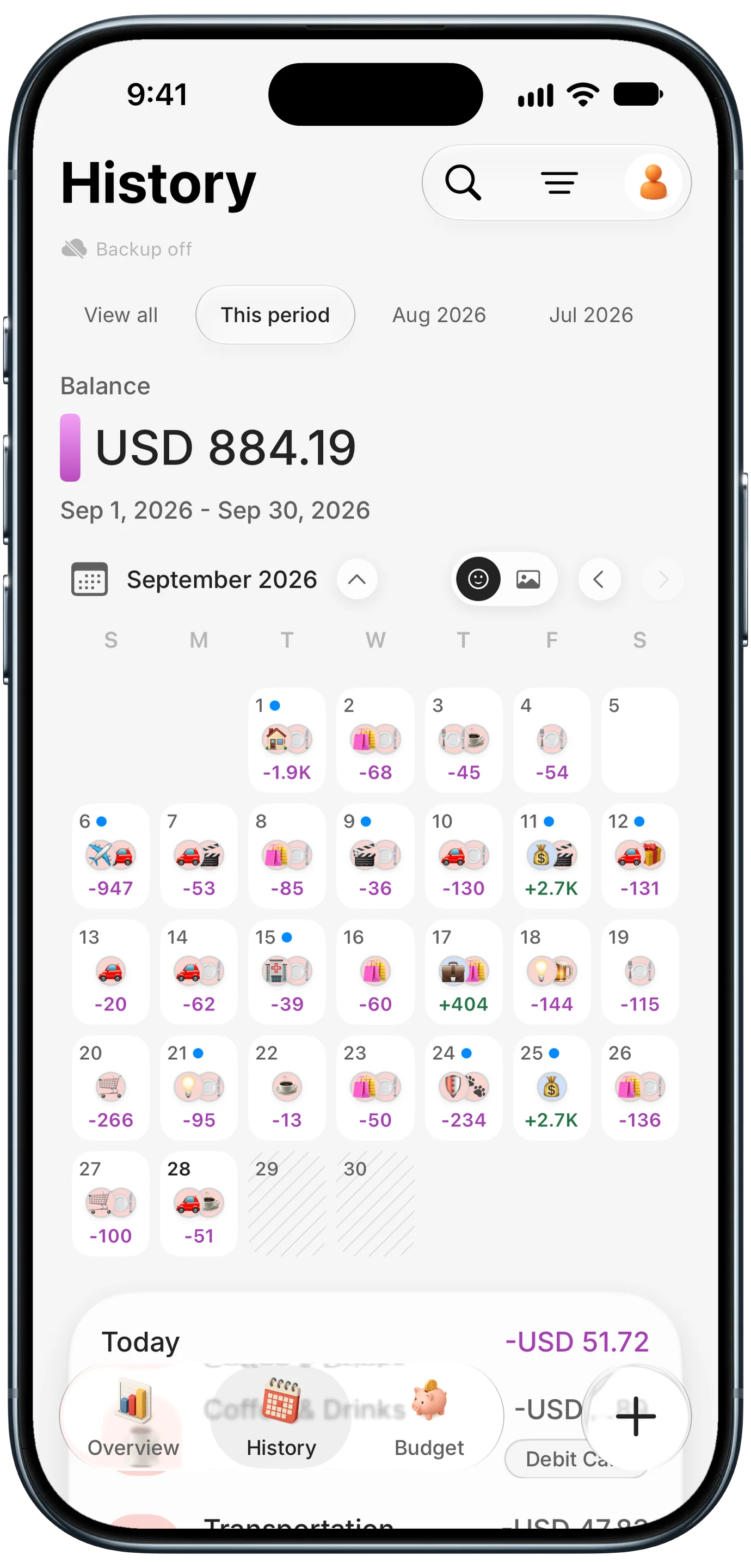
Finny app's History calendar feature
Include these points:
- The method and measurements: room sizes, total square footage, and the formula, so anyone can recheck it.
- The dollar amounts, including extras such as the bathroom or parking values.
- Who pays the landlord and when: for example, shares go to Jordan by the 28th and Jordan pays on the 1st.
- Utilities and supplies: equal per person is the usual default.
- Rent increases: scale every share by the same percentage. A 5 percent increase to $2,520 turns $880, $780, and $740 into $924, $819, and $777.
- Move-outs and room swaps: who finds a replacement, and whether they take the same share.
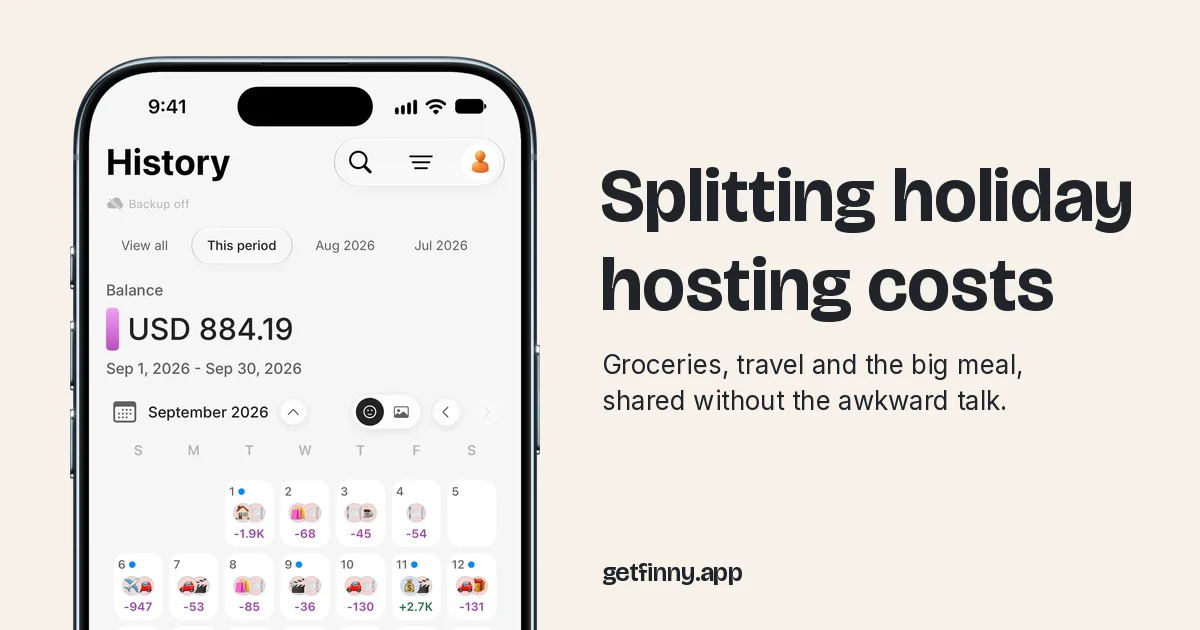
Then track it. In Finny you can log an expense by typing or saying a plain sentence, or snap a receipt, and the History calendar shows daily totals. If you pay your share by bank transfer, this short video shows how Finny logs a payment from what is on your iPhone screen, with no bank connection:
Common Questions About Splitting Rent by Room Size
How do you calculate rent per square foot for a bedroom?
Divide the rent assigned to bedrooms by the total bedroom square footage. With the straight method that is the whole rent: $2,400 ÷ 480 sq ft = $5.00 per square foot. With the hybrid, only the private share counts: $960 ÷ 480 sq ft = $2.00. Multiply each room's size by the rate, then check that the shares add up to the rent.
Should the master bedroom pay more rent?
Usually, yes, if it is noticeably larger or has its own bathroom. With the hybrid method in our example, the largest room pays $880 against $740 for the smallest, and an ensuite valued at $90 raises it to $915. If the bigger room has a drawback, such as street noise or no closet, the group can agree on a smaller premium or an equal split.
How should a couple split rent with a roommate?
Split the shared space per person and the bedroom by size. In our example, four people share $1,440 of common space at $360 each, so the couple's room pays $720 for shared space plus $400 for the bedroom, a total of $1,120, or $560 each. The single roommates pay $660 and $620. Split utilities per person too, since two people use more power and water than one.
Should utilities be split by room size?
Usually not. Utilities depend on how many people live in the home and how they use it, not on bedroom size. Most households split electricity, gas, water, and internet equally per person and settle them separately from rent. A space heater running all winter in one room is the kind of exception the group can price as an extra.
Want to see what you actually pay for rent and bills each month?
Download Finny to log rent, utilities, and shared supplies by text, voice, or receipt, and share only the household entries you choose with your roommates. No bank connection needed.