How to Pay Off Holiday Debt Fast: A Step-by-Step Plan
The gifts are unwrapped, and the statements are on their way. For a lot of households, January means paying for December. In a December 2025 LendingTree survey of 2,032 U.S. consumers, 37% said they took on holiday debt, and the average amount was $1,223, the highest since 2022.
Here is how to pay off holiday debt with a short plan: find every balance, sort out which ones cost interest, choose a payoff order, decide whether a 0% balance transfer makes sense, and fund next December in advance. For older, larger balances beyond the holidays, see our broader guide to paying off bad debt fast.
This is general education, not personal financial advice. Your own rates, credit, and income will shape the right choice.
How Much Holiday Debt Americans Carry, and for How Long
LendingTree's survey, published December 22, 2025 and fielded December 10 to 15, 2025, gives the clearest recent picture of holiday borrowing. The 2026 edition is not out yet, so these are the latest figures available. Treat them as a benchmark, not a verdict on your own situation.
| Finding (LendingTree, December 2025) | Figure |
|---|---|
| Consumers who took on holiday debt | 37% |
| Average holiday debt | $1,223 |
| Parents of kids under 18 who borrowed | 48%, averaging $1,324 |
| Holiday debtors expecting payoff in two months or less | 37% |
| Holiday debtors expecting three months or longer | 63% |
| Holiday debtors still paying last year's holiday bills | 41% |
The last row is the one worth sitting with. Among people who borrowed for the 2025 season, 41% were still paying off the season before. When a balance lingers that long, interest keeps accruing, and the next round of holiday spending lands on top of it.
The same survey shows how people borrowed: 62% put purchases on credit cards, 35% used buy now, pay later (BNPL) loans, and 32% used store credit cards. Separately, 45% of gift-givers used BNPL for at least one purchase. That mix matters for your plan, because each type of debt has different rules, deadlines, and costs.
Step 1: Total Every Holiday Balance, Including Buy Now, Pay Later
Holiday debt is easy to underestimate because it is scattered. A few charges on your main card, a store card you opened for a discount, a four-payment plan for a gaming console, another for a coat.
Start by listing every holiday-related balance in one place. For each one, write down:
- Where it lives: card, store card, or BNPL provider
- What you owe now: the current balance, not the original purchase price
- The minimum or scheduled payment: and the date it is due
- The interest rate: including any promotional rate
- When any promotion ends: this is the date most people miss
BNPL plans deserve extra care. They do not show up on your card statement, payments are pulled automatically on their own schedule, and several small plans can overlap in the same week. Pull up each provider's app and note every remaining installment. Our guide to tracking Klarna, Afterpay, and Affirm payments walks through keeping them in view.
Before you total it up, subtract anything coming back to you. Returns and price adjustments usually refund to the original card, and cash or gift money from relatives can go straight to a balance. The number you end up with is your real holiday debt, and it is often smaller than the dread suggests.
Step 2: Check Every APR and Promo End Date
Not all holiday debt costs the same. A standard credit card balance is charging interest every day. A BNPL pay-in-four plan usually charges no interest at all as long as you make each payment. A store card promotion might charge nothing for months, then charge a lot at once.
That last case is the trap. Many store cards use deferred interest, often advertised as "no interest if paid in full." According to the Consumer Financial Protection Bureau, if you do not pay the full balance by the end of the promotional period, or if you are more than 60 days late on a minimum payment, the issuer can charge interest calculated from the original purchase date. A purchase you thought was interest-free can suddenly carry months of back interest.
A true 0% promotion works differently: if a balance remains when it ends, interest starts from that point forward, not retroactively. Read the terms on each account to see which kind you have.
Once you know the rates and dates, sort your list into three groups:
- Deferred interest balances with a deadline. These need to be cleared in full before the promo ends.
- Balances charging interest now. These are costing you money every month.
- Interest-free installments. Pay these on schedule and on time, but they are not urgent beyond that.
Step 3: Choose Snowball or Avalanche
With your list sorted, decide where extra money goes first. You make every minimum payment on time no matter what, then send anything above the minimums to one balance at a time. There are two common ways to choose that target.
| Method | Pay extra toward first | Strength | Tradeoff |
|---|---|---|---|
| Debt avalanche | Highest interest rate | Costs the least in interest | First win can take longer |
| Debt snowball | Smallest balance | Quick wins build momentum | May cost more in interest |
For holiday debt, the difference is often small because the balances are small. A $300 store card and a $900 credit card at similar rates will be gone within months in either order. What matters more is consistency.
There is one holiday-specific exception: a deferred interest deadline outranks both methods. If a store card promo ends in June, clearing that balance before the deadline usually matters more than the order of everything else, because missing it can add months of back interest at once.
Our full comparison of the debt snowball vs avalanche methods includes worked examples. To test your own numbers, the debt payoff calculator shows how long each order takes and how much interest each one costs.
Step 4: Decide Whether a 0% Balance Transfer Card Is Worth It
A balance transfer card lets you move an existing credit card balance to a new card with a 0% introductory APR. For the length of the promotion, every dollar you pay goes to principal instead of interest.
It is not free. According to a September 2026 Experian guide, balance transfer fees are typically 3% to 5% of the amount transferred, or a flat $5 to $10, whichever is greater. On a $1,223 balance, that is roughly $37 to $61, added to what you owe on day one. Experian also notes that any balance left when the promotional period ends starts accruing interest at the card's standard APR.
A balance transfer tends to make sense when:
- The interest you would pay over your realistic payoff timeline is clearly larger than the fee
- You can pay the full transferred amount before the 0% period ends
- You have the credit to qualify, since the best offers generally require good credit
- You will stop putting new charges on the old card
It tends not to be worth it when:
- You can pay the balance off in a few months anyway, so the fee is close to the interest you would save
- The balance is BNPL or a deferred interest store card that is already interest-free if handled on time
- You expect to keep spending on cards, which can leave you with two balances instead of one
Step 5: Find the Money to Pay It Faster
Paying off holiday debt quickly comes down to how much you can add above the minimums. January is a good month to find it, because spending naturally drops after the holidays and the contrast with December is easy to see.
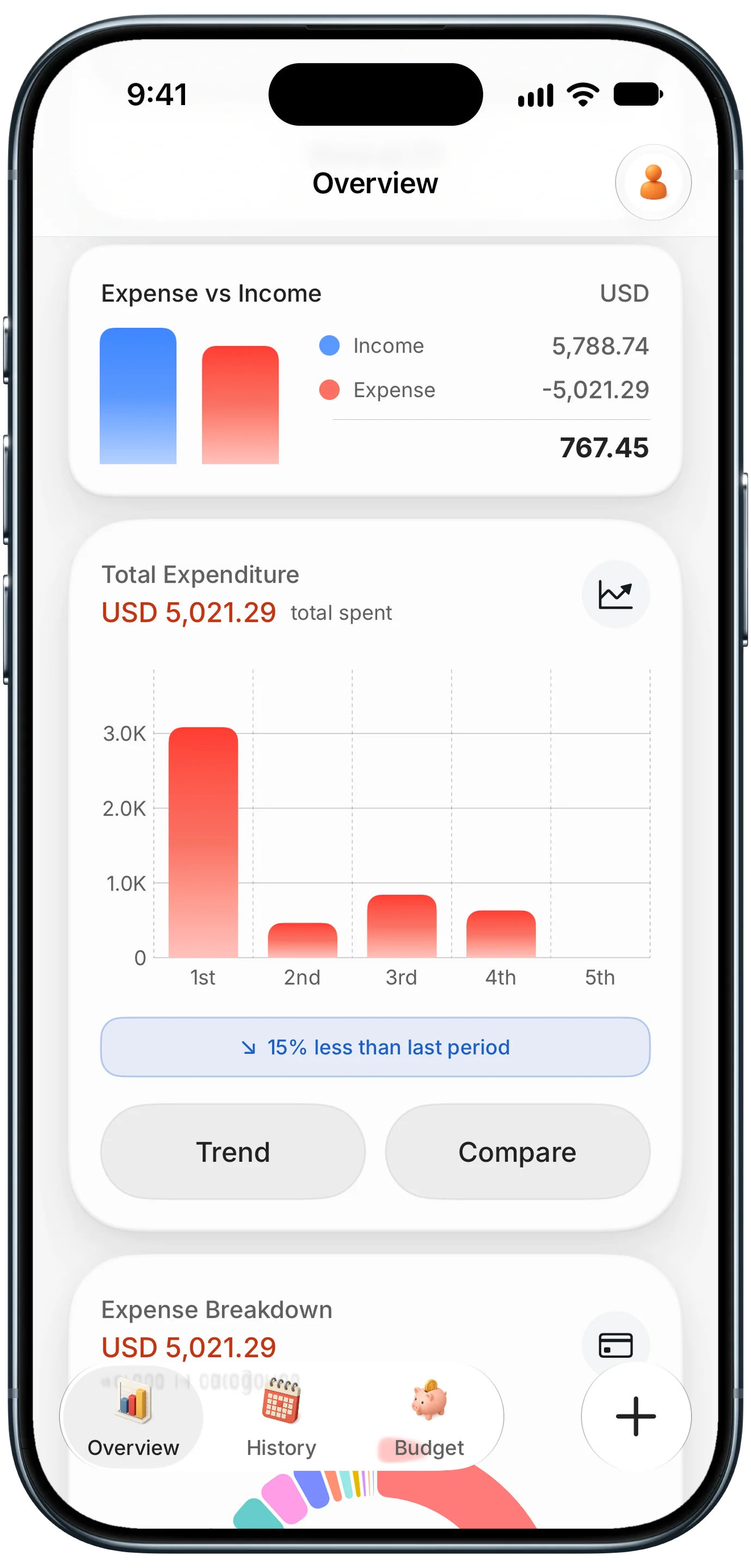
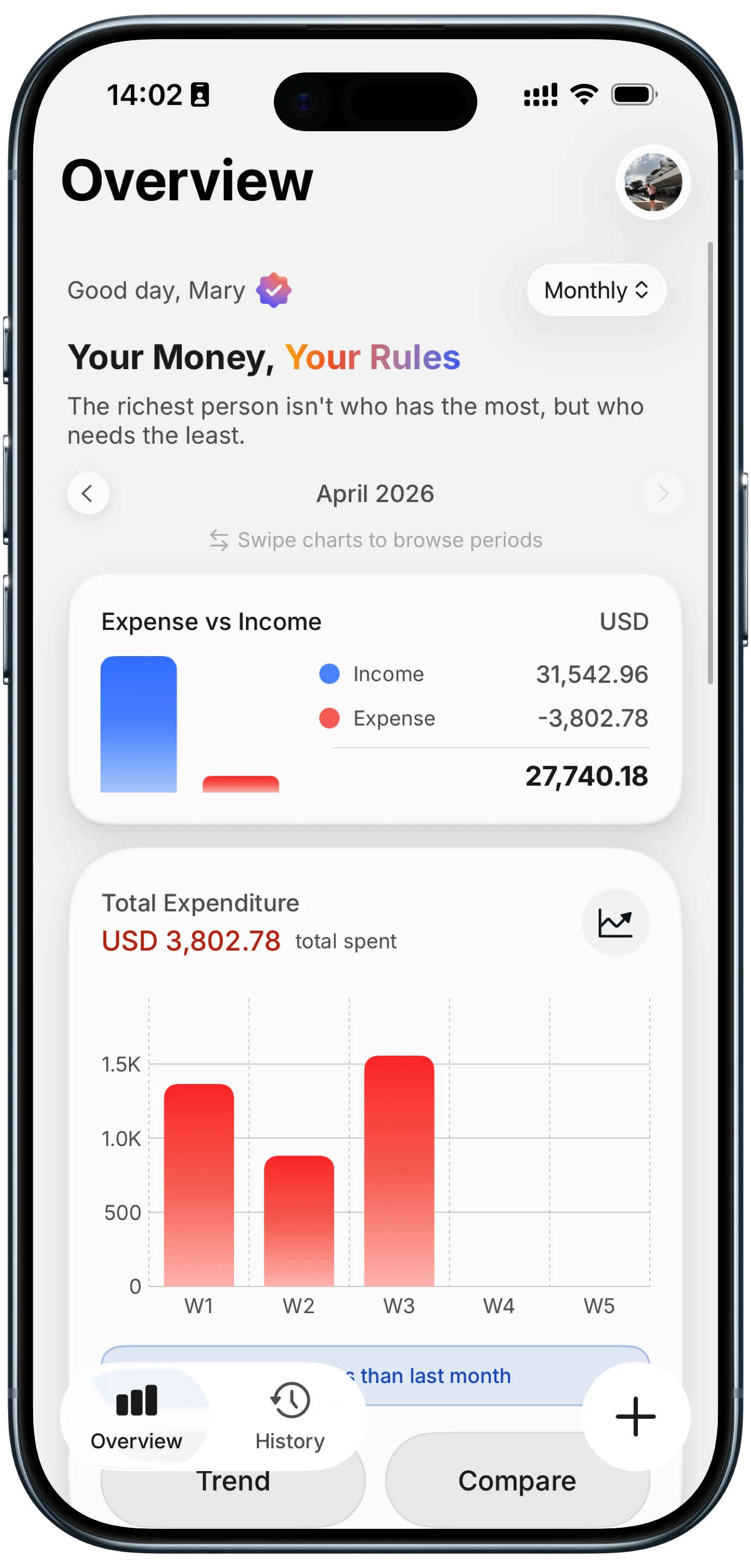
Finny app's Overview feature
Start by comparing what came in with what went out. In Finny, the Overview shows an Expense vs Income card and a Total Expenditure card that compares the current period to the last one, as in the "15% less than last period" figure above. A gap between income and expenses is money that can go toward the balance.
A few places that often free up cash in January:
- Subscriptions. Free trials started for holiday streaming, gaming, or shopping memberships quietly convert to paid plans. Run the subscription cost calculator to see what your recurring charges add up to per year, then cancel what you no longer use.
- Returns and unused gifts. Return what you can, and sell gift cards you will not use.
- A spending pause. Pick one category, such as takeout or online shopping, and pause it until the holiday balance is gone.
- Windfalls. A year-end bonus or a tax refund can wipe out a holiday balance in one payment.
Schedule the extra payment for the day your paycheck lands so it does not get absorbed into everyday spending.
A Worked Example: Paying Off $1,223 at 22.36% APR
To see what speed is worth, take LendingTree's average holiday debt of $1,223 and put it on a credit card at 22.36% APR. That rate is the average for credit card accounts assessed interest at commercial banks in the third quarter of 2026, from the Federal Reserve's G.19 release of November 6, 2026 (preliminary). At that rate, the first month alone adds about $23 in interest.
Here is how the monthly payment changes the outcome, assuming no new charges and interest applied monthly at one twelfth of the APR:
| Monthly payment | Months to pay off | Total interest |
|---|---|---|
| $50 | 33 | $424.70 |
| $100 | 15 | $177.84 |
| $150 | 9 | $115.95 |
| $250 | 6 | $71.62 |
At $50 a month, the holiday debt outlasts two more holiday seasons and costs about a third of the original balance in interest. At $250 a month, it is gone by early summer for about $72.
Now compare a balance transfer. At a 3% to 5% fee, moving $1,223 costs about $37 to $61 up front. If you were planning to pay $250 a month, the card interest would have been about $72, so the transfer saves only about $10 to $35. At $100 a month, card interest would be about $178, so the same fee saves noticeably more, provided the promotion outlasts the roughly 13 months you would need.
Real cards usually calculate interest daily, so your numbers will differ slightly.
How to Avoid Holiday Debt Next Year
The most reliable fix is to pay for next December before it arrives. A sinking fund does that: you divide the expected cost by the months left and set that amount aside on a schedule. If your holidays cost $1,200, that is $100 a month starting in January, or about $46 per biweekly paycheck. Our guide to what a sinking fund is and how to set one up covers the details.
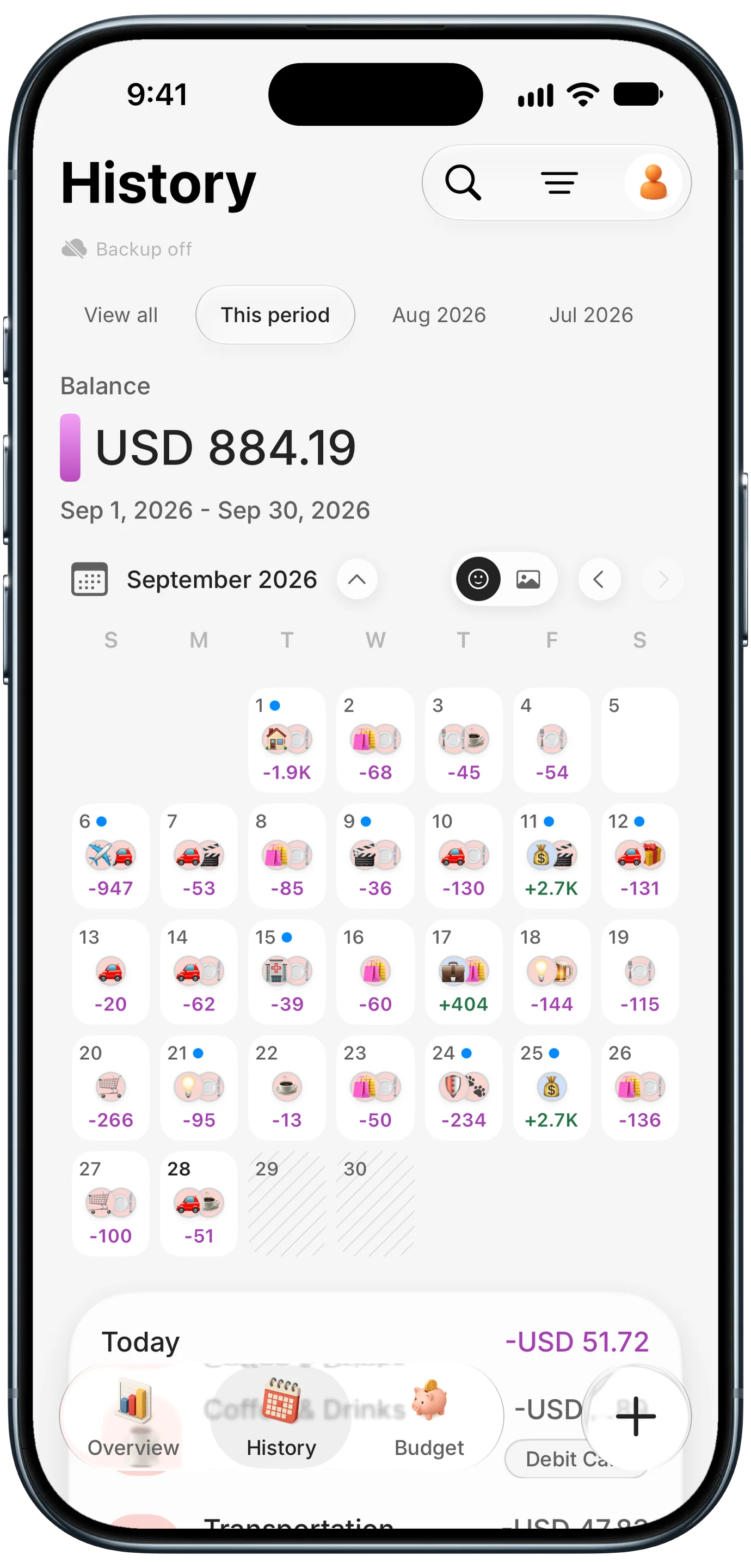
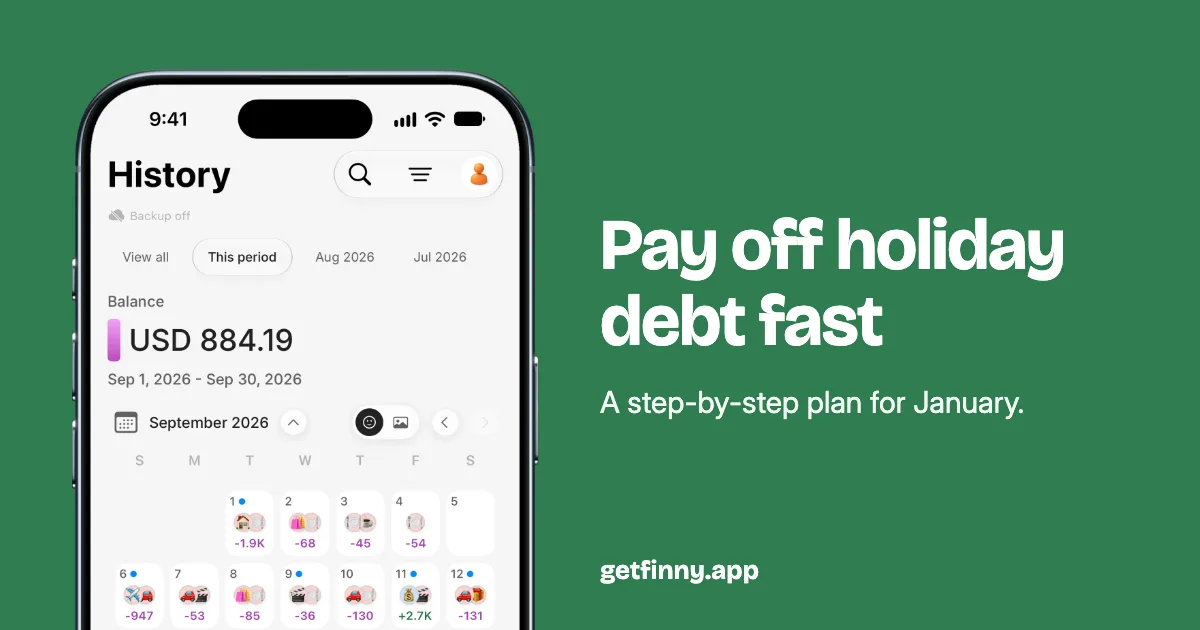
Finny app's History calendar feature
A sinking fund only works if you know what the holidays really cost you. Before the debt is paid off, go back through November and December and total everything: gifts, travel, food, decorations, and the BNPL plans. That number, not a guess, is your target for next year.
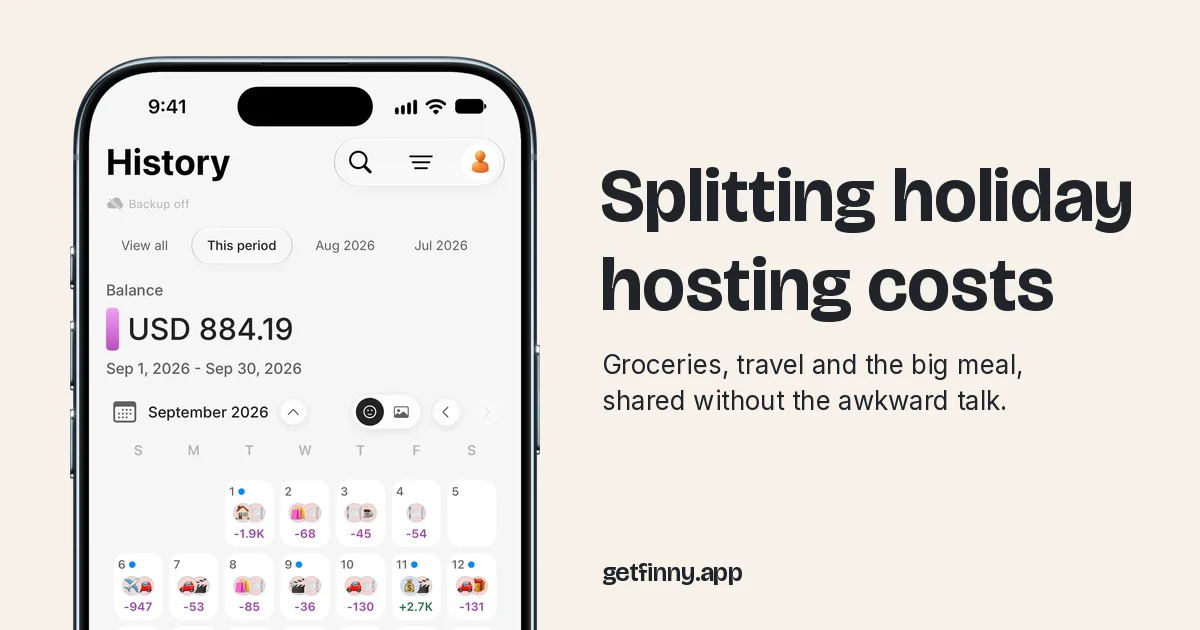
Then track the season as it happens. A calendar view like the one above, with each day's total and its category, makes a heavy shopping weekend obvious while you can still adjust. In Finny, card payments get logged as you make them, with no bank connection, so the running total stays current without end-of-month cleanup. For the full approach, see our holiday budget planner.
This short video shows card payments being logged as they happen:
Common Questions About Paying Off Holiday Debt
How long does it take to pay off holiday debt?
It varies with the balance and the payment. In LendingTree's December 2025 survey, 37% of people with holiday debt expected to pay it off in two months or less, while 63% expected it to take three months or longer. On an average $1,223 balance at 22.36% APR, paying $250 a month clears it in about six months, while paying $50 a month takes nearly three years.
Should I pay off holiday debt or save for an emergency fund first?
Many people do both: keep a small cash cushion so a surprise expense does not go back on a card, and send the rest toward the highest-cost balance. Card interest above 20% is hard for savings to outpace, but having no cushion at all can restart the cycle. The right split depends on your income stability and existing savings, so treat any rule of thumb as a starting point.
Is a balance transfer a good idea for holiday debt?
It can be, when the interest you would otherwise pay is clearly larger than the transfer fee and you can clear the full amount before the 0% period ends. Fees typically run 3% to 5% of the amount moved, per Experian. For a balance you can pay off within a few months, the fee may cost about as much as the interest it saves. It also requires good credit to qualify.
Do buy now, pay later plans charge interest?
Many pay-in-four plans charge no interest if you make every payment on time, though late fees can apply depending on the provider. Longer financing plans from the same companies can carry interest, so check each plan's terms. The bigger risk is overlap: several small plans pulling payments in the same week can squeeze your checking account and push other bills onto a card.
Ready to start the new year with your holiday spending in one place?
Download Finny to log expenses by typing or saying a plain sentence, or snapping a receipt, and see what December really cost so next year is planned ahead.