Average Grocery Bill for 2 People in 2026 (USDA Data)
A couple aged 19 to 50 who cook every meal at home would spend about $631 a month on groceries on USDA's Thrifty plan, $655 on the Low-Cost plan, $809 on the Moderate-Cost plan, and $1,009 on the Liberal plan. Those are the October 2026 figures from the USDA Food Plans, issued in November 2026, adjusted for a two-person household the way USDA recommends.
What couples actually spend is a little different. In the Bureau of Labor Statistics Consumer Expenditure Survey for 2025, released October 29, 2026, married couples living without children spent $6,890 a year on food at home, about $574 a month, plus another $392 a month eating out. So the average grocery bill for 2 usually lands somewhere between about $520 and $810 a month, depending on age, where you live, and how often you cook.
Below are the full tables, the one-person figures, and how to set and track a grocery budget together. For a step-by-step method, see how to budget for groceries.
Average Grocery Bill for 2 by USDA Food Plan
USDA publishes four food plans every month, each pricing a nutritious diet at a different cost level, and each assuming every meal and snack is prepared at home. Costs are listed per person for a four-person household, so USDA suggests adding 10 percent for two people. The table sums a man and a woman in the same age group and adds that 10 percent.
| USDA plan (October 2026) | Couple, 19 to 50 | Couple, 51 to 70 | Weekly, couple 19 to 50 |
|---|---|---|---|
| Thrifty | $631 | $570 | $146 |
| Low-Cost | $655 | $626 | $151 |
| Moderate-Cost | $809 | $779 | $187 |
| Liberal | $1,009 | $936 | $233 |
The Thrifty plan's age band is 20 to 50 rather than 19 to 50. Figures are rounded to the dollar.
The Thrifty and Low-Cost plans are close for a reason: USDA re-evaluated the Thrifty plan in 2021, while the other three still rest on 2001 to 2002 data updated with the Consumer Price Index, according to the report's notes. If you buy some convenience foods, fresh produce, and name brands, the Moderate-Cost plan is the more realistic benchmark. The Thrifty plan fits couples who cook from scratch and shop carefully.
Average Grocery Bill for One Person
Living alone costs more per person, so USDA suggests adding 20 percent for a one-person household. For one adult aged 19 to 50 in October 2026, that works out to:
| USDA plan (October 2026) | Woman, 19 to 50 | Man, 19 to 50 |
|---|---|---|
| Thrifty | $305 | $383 |
| Low-Cost | $332 | $382 |
| Moderate-Cost | $404 | $479 |
| Liberal | $516 | $584 |
The BLS survey shows real one-person households spending less on groceries and more on restaurants than the plans assume: $3,385 a year on food at home in 2025, about $282 a month, and $2,308 a year on food away from home, about $192 a month.
That gap makes sense: cooking for one often means more prepared food, more workday lunches out, and more waste. If your grocery bill is below the Thrifty figure but your restaurant spending is high, your total food spending may still top the Moderate-Cost plan. Our look at average daily spending shows how food fits alongside everything else.
What Couples Actually Spend on Groceries
The BLS survey's 2025 tables break real spending down by household type and size:
- Married couple, no children: $6,890 a year on food at home (about $574 a month) and $4,709 eating out (about $392 a month).
- Any two-person household: $6,249 a year on food at home (about $521 a month) and $4,188 eating out (about $349 a month).
- All households: $6,491 a year on food at home, up 4.3 percent from 2024. Spending on meats, poultry, fish, and eggs rose 11.7 percent, the biggest jump of any grocery category.
Why are these numbers lower than the USDA plans for a younger couple? Partly age: the average reference person in a married-couple-only household was 60 years old, and USDA's costs for adults aged 51 to 70 are lower than for younger adults on every plan. Partly eating out: couples spent more than $4,700 a year at restaurants, which replaces meals the USDA plans assume you cook. Add both together and married couples spent about $967 a month on food in total, which is above the Moderate-Cost grocery plan.
One caveat: BLS notes that the 2025 survey could not collect data in October and November 2025 because of the federal funding lapse, and it adjusted the weights to account for the missing months.
What Drives Your Grocery Bill Up or Down
Where you live. In 2025, the average household in the South spent $5,280 a year on food at home, while households in the Northeast and West spent about $7,450. That is roughly $180 a month apart, across households of all sizes.
How often you eat out. Restaurant meals and grocery bills move in opposite directions. A couple that cooks most nights has a higher grocery bill and usually a lower total food bill than one that orders in. Judge groceries alongside dining, never alone.
Diet and protein. Meat, seafood, and eggs drove most of the 2025 increase in grocery spending. Special diets, organic produce, and specialty products can push a couple from the Moderate-Cost toward the Liberal plan quickly.
Age and appetite. USDA's costs for men aged 19 to 50 are higher than for women in the same group on every plan, and costs dip slightly for ages 51 to 70. Two active adults in their twenties will usually spend more than a retired couple.
What counts as groceries. Many people buy toilet paper, cleaning supplies, and pet food at the grocery store. USDA's figures only cover food, so separate those items if you want a fair comparison.
How to Set a Grocery Budget for Two
Start from what you really spend, not from a number that sounds right, then adjust in small steps. Once you have a number, a budget with a visible limit keeps it honest.
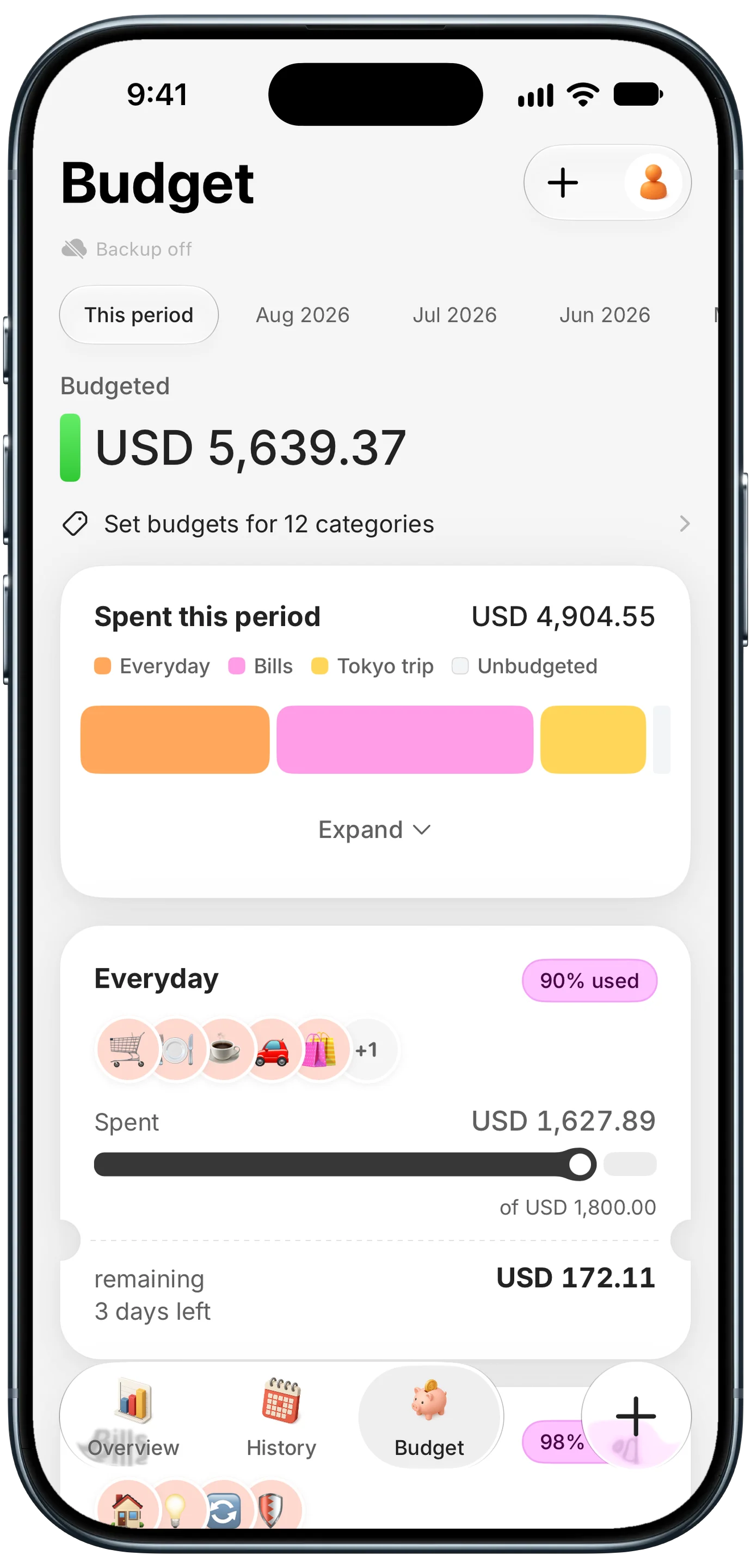
Finny app's Budgets feature
In the Budget tab above, three budgets run side by side and the Everyday budget is already at 90 percent used: the cue to cook from the pantry for the rest of the period.
- Add up the last two or three months. Pull grocery totals from statements or your tracker, including warehouse clubs and delivery apps.
- Pick a benchmark. Compare your average to the USDA table above. If you sit between two plans, aim for the lower one as a stretch goal.
- Agree on what is included. Decide together whether household supplies, alcohol, and pet food sit inside the grocery budget or outside it.
- Turn it into a weekly number. Divide the monthly budget by 4.33, the same factor USDA uses, so a $700 month becomes about $162 a week.
- Decide who pays. A joint card, a shared account, or taking turns all work. Our guides to joint vs separate accounts and splitting bills fairly on different salaries can help.
- Review once a month. Check the total, talk about anything surprising, and adjust.
8 Ways to Lower Your Grocery Bill for Two
- Plan meals around what you have. Check the fridge and pantry first, and build a few dinners around ingredients that need using up.
- Shop with a list, once a week. Every extra trip is a chance for unplanned purchases.
- Compare unit prices. The price per ounce on the shelf tag makes bigger packs and store brands easy to compare.
- Buy store brands for staples. For staples like flour, rice, canned tomatoes, and frozen vegetables, many shoppers cannot tell the difference.
- Cook for leftovers on purpose. Cooking for four turns tomorrow's lunch into a planned meal instead of takeout.
- Go easy on the priciest protein. Since meat, fish, and eggs led the 2025 increase, try beans, lentils, or cheaper cuts a few nights a week.
- Use frozen and in-season produce. Frozen produce lasts longer, and in-season produce is usually cheaper.
- Track waste for a month. Note what you throw away. You will likely spot one or two items you reliably overbuy.
How to Track Groceries Together
Many couples do not shop on one shared card. One person does the weekly shop, the other grabs milk on the way home, and nobody knows the total until the statements arrive. Logging both sides in one place is what makes a budget for two work. Our guide to tracking spending as a couple covers routines that stick.
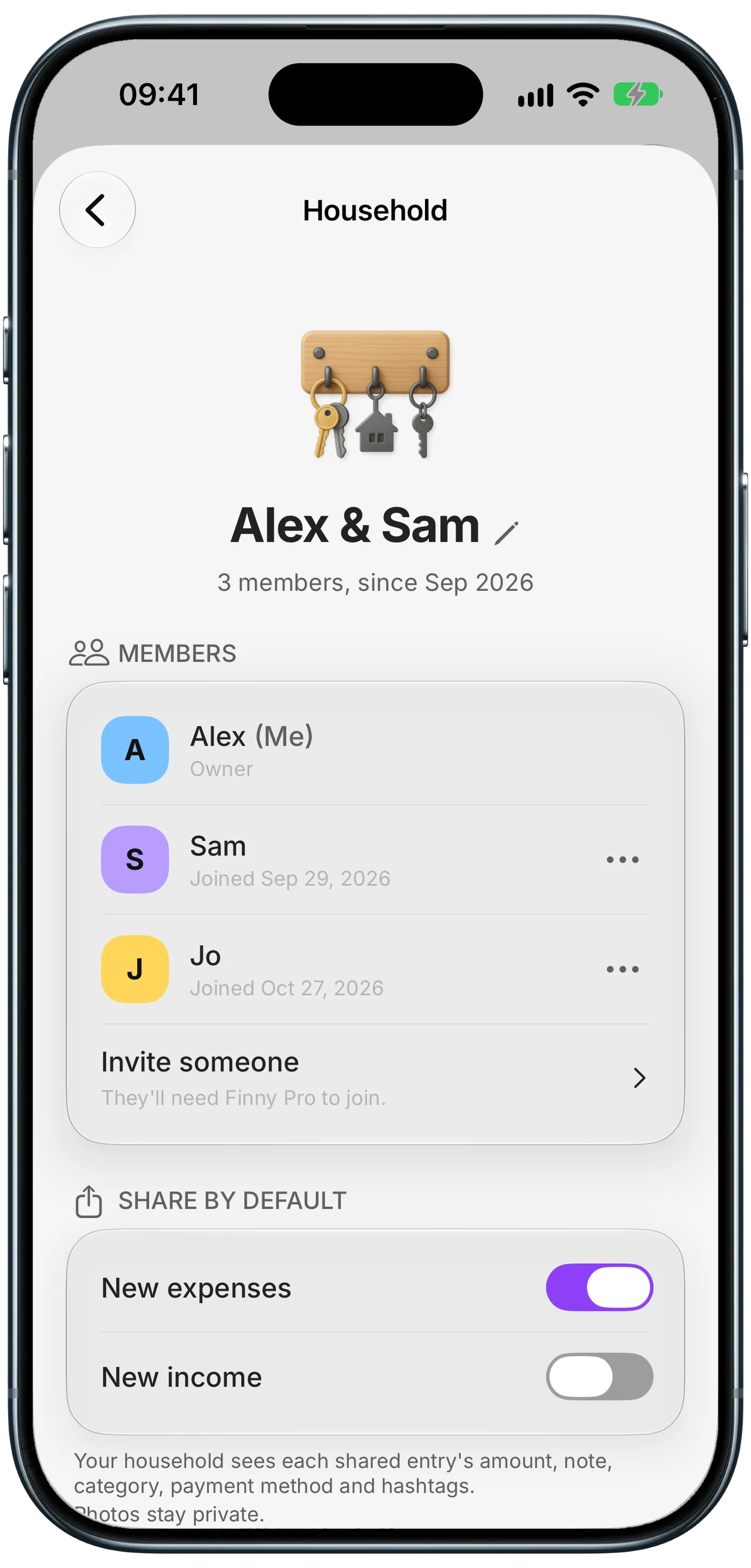
Finny app's Households feature
In Finny, Households lets you and your partner (up to 6 people in all) share the grocery entries you choose. Each shared entry shows who logged it, and only the person who logged an expense can edit it. Photos and anything you do not share stay private. On the Household screen above, a household called Alex & Sam has three members, an Invite someone option, and switches that share new expenses by default while keeping new income private.
At the end of the month, search for your grocery category and the top of the results shows a receipt-style total in your home currency, with a line for each payment method when more than one card was used. Finny shows who paid for what but does not calculate who owes whom. Households is part of Finny Pro, and everyone in it needs Pro. The full walkthrough is in our Finny Households guide.
This short video shows Households in action:
Common Questions About Grocery Costs for Two
Is $500 a month enough for groceries for 2?
It can be, but it is tight. $500 is below USDA's October 2026 Thrifty plan for a couple aged 19 to 50 ($631) and close to what the average two-person household spent on food at home in 2025 (about $521 a month, per BLS). Couples who manage it usually cook from scratch, lean on beans, grains, and frozen produce, and move some meals to the restaurant budget.
How much should a couple spend on groceries per week?
Based on USDA's October 2026 food plans, a couple aged 19 to 50 would spend about $146 a week on the Thrifty plan, $151 on Low-Cost, $187 on Moderate-Cost, and $233 on Liberal. Those figures include USDA's suggested 10 percent adjustment for a two-person household and assume every meal is cooked at home. If you eat out often, your grocery number can be lower than this.
How much does one person spend on groceries a month?
USDA's October 2026 plans put one adult aged 19 to 50 at roughly $305 to $584 a month, depending on the plan and whether you are a man or a woman, including the suggested 20 percent adjustment for living alone. In practice, one-person households spent about $282 a month on food at home in 2025, according to BLS, plus about $192 a month on food away from home.
Do USDA food plans include eating out?
No. USDA states that all four food plans assume every meal and snack is prepared at home. That is why they work well as a grocery benchmark but understate total food spending for most households. Couples in the 2025 BLS survey spent around $392 a month at restaurants on top of groceries, so compare your grocery and dining budgets together, not just the grocery line.
Want to see your grocery bill for two without a spreadsheet?
Download Finny to log groceries by text, receipt scan, or card payments as you make them, and share the household ones with your partner. No bank login needed.