Is Quicken Simplifi Safe? 2026 Security Review
Quicken Simplifi asks for the same thing every bank-synced budgeting app asks for: the login to your checking account, your credit cards and often your investment accounts. In return it pulls in your transactions every night, sorts them into categories and builds a spending plan around what it finds. That trade is convenient, and it is also a reasonable thing to pause over.
So is Quicken Simplifi safe? Short answer: yes, in the ordinary sense. Simplifi uses 256-bit encryption, a one-way bank connection that cannot move money, and verification codes at sign-in, and it comes from a company that has been handling personal finance data since the 1980s. The more useful questions are what Quicken does with your data, how the bank connection really works, and how often that connection breaks. This review covers all three. If you are still deciding whether to try it at all, our Quicken Simplifi review covers the features and our Quicken Simplifi free trial guide explains how the money-back window works.
Who Makes Simplifi: Quicken's Background
Simplifi is not a startup product. It comes from Quicken, one of the oldest names in personal finance software. Quicken began as an Intuit product in the 1980s and spent decades as the default desktop money manager for American households.
In 2016, Intuit sold Quicken to an affiliate of the private equity firm H.I.G. Capital, and the company became independent. Under H.I.G., Quicken moved to a subscription-only model. Simplifi launched in 2020 as a cloud-based, mobile-first app aimed at people who never used the desktop software. In 2021, H.I.G. sold Quicken to another private equity firm, Aquiline Capital Partners, which owns it today.
So Simplifi comes from a company with decades of experience handling bank connections, not a fly-by-night app that could vanish with your information. It is also owned by private equity and funded by subscriptions, which shapes the incentives covered in the privacy section.
One point of confusion worth clearing up: Quicken is not Quicken Loans. The mortgage lender, now Rocket Mortgage, is a completely separate company. Data incidents reported under the Quicken Loans name have nothing to do with Simplifi.
How Simplifi Protects Your Data
Quicken's security claims for Simplifi are standard for the category, though they are spread across several pages rather than one security page.
Encryption. Quicken's account-connection page describes 256-bit encryption for data on its servers and in transit, the same standard banks and most fintech apps use.
Sign-in verification. Simplifi uses your Quicken ID. When you sign in, Simplifi's help center says you may be asked for a 6-digit verification code sent by email or text, or read to you by phone call for a landline. Each code expires quickly and a new request cancels the old one. The help center does not document an authenticator app option, and Simplifi community threads show users asking for one. Text and email codes are better than a password alone, but they are weaker than an authenticator app because a hijacked phone number or email inbox can intercept them.
Where data lives. Your financial data is stored on Quicken-hosted servers, which is how the web and phone apps stay in sync.
What we could not find. Quicken does not publish a SOC 2 report, a public bug bounty or a detailed Simplifi security whitepaper that we could locate. That does not mean the controls are absent. It means you are taking the "advanced security measures" language on trust, while some competitors (Monarch, for example, as covered in our Monarch Money safety review) point to an independent audit.
How the Bank Connection Works
Simplifi's support article describes a one-way connection: data comes into Simplifi, but Simplifi cannot change your transactions or balances. It cannot move money, pay bills from your account or initiate transfers. Even if someone got into your Simplifi account, they could read your finances but could not drain them.
The connection runs through an aggregation partner. You give Simplifi the same username and password you use on your bank's website, and the partner stores those credentials in encrypted form so it can log in on your behalf. Updates typically run nightly, outside business hours, so do not be alarmed by overnight login activity in your bank's security log. That is the aggregator checking for new transactions.
There is a wrinkle in Quicken's own wording. Its marketing page says your login credentials are "never stored or shared," while the Simplifi support article says the aggregation partner stores them encrypted. The most charitable reading is that Quicken itself does not hold your bank password and the partner does. Either way, a third party holds it.
Quicken says it works with the top three aggregators but does not name them in its documentation. In Simplifi's community forum, staff have said Intuit is the default aggregator, with Finicity and Plaid used for a small number of connections.
Does Quicken Sell Your Data?
Quicken's US privacy statement (last updated September 4, 2025) says that, except as described in the statement, it will not sell, publish or share information that identifies you without your permission. The exceptions are where the detail lives.
Under the statement, Quicken can share personal information with its corporate parent and affiliates, and with service providers such as hosting and analytics companies. It can use your data to advertise its own products and its partners' products. It can also create de-identified data and share it with third parties for its business purposes.
Quicken's California privacy page goes further. Under California's broad definition of a "sale," Quicken lists two kinds of sharing it has re-categorized as selling: IP addresses and hashed email addresses passed to advertising partners, and potential sharing of personal information with credit card and bank partners to offer you products. Quicken provides an opt-out link for that sharing, and the opt-out is worth using if it bothers you.
To keep this in proportion: nothing in the policy says Quicken sells your transaction history to data brokers. The advertising sharing is mostly about knowing you are a customer. But it is a step looser than apps that say flatly they never share data for marketing. Our finance app security and privacy guide explains how to read these policies across the category.
Breach History and Notable Incidents
We found no reported breach of Simplifi itself as of late October 2026.
The closest event involving Quicken Inc. dates to February 2021, when the company sent incident notices that were filed with the Maine Attorney General. According to the notice, the issue sat with a third-party vendor, and Quicken stated that neither its software nor any Quicken-operated technology was affected. Public trackers put the number of people involved in the hundreds, not the millions, and Quicken said it corrected the vulnerability.
That record is reassuring for a company that has handled financial data for decades. It also shows where risk tends to sit in this category: less in the app itself than in the chain of vendors and aggregators around it. Every bank-synced app depends on partners you never see, and a problem at any link in that chain can involve your information. The most useful thing you control is your own account: give your Quicken ID a unique password, and secure the email address that receives its sign-in codes.
Connection Reliability: The Practical Risk
For most Simplifi users, the realistic downside is not stolen data. It is a budget built on transactions that quietly stopped arriving.
Simplifi's community forum shows a steady pattern of bank-specific outages through 2026. In February, Chase connections across both Quicken Classic and Simplifi went down until Quicken marked them resolved on February 11. In spring, Golden 1 Credit Union users hit a connection error (FDP-105) that stayed open for months, with one user reporting about 95 days without a sync. In May, Farm Credit Services of America blocked connections and users were told to retry days later.
None of these are security failures, and Monarch, Copilot and YNAB all have their own bad-sync stretches. But they matter in a practical sense: a spending plan that thinks you have more room than you do can push you into an overdraft.
If you use Simplifi, check the "last updated" time on each account weekly, and keep your bank's own app as the source of truth for balances. If your bank is small or regional, test the connection during the money-back window before you pay for a year. Our Quicken Simplifi pricing breakdown covers what renewal costs after the first-year promotion ends.
What You Give Up by Not Linking a Bank
Simplifi does let you skip linking. You can create manual accounts and import transactions from a CSV file using its template. The help center notes that some banks only let you download about 90 days of history, and community threads report quirks, such as a CSV that can only be imported into an account once.
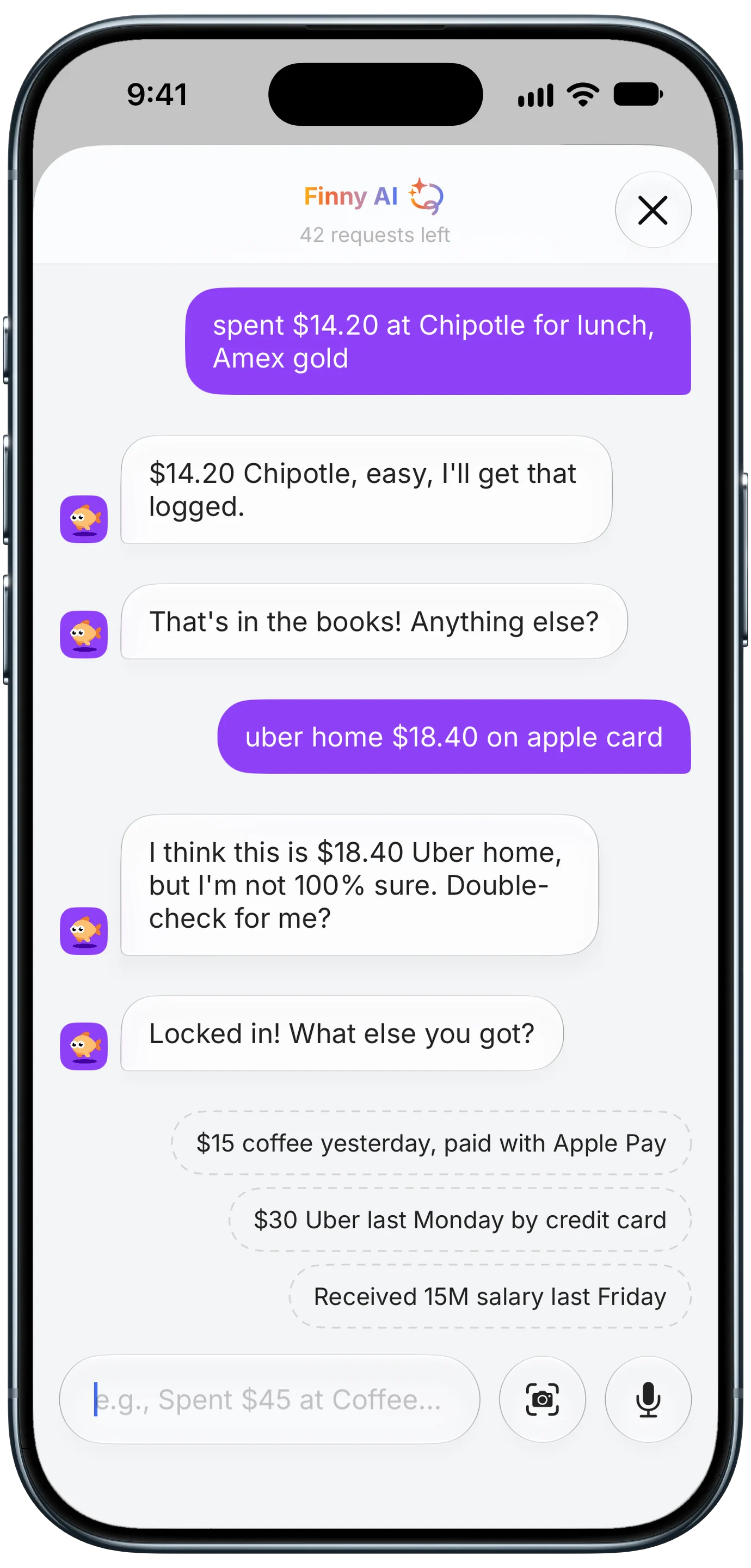
Finny app's AI chat feature
In practice, though, Simplifi is designed around the bank feed. Its spending plan, projected cash flow and automatic categorization all assume transactions arrive on their own. Run it on manual entry and you are paying for automation you are not using, while typing every purchase into an interface that was not built to make typing fast.
If you want to avoid the bank connection entirely, an app built for that works better. In Finny, you can type a sentence like "chipotle 14.20 on the apple card" into the AI chat and it becomes a categorized entry, as the screen above shows, and when a detail is unclear it asks you to double-check. AI input is part of Finny Pro, which costs a low monthly or yearly price, while the free tier covers unlimited manual entry, budgets with rollover, recurring reminders and charts. Our guide to tracking expenses without linking your bank walks through the whole approach.
Who Should Feel Fine, and Who Should Skip
Simplifi is a reasonable choice for most people. Here is how the risks line up:
| Concern | What Simplifi does | What it means for you |
|---|---|---|
| Can it move money? | No, one-way connection | Worst case is exposure, not theft from your account |
| Encryption | 256-bit, in transit and on servers | Industry standard |
| Sign-in protection | 6-digit codes by email, text or call | Better than a password, weaker than an authenticator app |
| Bank password | Stored encrypted by an aggregation partner | A third party holds your credentials |
| Data sharing | Affiliates, ad partners, de-identified data | California opt-out available |
| Reliability | Bank-specific outages, sometimes for months | Check account update times weekly |
Simplifi suits you if you want a full picture of checking, credit and investment accounts in one place, you are comfortable with aggregator connections, and your banks are large enough to connect reliably.
Consider skipping the bank link if you do not want a third party holding your bank password, you would rather not have advertising partners know you are a customer, or your bank is the kind of small institution that shows up in outage threads. In that case, an app built around fast capture removes the aggregator from the picture entirely.
The No-Bank-Link Route
Finny is built for people who land on the "skip" side of that list. There is no bank connection on any plan, so there is no password for an aggregator to store, no nightly login to your bank and no transaction feed to break. With Pro, Tap to Track logs card payments as you make them.
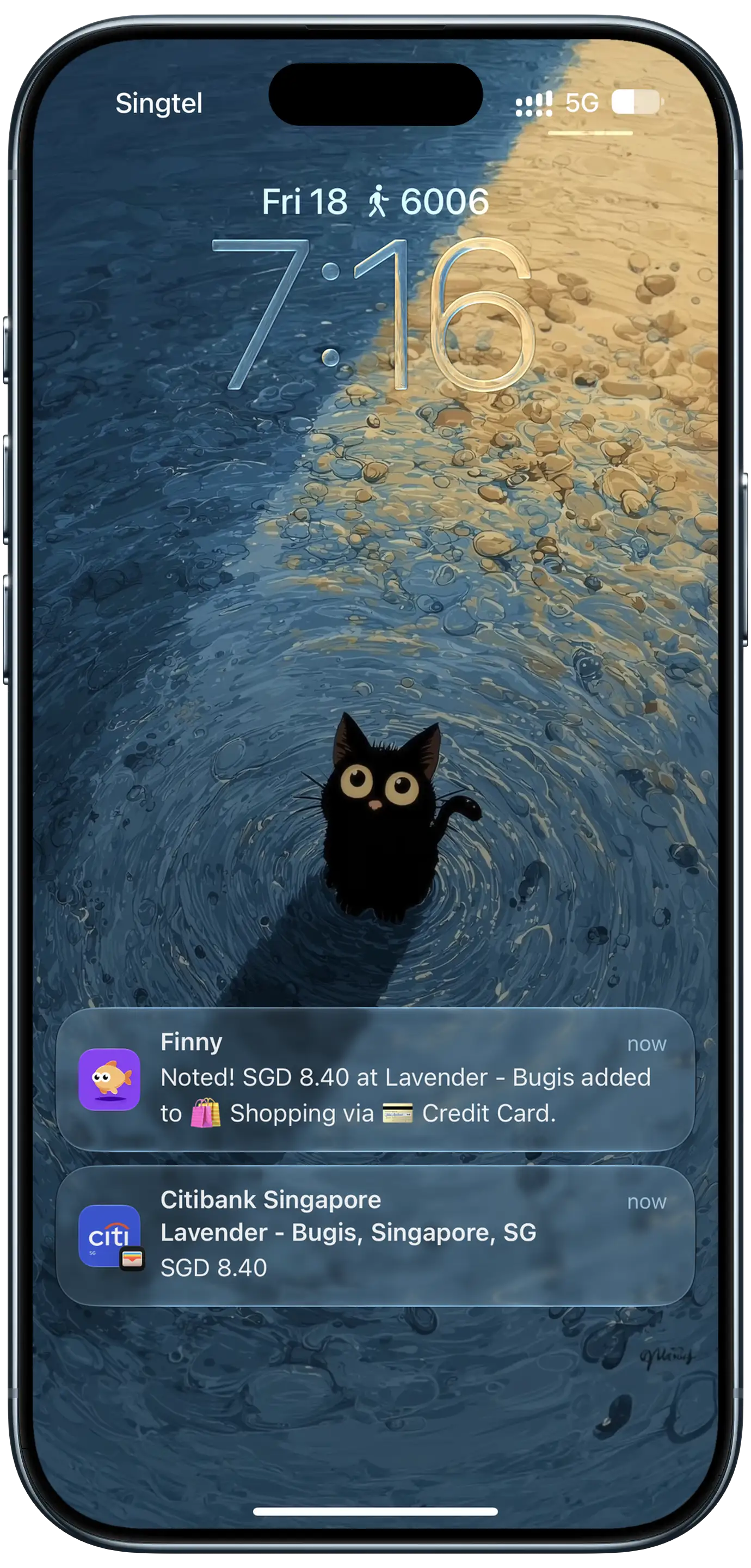
Finny app's Tap to Track feature
The screen above shows how that looks in practice: your bank's own payment alert arrives, and Finny's "Tracked!" confirmation appears right under it with the amount already logged. Your bank never talks to Finny, and Finny never sees your bank login.
The tradeoffs are real. Finny is an expense tracker, not a net worth dashboard, so it will not pull in your 401(k) or brokerage balances the way Simplifi does. Cash still gets entered by you, and because nothing is linked, Finny cannot discover a charge you never logged. In exchange, no third party ever holds your bank credentials, and the app itself sits behind Face ID or a PIN.
This short video shows card payments being logged automatically without any bank connection:
Common Questions About Quicken Simplifi Safety
Is Quicken Simplifi legit?
Yes. Simplifi is made by Quicken, a personal finance software company that started inside Intuit in the 1980s and has been independent since 2016. It is owned by Aquiline Capital Partners and funded by subscriptions. Simplifi has been on the market since 2020, connects to more than 14,000 financial institutions, and has no reported breach of its own. It is a real, established product, not a scam or a fly-by-night app.
Can Quicken Simplifi access or move my money?
No. Simplifi uses a one-way connection that imports transactions and balances but cannot make changes to your accounts. It cannot initiate transfers, pay bills or withdraw funds. If someone broke into your Simplifi account, they could see your financial data but could not move money through Simplifi. Your bank login is held in encrypted form by an aggregation partner, which uses it to refresh your accounts each night.
Does Quicken sell my Simplifi data?
Quicken's privacy statement says it will not sell or share information that identifies you without permission, except as the statement describes. Those exceptions include sharing with affiliates and service providers, advertising partners and de-identified data. Its California disclosures list IP addresses and hashed emails going to ad partners, plus potential sharing with card and bank partners. Nothing says it sells your transaction history, and an opt-out is available.
Does Simplifi have two-factor authentication?
Simplifi sign-in uses your Quicken ID and can ask for a 6-digit verification code sent by email, text or phone call. That adds a second step beyond your password. The help center does not document authenticator app support, which is the stronger option many security-minded users prefer. To reduce risk, protect the email account and phone number tied to your Quicken ID with their own strong security.
What is a safer alternative to Quicken Simplifi?
If your concern is the bank connection itself, the safest option is an app that never links one. Finny, for example, works without any bank connection on every plan, so there are no credentials for an aggregator to store. The tradeoff is that you capture spending yourself, with AI input and automatic card logging on Pro, instead of receiving a nightly feed from your bank.
Want a budget that never asks for your bank password?
Download Finny and start free, with no account and no bank connection required. Pro adds AI input and automatic card logging for a low monthly or yearly price, with a 3-day free trial.