Monarch Money vs Quicken Classic 2026: Which Wins?
Search for "Monarch vs Quicken" and you get two different arguments tangled together, because Quicken sells two very different products. Quicken Simplifi is a modern web and mobile app. Quicken Classic is the desktop software that has been around since the late 1980s, and it still runs on your own computer with a local data file.
This comparison covers Monarch Money vs Quicken Classic specifically: the desktop product with the local file, not Simplifi. They are built on opposite philosophies, so the right answer depends less on features and more on whether you want your financial history living in the cloud or on your own hard drive. If you meant the other product, read our Monarch vs Quicken Simplifi comparison instead.
Which Quicken Are You Actually Comparing?
This is worth ninety seconds, because picking the wrong one wastes a year of subscription.
Quicken Classic is installed software for Windows and Mac. Your data lives in a file on your machine. It handles investment lots, rental property, business income, and decades of transaction history. There is a companion mobile app, but the desktop program is the product.
Quicken Simplifi is cloud-first, mobile-friendly, and much simpler. No local file, no investment lot tracking, far less depth.
Monarch is cloud-first like Simplifi but aimed higher: collaborative household budgeting, net worth tracking, and a cleaner interface than anything Quicken ships.
If you want lot-level cost basis and Schedule E categories, only Quicken Classic does that. If you want your partner budgeting alongside you on a phone, Quicken Classic is the wrong tool.
Pricing: Watch the Renewal Rate, Not the Intro Price
| Monarch | Quicken Classic Deluxe | Quicken Classic Premier | |
|---|---|---|---|
| Monthly | $14.99 | about $5.99, billed annually | about $7.99, billed annually |
| Annual | $99.99 | about $71.88 | about $95.88 |
| First-year promo | occasional | frequent and steep | frequent and steep |
| Platform | Web and mobile | Windows and Mac desktop | Windows and Mac desktop |
| Data location | Cloud | Local file on your machine | Local file on your machine |
The headline numbers mislead. Quicken advertises aggressive first-year discounts, sometimes close to half off, and then renews at the list price. People sign up comparing a promotional $35 against Monarch's $99.99 and renew the following year at $71.88 or more, which is a very different comparison. Before you commit, check the renewal rate on the specific tier you are buying.
Monarch's pricing is flatter and easier to predict. Our Monarch pricing breakdown has the full tier detail, including where the Premium tier does and does not earn its cost.
Prices here were accurate at the time of writing and both companies adjust them, so verify before you buy.
Budgeting Models Are Genuinely Different
Monarch uses flexible category budgets with rollover. You set a monthly target per category, overspending shows clearly, and unused amounts can carry forward. It is forgiving and it suits variable income.
Quicken Classic offers budgeting too, but budgeting is not really why people run it. Quicken Classic is a ledger first. Its strength is a complete, reconciled, decades-long record of every transaction, matched against statements, with reports you can slice by tax category. If you have ever reconciled a checking account to the cent, that is the Quicken worldview.
That difference decides most purchases. Ask whether you want a forward-looking plan or a backward-looking record. Monarch is better at the plan. Quicken Classic is better at the record.
Investments, Property, and Taxes
This is where Quicken Classic is genuinely hard to replace.
Quicken Classic Premier tracks individual investment lots with cost basis, handles dividend reinvestment, and produces capital gains estimates you can hand to an accountant. It supports rental property with Schedule E categories in the Home and Business tier. It exports to TurboTax.
Monarch tracks investment balances and net worth over time, and it does that well and attractively. It does not do lot-level cost basis. For a household with a taxable brokerage account and an accountant asking for a gains report, that gap matters. For someone whose investments sit in a 401k and an index fund they never sell, it does not matter at all.
Sync Reliability and the Local File Question
Both connect to banks, and both inherit the same industry problem: connections break when institutions change their systems.
Monarch's failures are visible and fixable in the app. Quicken Classic's failures can be more frustrating because the desktop product supports several connection methods with different reliability, and diagnosing which one your bank uses is not obvious.
The local file cuts both ways. Nobody can read your Quicken data on a server because there is no server, which is a real privacy advantage. But you own the backups. A dead hard drive with no backup is a lost financial history, and people do lose decades this way.
Mobile and Everyday Logging
Monarch's mobile app is a genuine part of the product. Quicken Classic's companion app is a window onto the desktop file, and it shows.
That gap matters more than feature lists suggest, because the actual work of personal finance is capturing spending as it happens. Cash at a farmers market, a card tap at lunch, a split bill: none of it reaches a desktop ledger unless something captures it in the moment.
Finny app's Overview feature
Both apps solve this by connecting to your bank and importing transactions. That works, and it is also why both require handing over bank credentials through an aggregator.
The Third Option: Skip the Bank Connection
There is a category neither product occupies: tracking that never touches your bank login at all.
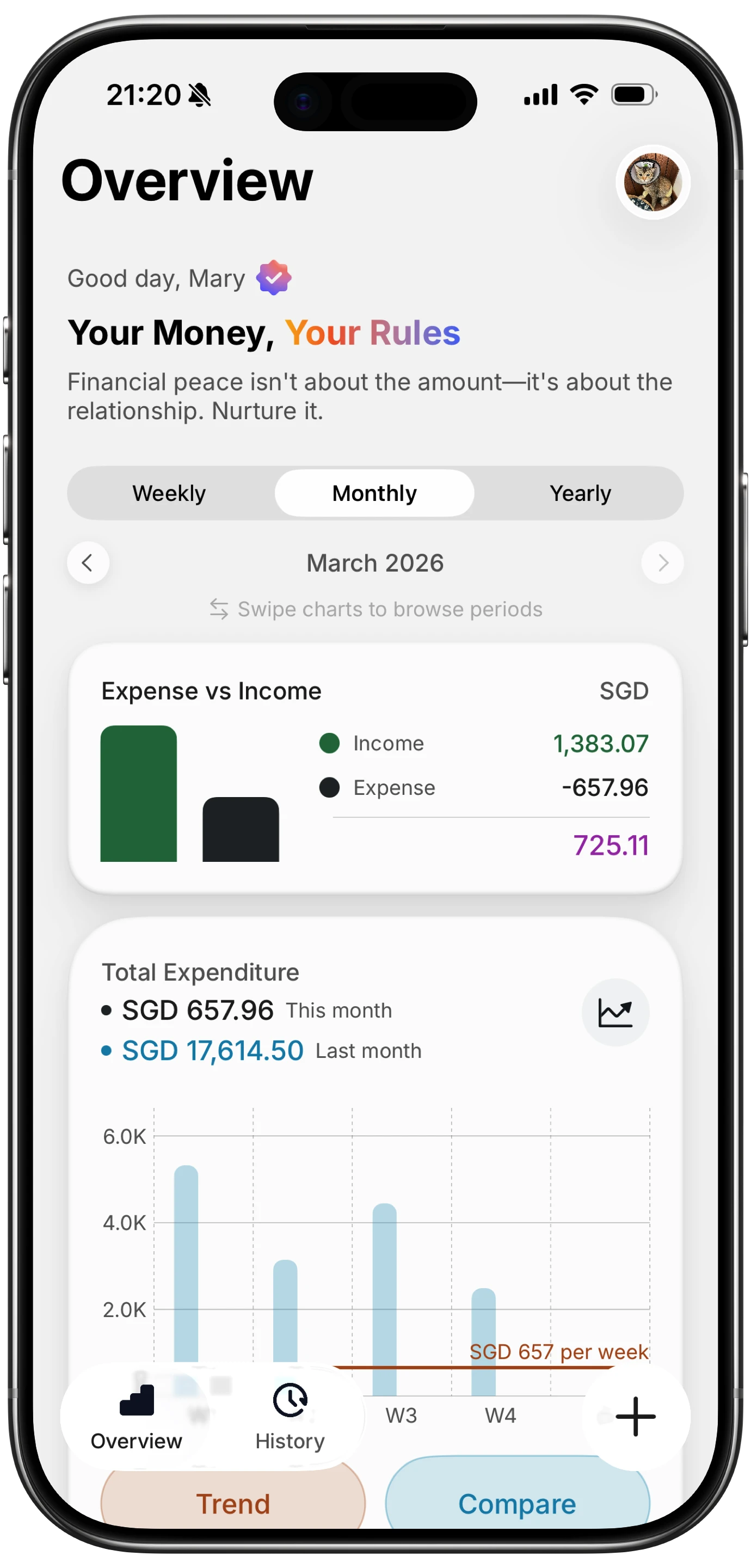
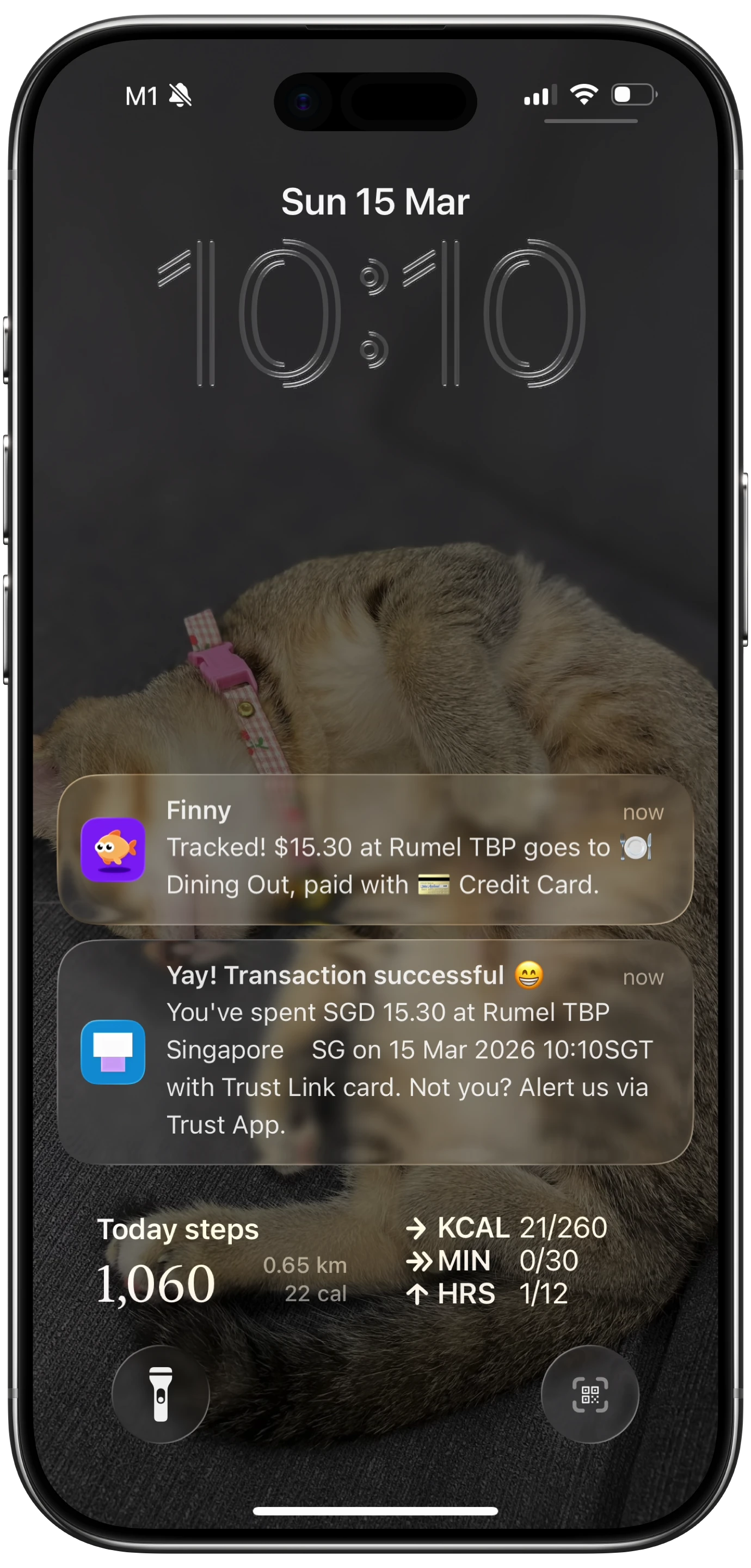
Finny takes that approach. Card payments get logged as you make them, receipts get captured from your photo library, and expenses can be entered by text or voice, all without a bank connection. It will not reconcile a decade of investment lots, and it is not trying to. It covers the part Quicken Classic handles worst, which is capturing spending the moment it happens on a phone.
Finny app's Tap to Track feature
This short video shows how card spending gets captured without linking an account:
If the bank connection itself is your hesitation, we compared the options in tracking expenses without linking a bank.
Who Each One Is For
Choose Quicken Classic if you have a taxable brokerage account with lots to track, own rental property, run a small business through your personal finances, or already have years of Quicken history you do not want to abandon. Also choose it if you would rather your financial data never sit on someone else's server.
Choose Monarch if you budget with a partner, want a plan rather than a ledger, care about the interface, and want the same experience on a laptop and a phone. Our Monarch review covers where it holds up over months of use, and is Monarch Money safe covers the security model.
Choose neither if the friction you actually feel is logging day-to-day spending rather than analyzing it. Both products assume a bank connection does the capturing.
The Bottom Line
Quicken Classic wins on depth, tax reporting, and data ownership. Monarch wins on usability, shared household budgeting, and not requiring a desktop computer to exist.
The mistake to avoid is comparing Quicken's promotional first-year price against Monarch's regular price. Compare renewal to renewal. Once you do, roughly $72 to $96 a year for Quicken Classic against $99.99 for Monarch is close enough that price should not decide it. Let the local file versus the cloud decide it, because that is the difference you will still be living with in five years.
Common Questions About Monarch vs Quicken Classic
Is Quicken Classic the same as Quicken Simplifi?
No. Quicken Classic is desktop software for Windows and Mac that stores your data in a local file and supports investment lots, rental property, and tax reporting. Quicken Simplifi is a separate cloud-based app with a simpler feature set and no local file. They share a brand and nothing else. Most people searching "Monarch vs Quicken" want one or the other specifically, so confirm which product a comparison is describing before trusting its conclusions.
Which is cheaper, Monarch or Quicken Classic?
Quicken Classic Deluxe is cheaper at roughly $71.88 a year against Monarch's $99.99, and Premier narrows the gap to about $95.88. The catch is promotional pricing: Quicken frequently discounts the first year heavily and renews at list. If you compare an introductory Quicken price against Monarch's standard price you will misjudge the difference by a wide margin. Compare renewal rates.
Can Monarch replace Quicken Classic for investment tracking?
Only partly. Monarch tracks investment account balances and shows net worth over time, which covers most households. It does not track individual investment lots or cost basis, so it cannot produce the capital gains reporting Quicken Classic Premier generates. If you sell individual securities in a taxable account and your accountant expects a gains report, Monarch alone will not cover it.
Is my data safer in Quicken Classic or Monarch?
They fail differently. Quicken Classic keeps your data in a local file, so there is no cloud database to breach, but you are responsible for backups and a lost drive means a lost history. Monarch stores data in the cloud with encryption and multi-factor authentication, which protects against local loss but places trust in a provider. Neither removes the underlying risk of connecting bank credentials through an aggregator.
Ready to track expenses with less friction?
Download Finny to log expenses using AI, receipts, or text. No bank connections, offline support, and full control over your financial data.