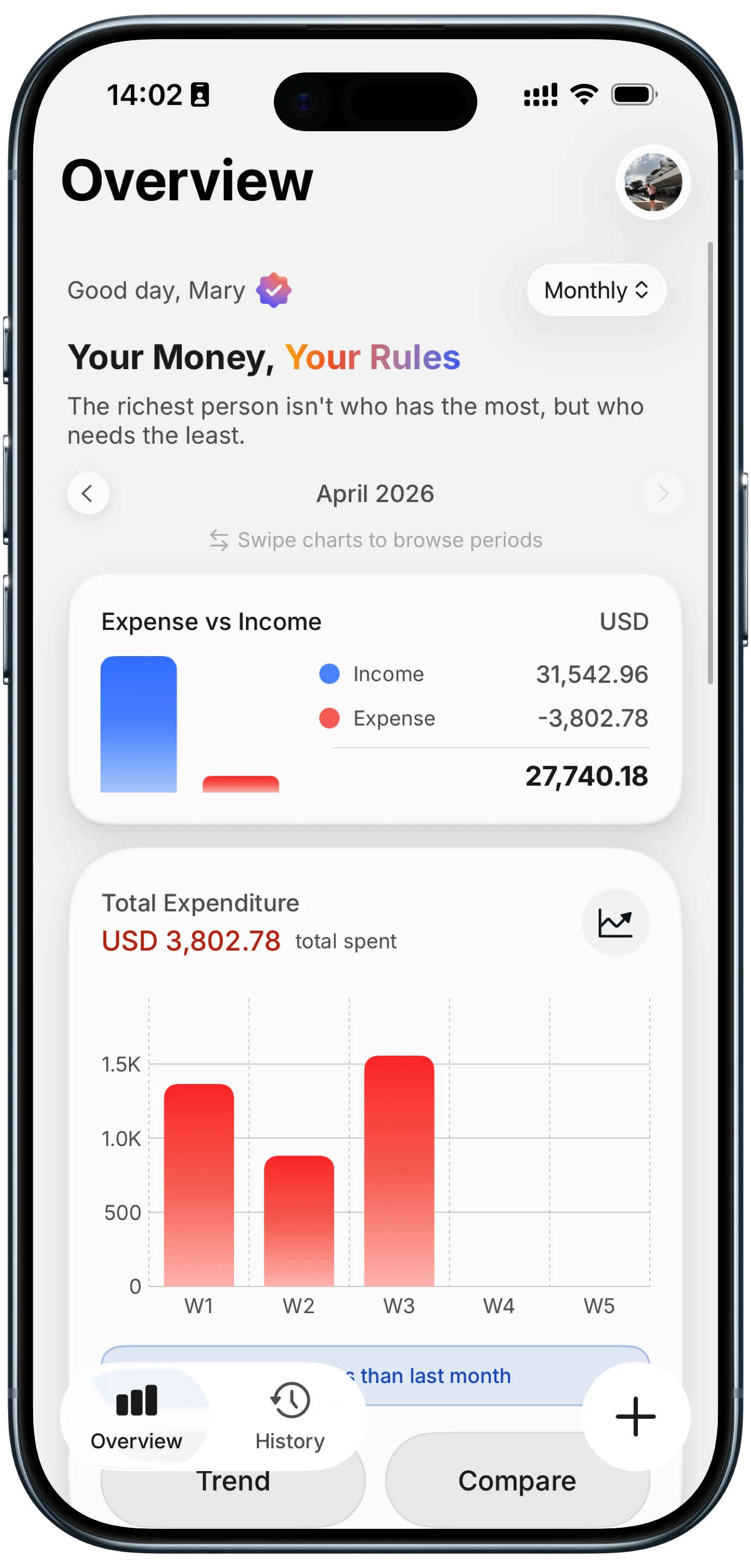
Is YNAB Safe? 2026 Security and Privacy Review
YNAB (You Need A Budget) asks for something many people hesitate over: a live connection to the checking account and credit cards you use every day. The budgeting method is famous, but a good method does not tell you what happens to your transaction history once it leaves your bank.
So is YNAB safe? Short answer: yes, by the standards of the industry. YNAB encrypts your data, offers two-step verification, uses read-only bank connections through Plaid and MX, runs a public bug bounty, and is funded by subscriptions rather than by selling your data. Below we cover each point, what bank sync actually grants, and how to use YNAB without linking a bank at all. For the bigger picture across the category, see our finance app security and privacy overview.
How YNAB Protects Your Account
YNAB's security setup is what you would expect from a mature, paid finance app.
Encryption. YNAB says all traffic between you and its servers uses bank-grade encryption, and that it forces an encrypted connection in your browser. Balances, transactions, and holdings imported from your bank are encrypted both in transit and at rest. Its public security page does not name a specific cipher.
Two-step verification. YNAB has offered optional two-step verification for years. Once it is turned on in Account Settings, signing in needs a code from an authenticator app in addition to your password. It is off by default, so turn it on.
Bug bounty and audits. YNAB runs a public vulnerability disclosure program on Bugcrowd, with payouts listed from $150 to $3,000 per valid finding. YNAB also publishes a trust center listing internal controls such as restricted access to encryption keys. Its security page mentions SOC 2, though it is not clear whether that report covers YNAB itself or its hosting providers.
Which Bank Connection Providers Does YNAB Use?
YNAB calls its bank sync feature Direct Import, and it does not build those connections itself. It works through regulated data aggregators.
In the US and Canada, YNAB uses Plaid and MX. YNAB's help center says your connection uses whichever of the two is performing best for your bank at the time, so your account may sit on either provider and can move between them.
In the UK and Europe, YNAB now uses Plaid. YNAB originally launched European Direct Import in 2021 through TrueLayer. In January 2025 it announced that TrueLayer was retiring coverage for a number of countries and that it was moving European connections to Plaid. Some banks, including several in Poland, Austria, Belgium, and Lithuania, lost coverage in that switch.
YNAB says it never sees or stores your bank password. You enter credentials into the aggregator's login flow, not into YNAB. Many large banks use OAuth, where you approve access on the bank's own website and no password is shared at all.
What Access Does YNAB Bank Sync Grant?
This is the part that matters most.
The connection is read-only. Direct Import can pull account balances and transactions into your budget. It cannot move money, pay bills, or initiate transfers. If someone broke into your YNAB account, they could see your spending, but they could not empty your checking account through YNAB.
The aggregator holds an ongoing link. Read-only does not mean one-time. Plaid or MX keeps a persistent connection to your bank so new transactions keep flowing in. That data is governed by the aggregator's own privacy policy, not only YNAB's. Disconnecting the account inside YNAB stops future imports, and Plaid's consumer portal lets you revoke the link itself.
Third-party apps can get access too. YNAB has a public API, and lots of community tools use it. Any app you authorize can read your budget data, and unless it requests the read-only scope, it can write to it as well.
Shared budgets widen the circle. A YNAB subscription can be shared with up to six people. Everyone you invite can see the full budget, so a shared household budget is only as private as the least careful person on it.
Does YNAB Sell Your Data or Show Ads?
YNAB's business model is simple: you pay $14.99 per month or $109 per year (see our YNAB pricing breakdown for the trial and student discount). There are no in-app ads.
YNAB says it does not sell your financial data. Its privacy policy states that it does not, under any circumstances, sell the information you provide through the product or share it for cross-context behavioral advertising.
There is one nuance worth knowing. YNAB does run targeted advertising to find new customers. Its policy acknowledges that this marketing, which can involve sharing website analytics, device identifiers, or a hashed email address with ad platforms, may count as a "sale" or "sharing" under broad state privacy laws such as California's. That concerns how YNAB advertises itself, not your budget or transactions, and YNAB offers an opt-out form for it.
Has YNAB had a data breach? We found no publicly reported breach of YNAB's systems as of October 2026. A 2019 Krebs on Security article mentioned YNAB alongside Plaid, Yodlee, and Mint in a piece about criminals abusing aggregation services, but that story was about account takeovers caused by reused bank passwords, not a compromise of YNAB itself.
The Residual Risks
None of this should alarm most people, but "safe" comes with a few honest caveats.
- Your data lives in the cloud. YNAB is a cloud service, so your budget sits on its servers and syncs across devices. You depend on YNAB's security, not your phone's.
- More parties, more exposure. With Direct Import, at least three organizations touch your data: your bank, the aggregator, and YNAB.
If those trade-offs bother you, the fix is not necessarily to drop YNAB. It is to change how you feed it data.
How to Use YNAB More Safely
You can keep the YNAB method and cut most of the exposure. A few steps make a real difference.
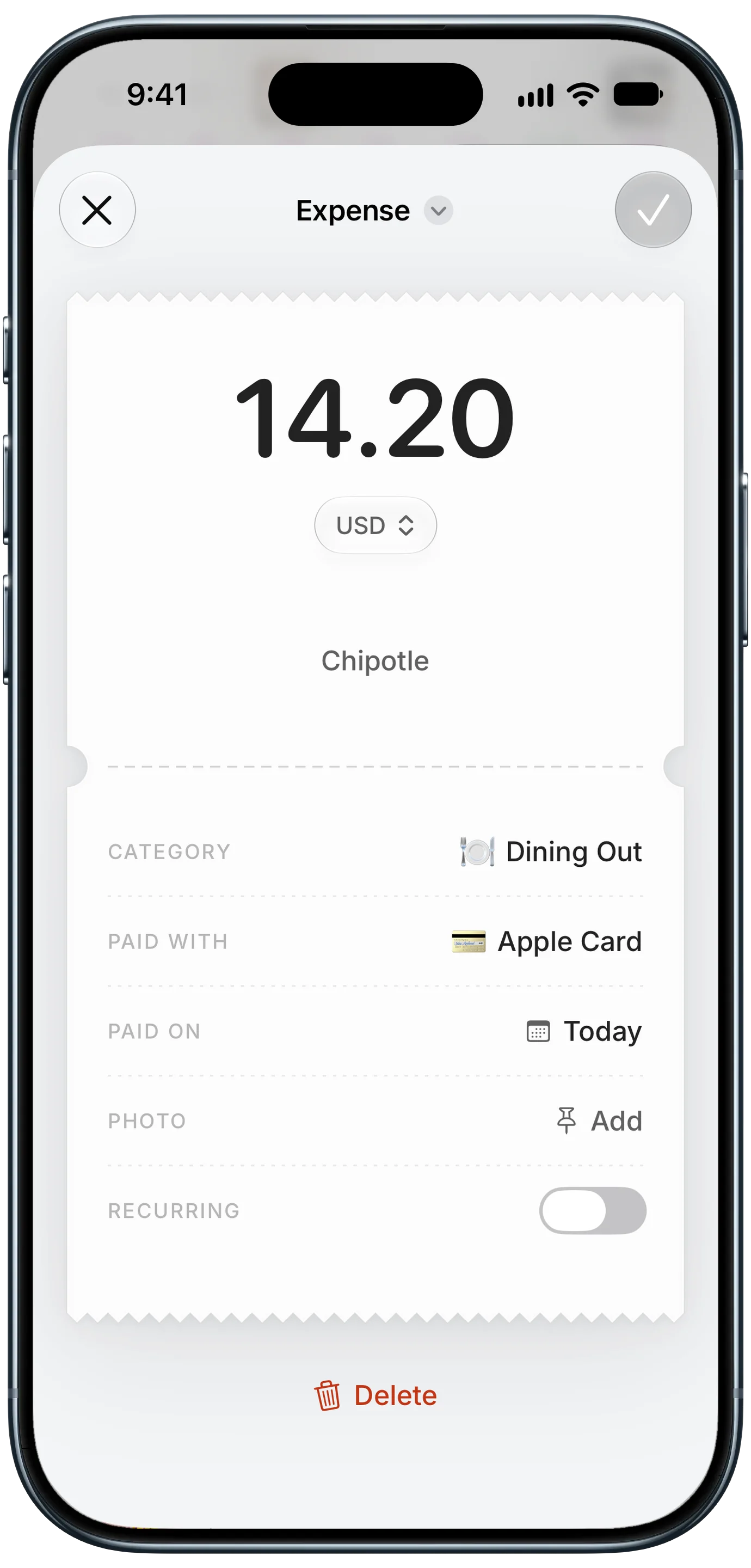
Finny app's expense entry feature
Start with these:
- Turn on two-step verification in Account Settings and use a unique password stored in a password manager.
- Use unlinked accounts. When you add an account, choose to track it without connecting a bank. You type transactions in yourself, which many YNAB veterans argue is better for the method anyway, since every purchase gets a moment of attention.
- Use File-Based Import instead of Direct Import. Download a CSV, QFX, OFX, or QIF file from your bank and import it in the YNAB web app or on an iPad. No aggregator ever gets a connection. File import is not available on iPhone or Android, so this is a desktop or iPad routine.
- Audit connected apps that use the YNAB API, and revoke anything you do not recognize.
- Check Plaid's consumer portal if you ever linked accounts, and remove old connections you no longer need.
The trade-off is a few minutes a week. Our guide to tracking expenses without linking a bank covers routines that keep that effort small.
YNAB Alternatives That Need No Bank Login
If the real goal is to budget without handing any company a bank connection, a few apps are built that way from the start. Our full best expense trackers with no bank login roundup goes deeper, and best YNAB alternatives covers the wider field.
| App | Price (Oct 2026) | Bank link required | Where data lives | Best for |
|---|---|---|---|---|
| YNAB | $14.99/mo or $109/yr | No (optional) | YNAB cloud | Zero-based budgeting with optional sync |
| Goodbudget | Free; paid plan around $10/mo or $80/yr | No (manual only) | Goodbudget cloud | Envelope budgeting for couples |
| Actual Budget | Free, open source | No (optional) | Your own server or device | Self-hosters who want YNAB-style budgets |
| Finny | Free; Pro a low monthly or yearly price | No (never) | Your device and your iCloud | Fast, private iPhone expense tracking |
Goodbudget
Goodbudget is a digital envelope system with no bank sync at all. You fill envelopes each month and record spending by hand, and a partner can share the same envelopes. The paid plan was around $10 a month or $80 a year at the time of writing.
Actual Budget
Actual Budget is a free, open-source, local-first budgeting app that borrows heavily from the YNAB method. You can run it on your own server so your data never touches a company's cloud. Bank sync is optional and off unless you set it up.
Finny
Finny is an iPhone expense tracker that never asks for a bank login. Instead of syncing accounts, it makes logging fast: Tap to Track logs card payments as you make them, Screen Log captures a payment showing on your screen, and you can also type or speak an expense or scan a receipt. Photos and entries stay on your device and in your own iCloud, not on Finny's servers.
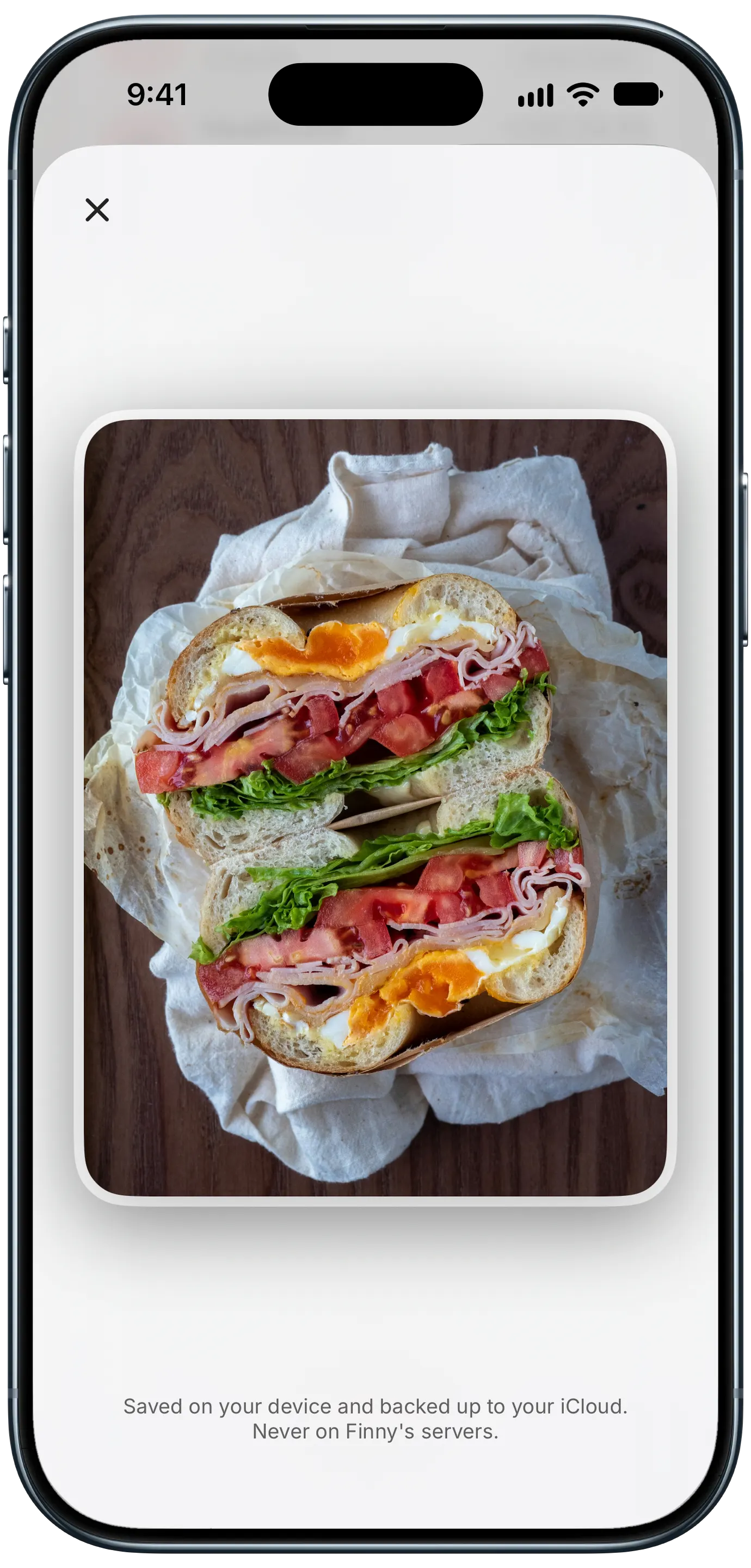
Finny app's private photo storage feature
Here is Screen Log recording a payment straight from the screen, with no bank connection involved:
It is not a zero-based budgeting tool, so if the YNAB method is what you love, keep YNAB and use unlinked accounts. If you mainly want to know where your money goes, a lighter tracker does the job with less exposure.
The Bottom Line
YNAB is a legitimate, well-run company with sensible security: encryption in transit and at rest, optional two-step verification, read-only bank access through Plaid and MX, a paid bug bounty, and a subscription model that does not depend on your data. We found no reported breach of its systems.
The real question is how much of your financial life you want flowing through a cloud service and an aggregator. If you are comfortable with that, turn on two-step verification. If not, use unlinked accounts and file imports, or pick an app that never asks for a bank login in the first place.
Common Questions About YNAB Safety
Is it safe to link my bank to YNAB?
For most people, yes. YNAB's Direct Import connects through Plaid or MX with read-only access, so it can see balances and transactions but cannot move money. YNAB says it never sees or stores your bank password, and many banks use OAuth so you approve access on the bank's own site. The trade-off is that an aggregator keeps an ongoing connection to your account, so you are trusting two companies instead of one. If that bothers you, use unlinked accounts or file imports.
Does YNAB sell my data?
No. YNAB's privacy policy says it does not sell the information you provide through the product, including financial data, or share it for cross-context behavioral advertising. It is funded by subscriptions, not ads. The one nuance is marketing: YNAB runs targeted ads to find new customers, which can involve sharing website analytics or a hashed email with ad platforms, and state privacy laws may label that a "sale." YNAB provides an opt-out form for it.
Has YNAB ever been hacked?
We found no publicly reported breach of YNAB's systems as of October 2026. A 2019 security article named YNAB among aggregation-connected apps that criminals targeted, but that was about account takeovers caused by people reusing bank passwords, not a compromise of YNAB. YNAB runs a public bug bounty on Bugcrowd and posts outages and sync problems on its status page. Turning on two-step verification is still the best protection for your own account.
Can I use YNAB without connecting my bank?
Yes. When you add an account, you can choose to track it without linking a bank and enter transactions by hand. You can also download CSV, QFX, OFX, or QIF files from your bank and use File-Based Import in the YNAB web app or on an iPad, which is not available on iPhone or Android. Both options keep Plaid and MX out of the picture entirely, at the cost of a few minutes of manual work each week.
Does YNAB use Plaid or TrueLayer?
YNAB uses Plaid and MX in the US and Canada, choosing whichever performs best for your bank. In Europe and the UK, YNAB originally used TrueLayer, but in January 2025 it announced a move to Plaid after TrueLayer retired coverage for several countries. Reviews that still say YNAB relies on TrueLayer predate the change.
Want to track spending without giving any app access to your bank?
Download Finny to log expenses by text, voice, receipt scan, or as you pay. No bank connections, offline support, and a low-cost Pro tier.