Best Budgeting Apps 2027: 9 Apps Compared by Real Cost
Picking a budgeting app for the new year often ends with a subscription you forgot about by March. The market has also shifted: prices went up, new tiers appeared, and a few free apps quietly stopped being free.
This guide to the best budgeting apps 2027 compares nine apps that are actively maintained as of October 2026, with prices checked at the time of writing. If you are setting up a fresh budget for January at the same time, our new year budget reset guide walks through the method side.
How We Picked These Apps
We started from the apps people actually search for and switch between, then cut anything shut down or too niche. Mint closed in 2024, so it does not appear here; our best Mint alternatives guide covers its closest replacements.
Each app was judged on five things:
- Real annual cost: what you pay over a year on the cheapest sensible plan, not a first-year promo.
- Budgeting method: whether the app teaches a method or simply reports spending.
- Bank sync: whether it imports transactions, and whether it works without a bank connection.
- Platforms: iPhone only, Apple only, or Android and web too. This matters for couples on different phones.
- Daily friction: how long it takes to log, categorize, and check where you stand on an ordinary Tuesday.
We did not rank on feature count. Prices are US prices as listed in October 2026 and can change, so confirm them before subscribing.
Best Budgeting Apps 2027 at a Glance
| App | Price (US) | Free option | Bank sync | Platforms | Best for |
|---|---|---|---|---|---|
| YNAB | $14.99/mo or $109/yr | 34-day trial | Yes | iOS, Android, web | Zero-based budgeting with coaching |
| Monarch Money | $14.99/mo or $99.99/yr | 7-day trial | Yes | iOS, Android, web | Households and net worth |
| Copilot Money | $13/mo or $95/yr | Trial | Yes | iPhone, iPad, Mac, web | Apple users who want automation |
| Rocket Money | Free, Premium about $7 to $14/mo | Free plan | Yes | iOS, Android, web | Subscription cleanup |
| Quicken Simplifi | From $3.99/mo billed yearly (promo) | 30-day refund | Yes | iOS, Android, web | Low-cost bank-linked spending plan |
| EveryDollar | Free, Premium $17.99/mo or $79.99/yr | Free plan | Premium only | iOS, Android, web | Ramsey-style zero-based budgets |
| Goodbudget | Free, Premium $10/mo or $80/yr | Free plan | Premium only (US) | iOS, Android, web | Envelope budgeting, shared households |
| PocketGuard | $12.99/mo, $74.99/yr, or $149.99 lifetime | 7-day trial | Yes | iOS, Android, web | One "safe to spend" number |
| Finny | Free, Pro at a low monthly price | Free plan | No (by design) | iOS | Private, fast manual tracking |
The full-featured bank-linked apps cluster around $95 to $110 a year. The apps with a genuine free plan either skip bank sync or make money elsewhere, such as Rocket Money's bill negotiation fees.
The 9 Best Budgeting Apps for 2027
YNAB: Best for Zero-Based Budgeting
YNAB (You Need A Budget) is built around one rule: give every dollar a job before you spend it. You assign income to categories, and when you overspend one, you move money from another. That deliberate friction is the point.
It syncs with US banks, works on iPhone, Android, and the web, and lets a household share one subscription. Its workshops and guides are the best in the category.
The cost is the catch. At $14.99 a month or $109 a year, YNAB is the most expensive app on this list, and there is no free plan after the 34-day trial. College students can usually get a free year. See our YNAB pricing breakdown for the details, or the full YNAB review for how it holds up in daily use.
Best for: People who want a strict method and will actually use it every week.
Monarch Money: Best for Households and Net Worth
Monarch became the default landing spot for former Mint users. It pulls in checking, credit cards, loans, and investments, then layers budgets, net worth, and goals on top. Shared access for a partner is included, which makes it one of the stronger budgeting apps for couples.
The Core plan costs $14.99 a month or $99.99 a year after a 7-day trial, and a pricier Plus tier adds deeper investment and business reporting that most households do not need. There is no free plan. Our Monarch Money review covers the AI assistant and where sync can stumble.
Best for: Couples and families who want every account in one dashboard.
Copilot Money: Best for Apple Users Who Want Automation
Copilot is the most polished bank-linked app for iPhone, iPad, and Mac, and it now has a web app too. Its categorization learns from your corrections, so after a few weeks most transactions land in the right place on their own.
It costs $13 a month or $95 a year after the trial. There is no Android app, which is awkward for mixed-phone couples. Read our Copilot Money review for a closer look at the design and the annual cost.
Best for: Apple households that want a hands-off, bank-synced tracker.
Rocket Money: Best for Finding and Canceling Subscriptions
Rocket Money started as a subscription canceler and grew into a budgeting app. The free plan links accounts, lists recurring charges, and tracks basic spending. Premium uses a pay-what-you-think-is-fair slider, typically $7 to $14 a month, and adds unlimited budgets, net worth, and cancellation help.
Bill negotiation is optional and separate: when it lowers a bill, it keeps a share of the first year's savings, usually 35% to 60%. Our Rocket Money pricing guide breaks down each fee, and the Rocket Money review covers how well the budgeting side works.
Best for: People whose main problem is subscriptions they forgot about.
Quicken Simplifi: Best Low-Cost Bank-Linked Option
Simplifi uses a "spending plan": it takes your income, subtracts bills and savings goals, and shows what is left to spend. It syncs with banks and works on iPhone, Android, and the web.
It is the cheapest full bank-linked app here, but only on annual billing. Promotional pricing has run at around $3.99 a month billed yearly ($47.88 for the first year), and the standard rate at renewal has been quoted at roughly $6 to $7 a month billed yearly. There is no free plan, though a 30-day money-back guarantee lets you test it. See our Quicken Simplifi review before committing.
Best for: Anyone who wants Monarch-style automation for roughly half the price.
EveryDollar: Best for Ramsey-Style Budgets
EveryDollar, from Ramsey Solutions, is a clean zero-based budget builder. The free version lets you plan a monthly budget and log transactions by hand.
Premium adds bank connections, automatic imports, and paycheck planning for $17.99 a month or $79.99 a year, after a 14-day trial. Our EveryDollar pricing guide compares the two tiers.
Best for: People following the Baby Steps who want a simple zero-based plan.
Goodbudget: Best for Envelope Budgeting
Goodbudget is a digital version of the cash envelope system. The free plan gives you 20 envelopes, one account, and sync on two devices, with no time limit, which works well for partners on separate phones.
Premium costs $10 a month or $80 a year, lifts the limits, and now adds automatic bank sync for US accounts. Free users enter transactions by hand or import a bank file. Details are in our Goodbudget pricing guide, and the method itself is explained in what is envelope budgeting.
Best for: Beginners who like visual limits and couples sharing one budget.
PocketGuard: Best for a Single "Safe to Spend" Number
PocketGuard reduces budgeting to one question: how much can I spend right now? It links your accounts, subtracts upcoming bills and goals, and shows the remainder.
PocketGuard Plus costs $12.99 a month, $74.99 a year, or $149.99 once for lifetime access. Its long-running free tier has largely given way to a 7-day trial, so older lists that call it free are out of date. Our PocketGuard pricing guide explains what Plus includes.
Best for: People who want a quick daily check, not a detailed plan.
Finny: Best for Private Tracking Without a Bank Link
Finny never connects to your bank. Instead, it makes manual tracking fast enough to keep up with: type or say an expense in plain language, scan receipts, or let card payments get logged as you make them. Budgets show how much of each limit you have used.
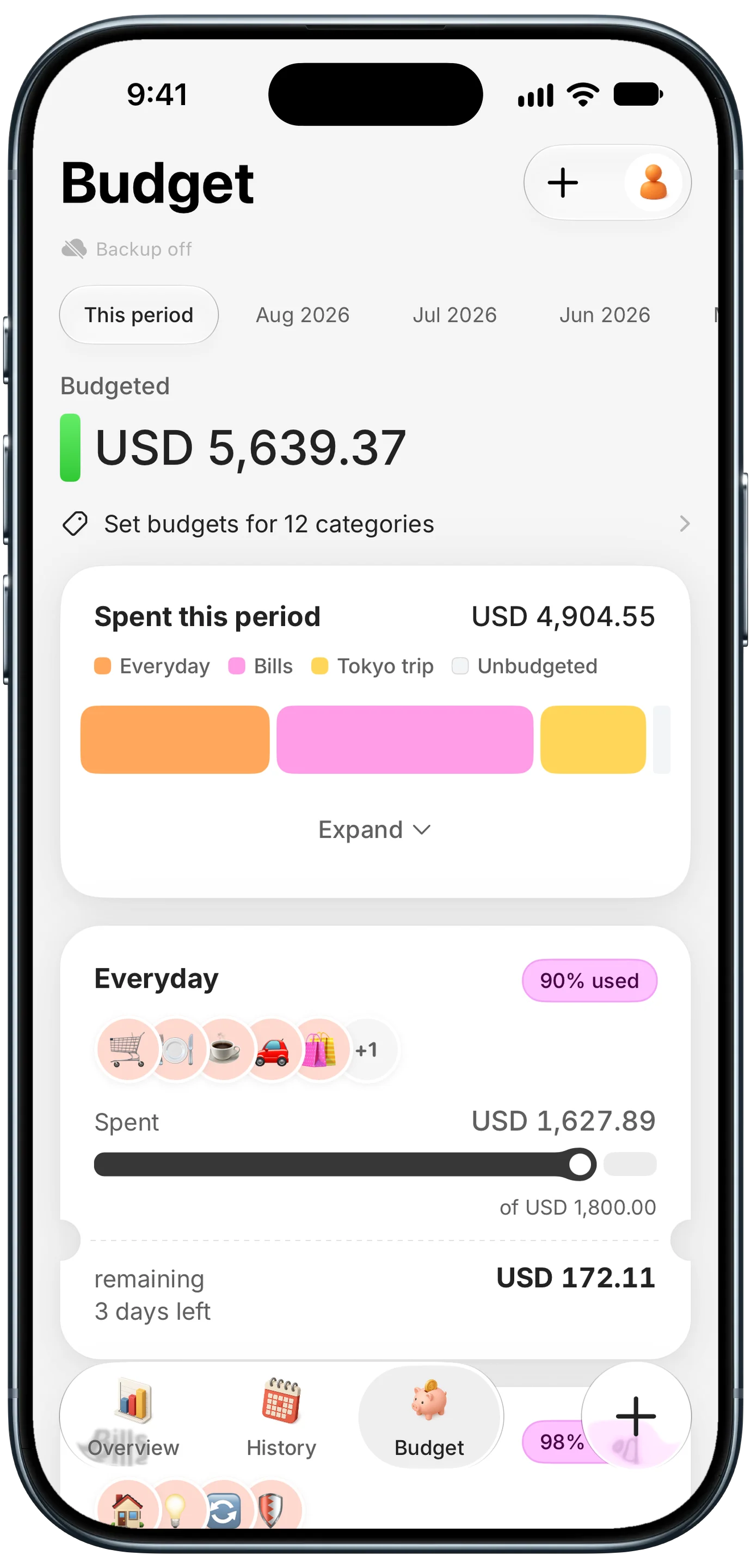
Finny app's Budgets feature
The free plan covers unlimited manual tracking, custom categories, charts, and more than 150 currencies, and it works offline. Pro is a low monthly or yearly price and adds AI input and extras such as a custom month start that lines up with your payday. The trade-off: it is iPhone only, and you confirm entries yourself.
Here is a short look at how card payments get logged as you make them:
Best for: iPhone users who want privacy, offline use, and a low cost.
Bank Sync or No Bank Link: Which Suits You?
Bank-synced apps (YNAB, Monarch, Copilot, Simplifi, PocketGuard, Rocket Money) are the better choice if you have many accounts, a partner whose spending you need to see, or investments in the same view, or if you know you will not log purchases by hand. The costs are a higher price, occasional broken connections, and sharing account access with a data aggregator.
Apps without a bank link (Finny, free Goodbudget, free EveryDollar) suit people who want to notice each purchase, are wary of linking accounts, or mostly spend on one or two cards. They are cheaper and never break when a bank changes its login, but you capture spending yourself, so logging speed matters most. If privacy is your deciding factor, our guide to finance app security and privacy covers what to look for.
How to Choose the Right Budgeting App
Match the app to how you actually behave with money.
- You want a strict system: YNAB, or EveryDollar for a free start.
- You share finances with a partner: Monarch for automation, or Goodbudget for a cheaper envelope setup.
- You are all-in on Apple and want automation: Copilot.
- You want bank sync for the lowest price: Quicken Simplifi on annual billing.
- Your main leak is subscriptions: Rocket Money's free plan.
- Full budgets overwhelm you: PocketGuard's single number.
- You care most about privacy and low cost: Finny or free Goodbudget.
- Your income is irregular: YNAB or Goodbudget, which budget money you already have. Read our guide on budgeting with variable income.
Use any trial for a full pay cycle before paying. For more options at the free end, our best free budgeting apps list goes deeper on free tiers.
Common Questions About the Best Budgeting Apps
What is the best budgeting app for 2027?
There is no single winner. YNAB is strongest if you want a strict zero-based method and accept $109 a year. Monarch Money suits households that want every account in one place. Copilot is the most polished option for Apple users, and Quicken Simplifi is the cheapest full bank-linked app on annual billing. If you would rather not connect a bank at all, Goodbudget and Finny both work without one. Choose the method you will stick with.
Are budgeting apps worth paying for?
A paid app is worth it when it changes behavior enough to save more than it costs. At around $100 a year, preventing one unnecessary purchase a month covers it. That said, free plans from EveryDollar, Goodbudget, and Rocket Money cover the basics of planning and tracking. Start free and pay only when a missing feature, such as bank sync, is costing you time.
Which budgeting apps work without linking a bank account?
Finny works entirely without a bank connection and also runs offline. Goodbudget's free plan and EveryDollar's free plan are manual as well, while their paid tiers add bank sync. A spreadsheet is another fully private option. The trade-off is that you capture each purchase yourself, so look for fast entry methods such as text input or receipt scanning.
Is YNAB better than Monarch Money?
They solve different problems. YNAB is a method: it asks you to assign every dollar before you spend it and rewards weekly attention. Monarch is a dashboard showing spending, net worth, and investments across all accounts with less hands-on work. YNAB costs $109 a year and Monarch Core costs $99.99 a year. If you need to change spending habits, YNAB usually helps more. If you want visibility across many accounts, Monarch fits better.
Ready to start 2027 with a budget you will actually keep?
Download Finny to log expenses using AI, receipts, or text. No bank connections, offline support, and full control over your financial data.