Most people assume financial freedom means being wealthy. It does not. It means reaching a point where money decisions come from choice rather than pressure. You pay your bills without anxiety. You handle unexpected expenses without panic. You make career and life decisions based on what matters to you, not what your bank balance demands.
Financial freedom is less about a specific dollar amount and more about the relationship between your income, your expenses, and your sense of control. This guide breaks down what financial freedom actually looks like, the stages most people move through to reach it, and the practical habits that get you there. If you are working on the basics first, our guide on budgeting for beginners is a good starting point.
What Financial Freedom Actually Means
Financial freedom is the ability to cover your living expenses and make meaningful life choices without being constrained by money. It does not require millions in the bank. It requires enough income, savings, and financial awareness that money stops being a source of stress.
Some people reach financial freedom earning $60,000 a year because their expenses are well managed and their savings are consistent. Others earn $200,000 and feel financially trapped because of debt, lifestyle inflation, and no clear picture of where their money goes. Many who achieve it follow the principles of the FIRE movement, which focuses on aggressive saving and intentional spending to make work optional decades ahead of schedule.
The distinction matters: financial freedom is personal. Your version depends on your cost of living, your goals, and how much security you need to feel at ease. A single person renting in a mid-size city has a different threshold than a family of four with a mortgage. Neither version is wrong.
What separates financially free people from everyone else is not income. It is clarity. They know what they earn, what they spend, what they owe, and what they own. That awareness is the foundation everything else builds on.
Financial Freedom vs Being Rich
Being rich and being financially free overlap, but they are not the same thing.
| Aspect | Financial Freedom | Being Rich |
|---|---|---|
| Core measure | Expenses covered without stress | High income or high net worth |
| Spending habits | Intentional and tracked | Varies widely |
| Debt | Minimal or managed | May carry significant debt |
| Lifestyle | Aligned with values | May be driven by status |
| Sustainability | Built on systems and habits | Can be fragile without discipline |
A doctor earning $400,000 with $350,000 in annual expenses, $200,000 in student loans, and no savings is rich by income but not financially free. A teacher earning $55,000 with $40,000 in annual expenses, no debt, and a year of savings is closer to financial freedom than most high earners.
The key difference is the gap between income and expenses, combined with the awareness to maintain that gap over time. Understanding your net worth helps you see where you actually stand, beyond what your paycheck suggests.
The Stages of Financial Freedom
Financial freedom is not a switch you flip. Most people move through it in stages, and recognizing where you are helps you focus on the right next step.
Stage 1: Financial Awareness
You know how much you earn, how much you spend, and where your money goes each month. This sounds basic, but most people skip it entirely. Without awareness, every other stage is guesswork.
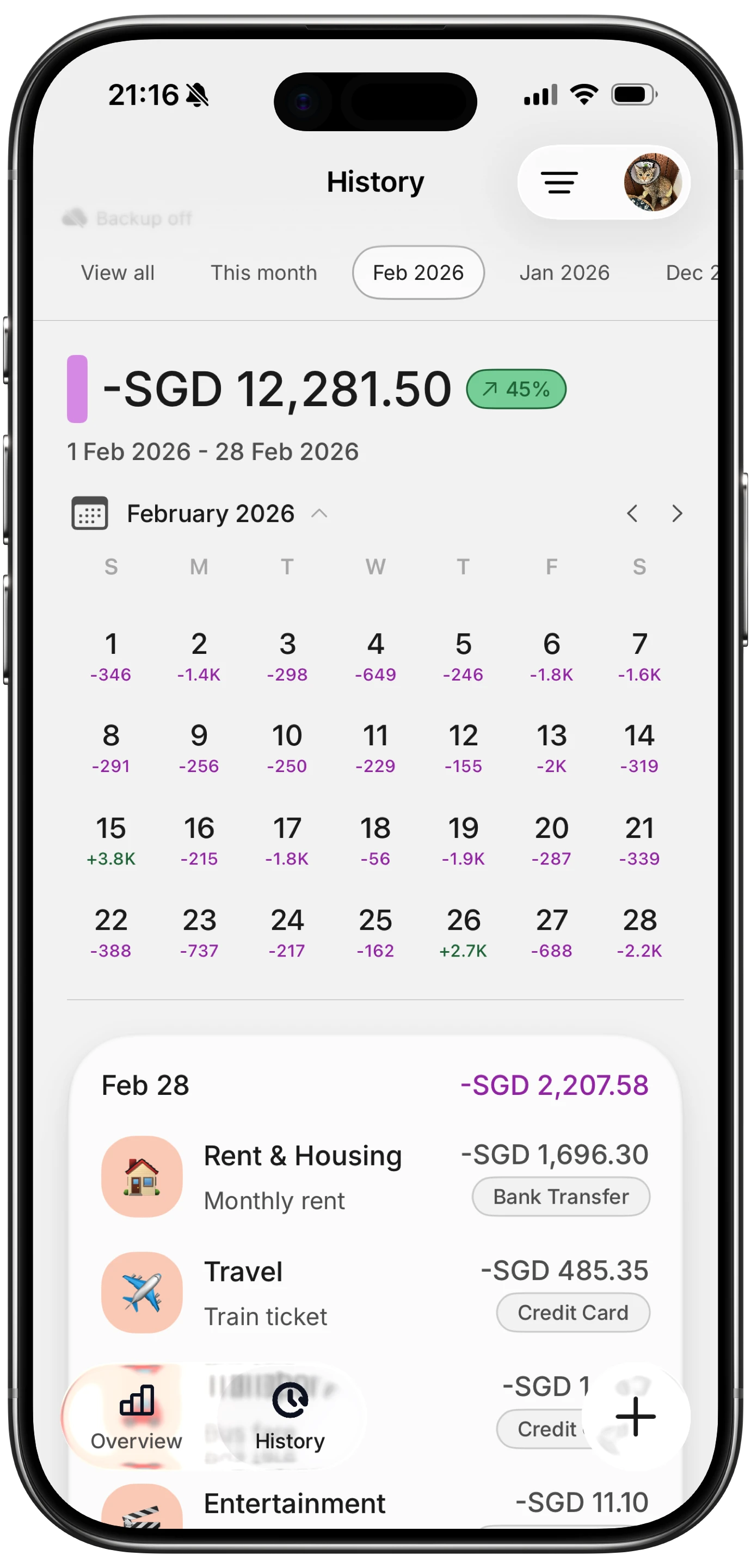
Finny app's History calendar feature
Tracking expenses daily, even for a few weeks, reveals patterns that budgets alone miss. You see the recurring subscriptions, the impulse purchases, the categories where spending quietly adds up. This stage is about seeing clearly before trying to change anything.
Stage 2: Financial Stability
You can pay all your bills on time, cover basic needs without borrowing, and handle a small unexpected expense (a car repair, a medical copay) without going into debt. You have a starter emergency fund, even if it is modest.
At this stage, the goal is reducing financial fragility. That means building an emergency fund and eliminating high-interest debt. You are not thriving yet, but you are no longer one bad month away from a crisis.
Stage 3: Financial Security
Your emergency fund covers three to six months of expenses. You have no high-interest debt. Your retirement contributions are consistent, even if they are not maxed out. You can absorb most financial shocks without changing your lifestyle.
This is where many people first feel a genuine shift in their relationship with money. Bills stop causing anxiety. Financial decisions become less reactive and more intentional.
Stage 4: Financial Independence
Your savings and investments generate enough passive income to cover your basic living expenses. You could stop working and maintain your current lifestyle for a significant period, possibly indefinitely.
This does not mean you stop working. Most people at this stage continue working because they choose to, not because they have to. The psychological shift is significant: work becomes optional rather than mandatory.
Stage 5: Financial Abundance
You have more than enough to cover your needs and most of your wants. You can give generously, take risks on projects you care about, and make decisions with very few financial constraints.
Most people do not need to reach this stage to feel financially free. Stages 3 and 4 represent genuine freedom for the majority of people.
How to Measure Your Progress
Financial freedom needs concrete markers, not vague feelings. Here are the metrics that matter most.
Your Savings Rate
Your savings rate is the percentage of your after-tax income that you save or invest each month. A savings rate of 20% or higher puts you on a strong trajectory. Below 10%, progress will be slow regardless of income.
To calculate it: (Monthly savings + investments) / Monthly after-tax income x 100.
Your Net Worth Trajectory
Net worth is what you own minus what you owe. The number itself matters less than the direction. Is it increasing each quarter? If not, something in your spending or debt management needs attention. Tracking your net worth over time turns an abstract concept into a measurable trend.
Your Expense Coverage Ratio
Divide your liquid savings (cash and easily accessible investments) by your monthly expenses. The result tells you how many months you could sustain your current lifestyle without income.
- Under 1 month: financially fragile
- 1 to 3 months: building stability
- 3 to 6 months: financially stable
- 6 to 12 months: financially secure
- 12+ months: approaching independence
Your Debt-to-Income Ratio
Total monthly debt payments divided by gross monthly income. Under 20% is healthy. Over 36% limits your options significantly.
Realistic Steps to Build Financial Freedom
Step 1: Track Every Expense for 30 Days
You cannot manage what you do not measure. Before creating a budget, cutting expenses, or setting savings goals, you need an accurate picture of your current spending. Every coffee, every subscription, every grocery run.
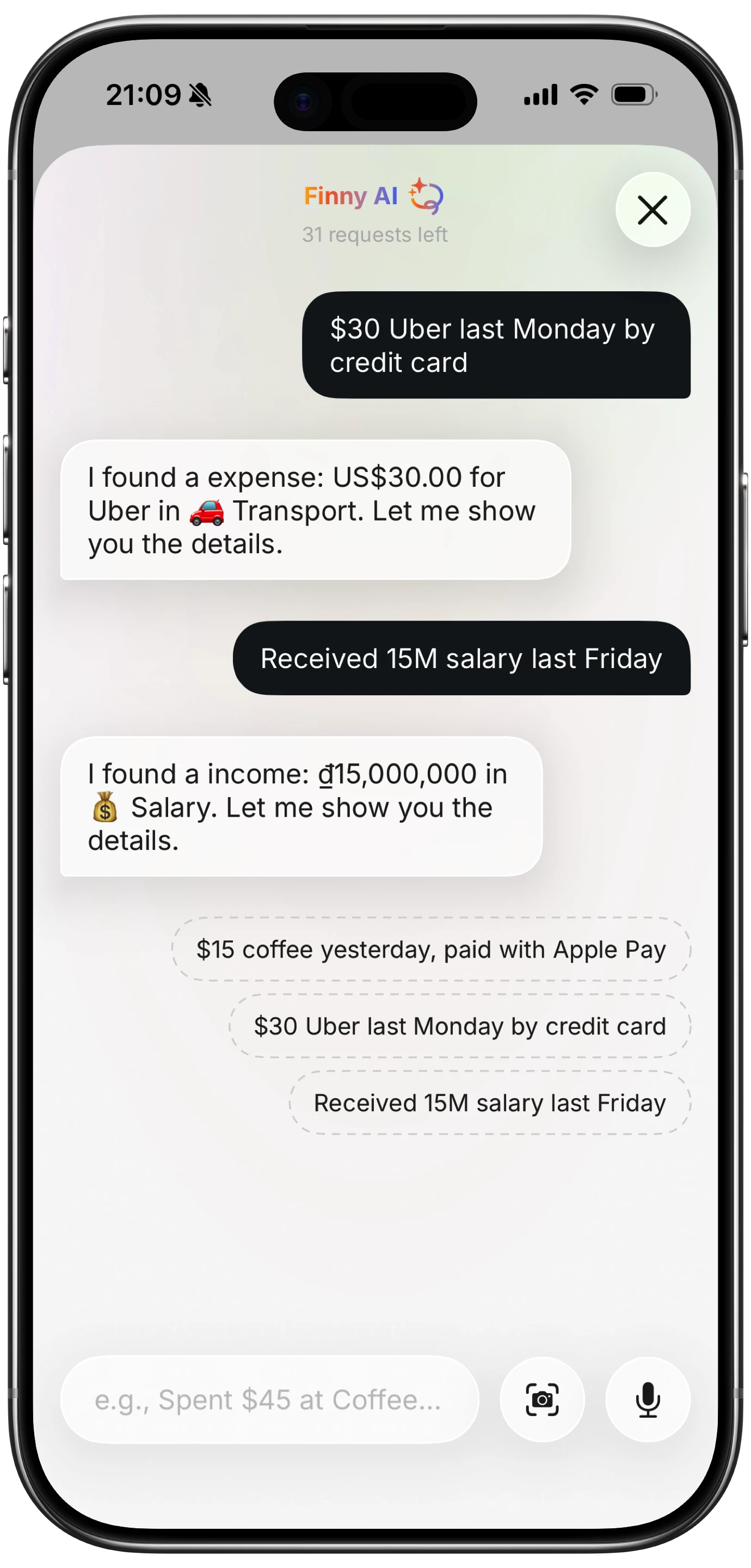
Finny app's AI chat feature
This is where most people stall, because manual tracking feels tedious. Tools that reduce friction make a real difference. Finny lets you log expenses through text, voice, or receipt scanning, so capturing a purchase takes seconds rather than minutes. The goal is not perfection. It is building the habit of noticing where your money goes.
Step 2: Identify Your Baseline Expenses
After 30 days of tracking, separate your spending into three categories:
- Fixed essentials: Rent, utilities, insurance, minimum debt payments
- Variable essentials: Groceries, transportation, medical costs
- Discretionary: Dining out, entertainment, subscriptions, impulse purchases
Your fixed and variable essentials represent your financial floor: the minimum you need to sustain your life. Knowing this number is critical because it defines what financial freedom actually costs for you.
Step 3: Close the Gap Between Income and Expenses
Financial freedom grows in the space between what you earn and what you spend. You can widen that gap from either side: earn more or spend less. Most people have more immediate control over spending.
Look at your discretionary spending from Step 2. You do not need to eliminate it. You need to make it intentional. The difference between spending $400 on dining out because you planned for it and spending $400 because you lost track is enormous, even though the dollar amount is the same.
For strategies on managing spending more deliberately, see our guide on how to stop overspending.
Step 4: Automate Savings Before You Spend
Set up automatic transfers to savings and investment accounts on payday. The amount matters less than the consistency. Starting with 10% of your income and increasing by 1% every few months is more sustainable than trying to save 30% immediately and burning out.
The order of priority:
- Emergency fund until you reach 3 months of expenses
- Employer retirement match (if available, this is free money)
- High-interest debt payoff (anything above 7-8%)
- Emergency fund to 6 months
- Additional retirement and investment contributions
Step 5: Reduce and Eliminate Debt Strategically
Debt is the most common barrier to financial freedom. Each debt payment is money committed to past decisions rather than future goals.
Focus on high-interest debt first (credit cards, personal loans). For strategies on choosing between payoff methods, our debt snowball vs avalanche comparison can help you decide which approach fits your situation.
Step 6: Build Income Streams Over Time
Once your spending is under control and your debt is manageable, turn attention to the income side. This could mean negotiating a raise, developing skills that command higher pay, starting a side project, or eventually building investment income.
Income growth accelerates financial freedom, but only if spending discipline stays intact. Without tracking, higher income often leads to lifestyle creep rather than faster progress.
Why Daily Expense Tracking Is the Foundation
Every stage of financial freedom depends on one skill: knowing where your money goes. This is not a one-time exercise. It is an ongoing practice.
Daily expense tracking builds two things that no amount of income can replace:
Awareness: You see your real spending patterns, not what you think you spend. Most people underestimate their discretionary spending by 20-40%. Tracking closes that gap between perception and reality.
Discipline: The act of recording a purchase creates a moment of reflection. Over time, this micro-habit reduces impulsive spending naturally. You do not need willpower when you have visibility.
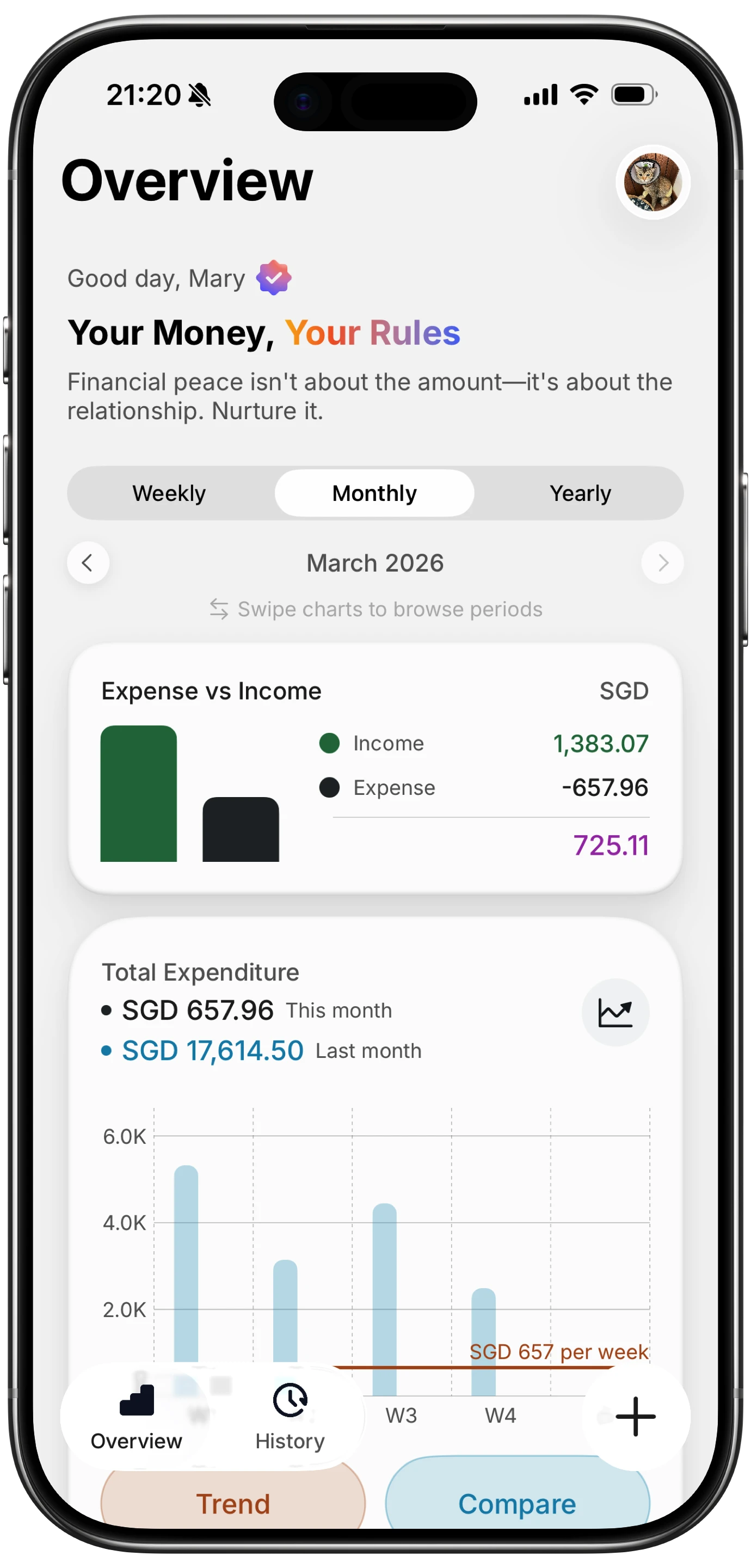
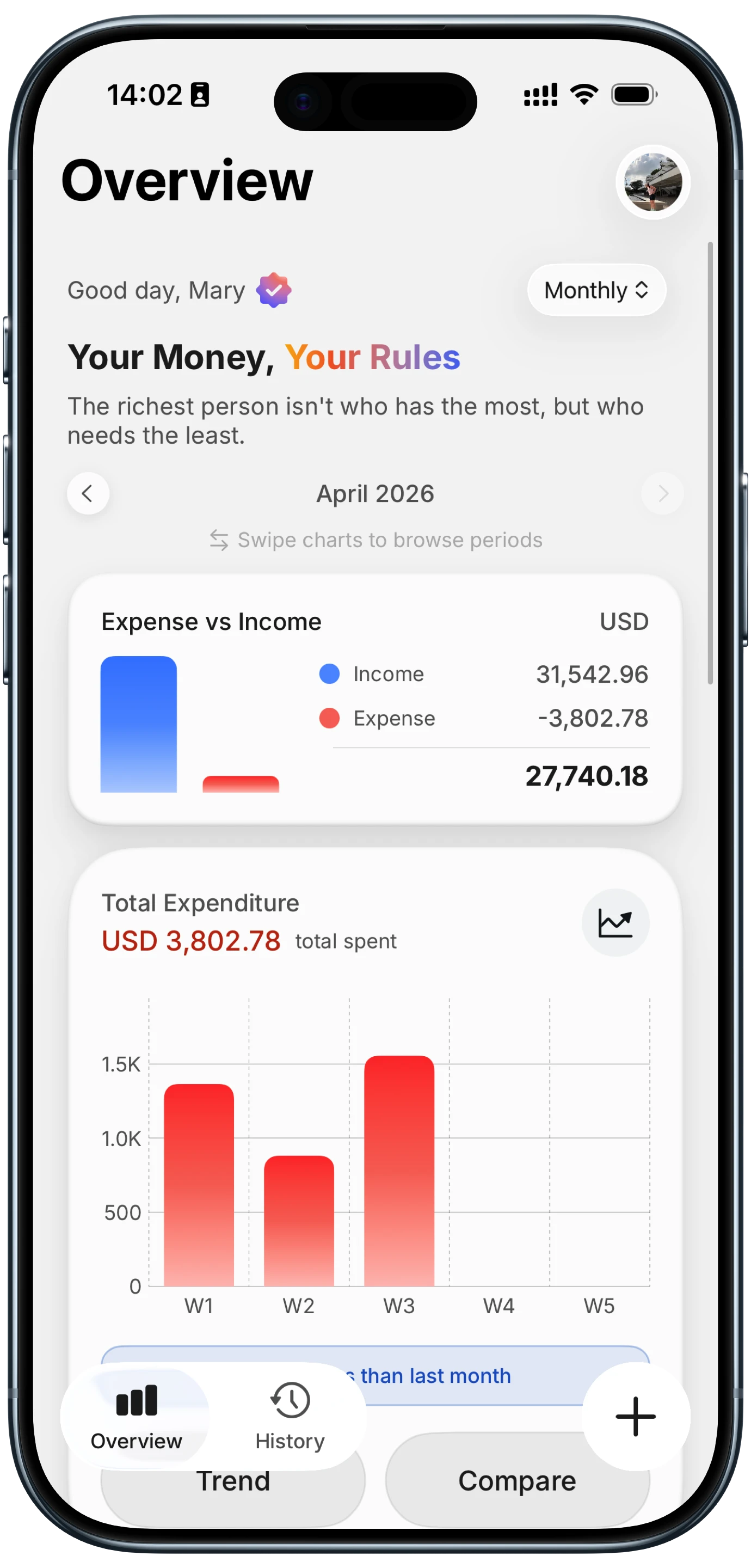
Finny app's Overview feature
Finny is designed around this principle. By making expense logging fast (through AI-assisted text, voice, or receipt input) and keeping your data private (no bank connections required, offline support), it removes the friction that causes most people to abandon tracking after a week. The analytics then turn raw data into spending insights you can act on.
Financial freedom is not built in a single dramatic decision. It is built in hundreds of small, informed ones. And those informed decisions start with knowing your numbers.
The Bottom Line
Financial freedom is not about being rich. It is about reaching a point where your money works for your life instead of against it. The stages are clear: awareness, stability, security, independence, and eventually abundance. Progress is measurable through your savings rate, net worth trajectory, and expense coverage ratio.
The single most impactful habit you can build is tracking your expenses consistently. It creates the awareness that makes every other financial decision better. Without it, budgets are guesses, savings goals are arbitrary, and progress is invisible.
Start where you are. Track what you spend. Build from there.
Common Questions About Financial Freedom
What is financial freedom in simple terms?
Financial freedom means your savings, investments, and income cover your living expenses without stress. You make life decisions based on what you want, not what you can afford. It does not require extreme wealth, just enough control over your finances that money is no longer a source of anxiety.
How much money do you need for financial freedom?
There is no universal number. A common benchmark is 25 times your annual expenses (based on the 4% withdrawal rule for retirement). If you spend $40,000 per year, that suggests $1,000,000 in invested assets. But financial security, a meaningful milestone on its own, requires far less: 3 to 6 months of expenses in savings and minimal high-interest debt.
How long does it take to achieve financial freedom?
It depends on your savings rate more than your income. At a 10% savings rate, it could take 30+ years. At 30%, roughly 20 years. At 50%, closer to 15. The timeline shortens dramatically as the gap between income and expenses widens.
Can you achieve financial freedom on a low income?
Yes, though the timeline is longer. The principles are the same: track spending, reduce expenses to essentials, eliminate debt, and save consistently. A lower income means each dollar of savings matters more, which makes expense tracking even more valuable for finding opportunities to redirect money.
What is the first step toward financial freedom?
Track your expenses for 30 days. Before budgeting, investing, or setting goals, you need an accurate picture of where your money currently goes. This single step creates the foundation for every financial decision that follows.
Ready to take the first step toward financial freedom?
Download Finny to start tracking your daily expenses with AI-assisted input, receipt scanning, and clear spending analytics. No bank connections required, fully offline capable, and designed to make the habit stick.