Couples and Money Statistics 2026: Surveys and Data
Only 38% of American couples completely combine their finances, according to a Bankrate survey published in February 2026. The rest keep at least some money apart, which shapes who pays which bill and what goes unsaid.
This page collects the most useful couples and money statistics released in 2025 and 2026, from Bankrate, Fidelity, CFP Board, the Census Bureau, YouGov, Credit Karma and others. Every figure links to its source and publication date. The final section turns the numbers into a money system for your own relationship.
Key Couples and Money Statistics for 2026
- 38% of couples completely combine their finances, 36% use a mix of joint and separate accounts, and 26% keep everything separate (Bankrate, February 2026).
- 42% of couples combine their finances into joint accounts, and about 1 in 5 keep everything separate (Fidelity, May 2026).
- 65% of married or cohabiting Americans say money is a top relationship stressor, and 34% call it their number one stressor (CFP Board, October 2026).
- 49% of couples avoid money conversations to prevent arguments (Fidelity, May 2026).
- 43% of U.S. adults say keeping financial secrets from a partner is at least as bad as physical cheating (Bankrate, January 2026).
- 45% of couples say they and their partner do not know everything about each other's finances (Bankrate, January 2026).
- 58% of couples say they do not contribute equally to household finances (Fidelity, May 2026).
- 26% of opposite-sex couples living together earn within $5,000 of each other (Census Bureau, April 2026).
- 24% of unmarried couples split everything 50/50, and another 24% split in proportion to income (Credit Karma, September 2025).
How Many Couples Combine Their Finances
Fully merged finances are now the minority approach. In Bankrate's survey, fielded by YouGov in December 2025 among 1,208 married or cohabiting adults, 62% of couples keep at least some money separate. Fidelity's 2026 Couples & Money study, released May 19, 2026, found a similar picture: 42% combine into joint accounts, and two thirds say keeping some financial autonomy is important.
Age is the biggest divide. Here is how Bankrate's figures break down by generation:
| Generation (Bankrate, 2026) | Completely combined | Mix of joint and separate | Completely separate |
|---|---|---|---|
| Gen Z (18 to 29) | 22% | 26% | 51% |
| Millennials (30 to 45) | 32% | 34% | 34% |
| Gen X (46 to 61) | 40% | 37% | 23% |
| Baby boomers (62 to 80) | 45% | 39% | 15% |
Income matters too: 39% of couples earning under $50,000 a year keep finances completely separate, compared with 17% of those earning $100,000 or more, who lean hybrid (47%).
Marriage also changes the picture. In a January 2026 survey of 1,400 adults in committed relationships, the business bank Mercury found that 52% of married respondents combine most or all of their finances, compared with 21% of those in other committed relationships. Among married couples, a Credit Karma survey from September 2025 found 36% use both joint and separate accounts and 22% keep finances fully separate.
Money as a Source of Stress and Arguments
In an October 2026 survey by CFP Board, conducted by Morning Consult among 820 married or cohabiting Americans, 65% named money as a top relationship stressor. That put it ahead of health (46%), work-life balance (36%), household chores (35%), job stress (33%) and intimacy (30%).
The same survey found that 46% call money the most uncomfortable subject to discuss with their partner, and 83% have had a difficult money discussion. Only 45% say their most recent one was completely resolved.
Arguing is less common than stress. A YouGov poll of 1,114 U.S. adults, published February 12, 2026, found that 26% of people in relationships sometimes argue about money. Tone of voice (36%) and communication styles (29%) came up more often. The gap by living situation is striking:
| Relationship type (YouGov, 2026) | Sometimes argue about money |
|---|---|
| Unmarried, living together | 40% |
| Married | 28% |
| Serious relationship, living apart | 9% |
Avoidance may explain part of the gap. Fidelity found that 49% of couples avoid money conversations specifically to prevent arguments, and fewer than a third regularly talk about day-to-day finances. Half say they wish they talked more, including 64% of Gen Z and 63% of millennials.
Financial Secrets and Financial Infidelity
Financial infidelity means hiding money matters from a partner: a secret debt, an account, a purchase or income. A Bankrate survey released January 29, 2026 found that 43% of U.S. adults consider keeping financial secrets at least as bad as physical cheating, including 5% who say it is worse. Millennials were the most likely to hold that view (47%), followed by Gen X (44%), Gen Z (42%) and baby boomers (39%).
Secrets are common in practice. Among couples, 45% say they and their partner do not know everything about each other's finances. Among Americans in a committed relationship, Bankrate found:
- 25% are keeping minor sources of debt, expenses or income secret.
- 11% are not discussing credit scores, credit histories, savings or investments.
- 9% are keeping major sources of debt, expenses or income secret.
The top reason, given by 28% of those holding back, is feeling they should be allowed to keep some information to themselves.
Fidelity found that almost 1 in 4 couples admit to hiding a financial secret. In Credit Karma's 2025 survey, 39% of respondents admitted to some form of financial infidelity, and 44% had hidden a purchase from their partner, with men (51%) more likely than women (38%). CFP Board found that 41% made a major financial decision in the past year without telling their partner.
How Couples Split Bills: 50/50 vs Proportional
There is no single standard for splitting costs. Credit Karma's survey of 1,005 adults, fielded August 29 to September 2, 2025, found unmarried couples divided almost evenly across three methods: 24% take turns covering expenses without tracking exactly, 24% split everything 50/50, and 24% divide costs in proportion to income.
Married couples are more likely to pay from a shared pot:
| How married couples pay shared expenses (Credit Karma, 2025) | Share |
|---|---|
| From a joint account | 43% |
| One partner pays most or all | 26% |
| Split by category (one covers rent, the other groceries and utilities) | 24% |
The income gap is why this question matters. The Census Bureau reported in April 2026 that in 52% of opposite-sex couples living together in 2025, the man earned at least $5,000 more a year. Only 26% of couples earned within $5,000 of each other, and that share fell below 10% among couples with at least one child at home.
When incomes differ, a strict 50/50 split takes a bigger bite out of the lower earner's pay. Fidelity found 58% of couples say they do not contribute equally to household finances, and nearly 1 in 4 say the imbalance affects their relationship. In Mercury's survey, Gen Z respondents were more than three times as likely as baby boomers to split bills by income (17% vs 5%).
Who Manages the Money in a Relationship
Many couples share money management, but men and women describe it differently. In Mercury's January 2026 survey, 45% of respondents said financial responsibilities are roughly equal, rising to 54% among baby boomers. When asked who leads, men named themselves 38% of the time and women 21% of the time, yet only 16% of women said their partner leads.
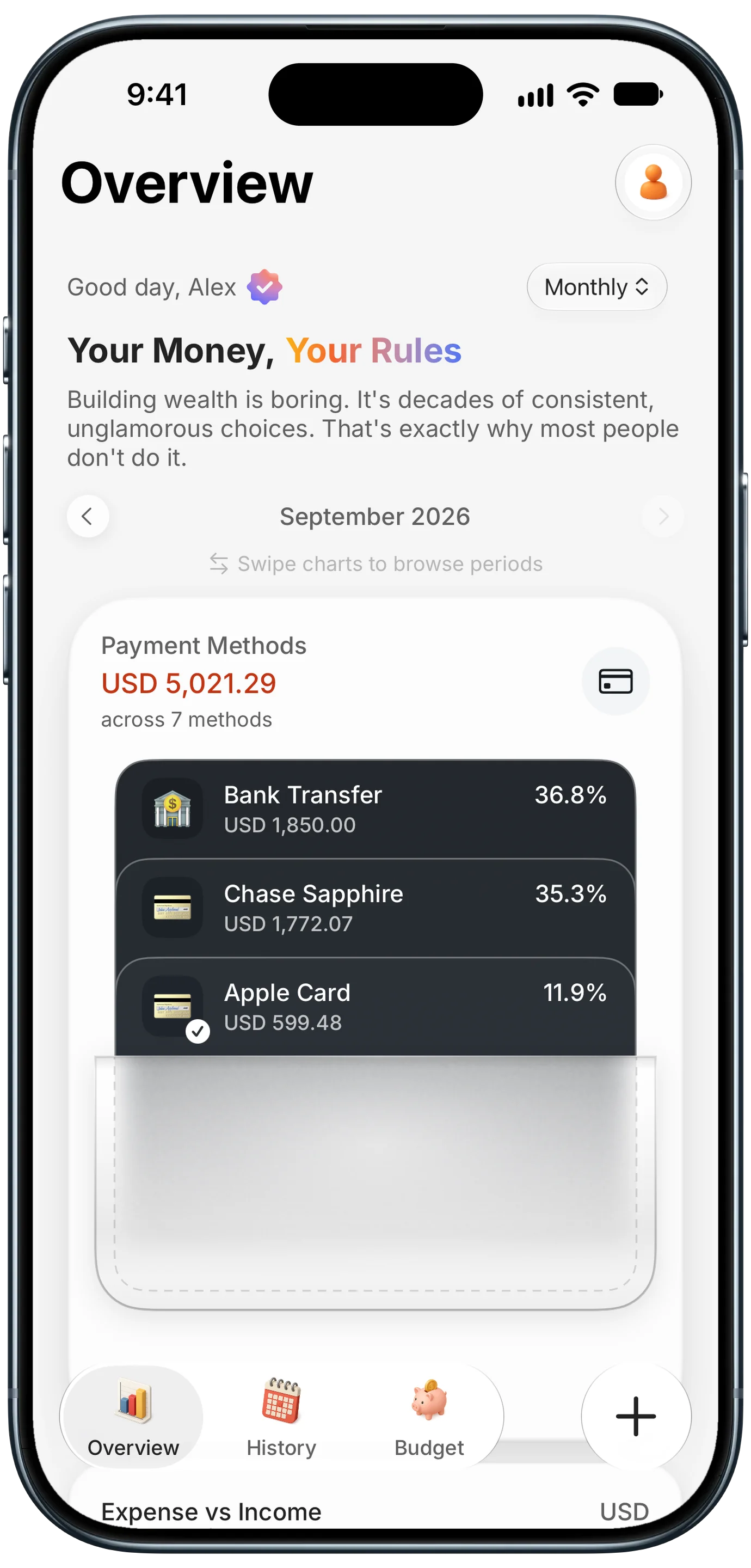
Finny app's Payment Methods feature
Visibility is a separate question. Mercury found 51% of couples say both partners have full visibility and access to shared and individual accounts, and 17% do not use any shared financial tools at all.
Big purchases are usually a joint decision. CFP Board found that 72% of couples consult their partner before a big purchase. One in three check in before spending as little as $100 to $499.
So "who manages the money" is rarely one person doing everything. Usually each partner handles certain accounts or bills, and the risk is that nobody sees the whole picture. A shared view of payment methods, even with separate cards, can close that gap without merging every account.
Money Talks Before Marriage
Americans are marrying later, which means more money history arrives with each partner. The Census Bureau's 2026 families and living arrangements estimates, released November 17, 2026, put the median age at first marriage at 30.5 for men and 28.6 for women, up from 23.8 and 21.3 in 1976.
When should couples start talking about money? Bankrate asked how early in a relationship each topic should come up. "After a few months of dating" was the most common answer for every topic, and no topic was picked for a first date by more than 4% of respondents.
| Topic (Bankrate, 2026) | After a few months of dating | After moving in | After marriage or never |
|---|---|---|---|
| Debt | 49% | 19% | 16% |
| Spending habits | 45% | 15% | 12% |
| Salary | 43% | 20% | 19% |
| Credit scores | 42% | 25% | 22% |
| Savings and investments | 36% | 27% | 29% |
Practice lags behind intention. CFP Board found that 78% say they fully disclosed their finances before committing, yet Fidelity found that 68% did not know their partner's complete financial situation before moving in together, and for nearly 1 in 5 it took more than a year after moving in.
In Credit Karma's 2025 survey, 24% have signed or plan to sign a prenup, rising to 42% in households earning $100,000 or more. Fidelity found more than 1 in 4 Gen Z couples have a formal or informal prenup.
How to Turn the Data Into a System for Your Relationship
The data points to three weak spots: unspoken assumptions, uneven contributions and money nobody can see. A simple system addresses all three, whether you combine everything or nothing.
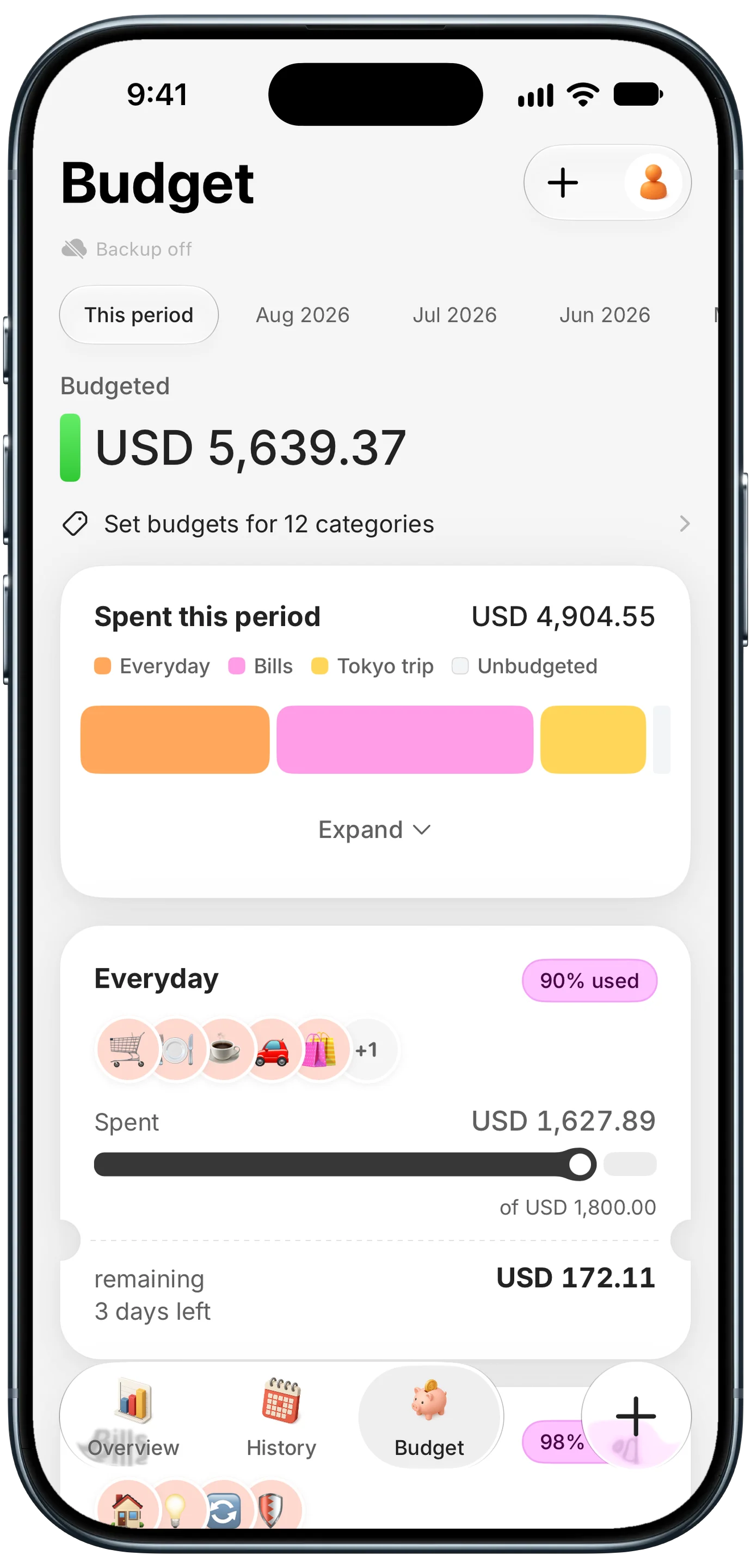
Finny app's Budgets feature
- Pick an account structure on purpose. Mercury found boomers were the most likely to say their arrangement just happened without a plan (48%). Compare all joint, all separate and yours, mine and ours in our guide to joint vs separate accounts for couples.
- Choose a split that fits your incomes. With only about a quarter of couples earning within $5,000 of each other, a proportional split is often fairer. Try the bill split calculator and our guide to splitting bills fairly on different salaries.
- Set a shared budget with clear limits. Agree on categories such as groceries and dining out, with a dollar amount for each. A budget that shows how much is used, like the Everyday budget above at 90%, tells you when to slow down.
- Agree on a check-in threshold. CFP Board found most couples consult each other on big purchases. Name your number, such as $250, so neither partner has to guess.
- Hold a short monthly money talk. Since nearly half of couples avoid the subject, put it on the calendar.
- Track shared spending in one place. Our roundup of the best budgeting apps for couples compares the options. In Finny, Households lets you share expenses with up to 5 other people, and each person chooses which entries to share, so personal spending can stay personal.
This one-minute video shows how a shared household works for couples and families:
Common Questions About Couples and Money
What percentage of couples combine their finances?
It depends on the survey, but most recent data puts fully combined finances below half. Bankrate's February 2026 survey found 38% of married or cohabiting couples completely combine their finances, 36% use a mix of joint and separate accounts, and 26% keep everything separate. Fidelity's May 2026 study found 42% combine into joint accounts. Older and married couples are much more likely to merge than younger or unmarried ones.
What percentage of couples argue about money?
In a February 2026 YouGov poll, 26% of Americans in relationships said they sometimes argue about money, rising to 40% among unmarried couples who live together and 28% among married couples. Stress is more common than open arguments: CFP Board's October 2026 survey found 65% of married or cohabiting Americans call money a top relationship stressor, and Fidelity found 49% avoid money talks to prevent fights.
What counts as financial infidelity?
Financial infidelity is hiding money matters from a partner, such as a secret credit card balance, a private account, hidden purchases or income your partner does not know about. In Bankrate's January 2026 survey, 9% of people in committed relationships were keeping major debts, expenses or income secret, and 25% were hiding minor ones. Keeping separate accounts that both partners know about is not financial infidelity.
Should couples split bills 50/50 or by income?
There is no single right answer, and real couples are divided. Credit Karma's 2025 survey found 24% of unmarried couples split 50/50 and 24% split by income. A 50/50 split works best when incomes are similar. When one partner earns much more, a proportional split keeps the share of income each person pays the same, so neither partner is left with far less spending money than the other.
Want your money system to match what you agreed on?
Download Finny to log expenses by typing a plain sentence or snapping a receipt, share the household ones with your partner, and keep personal spending private. No bank login needed.