Should Couples Share a Credit Card? Pros and Cons
Sooner or later, most couples hit the same small friction. One of you buys the groceries, the other pays for the internet, and the takeout order lands on whichever card was closest. A single shared card sounds like the obvious fix: one bill, one set of rewards, one place where household spending lives.
Should couples share a credit card? It can work well, but "sharing" can mean two very different arrangements, and they carry different legal and credit consequences. This guide covers joint cardholders versus authorized users, how each shows up on your credit reports, how Apple Card Family handles it, and house rules that keep a shared card calm. If you are still deciding how much to combine, see our guide to tracking spending as a couple.
Two Ways to Share: Joint Cardholder vs Authorized User
A joint cardholder (sometimes called a co-owner or joint account holder) applies for the account together with you. Both of your incomes and credit histories are considered, and both of you own the debt. The Consumer Financial Protection Bureau is direct about this: on a joint account, each account holder is responsible for the full balance, and the issuer can collect from either one. That is true even for charges you did not make.
An authorized user gets a card on someone else's account. They can spend, but the primary account holder is the one legally responsible for paying. Chase's guide to authorized users and joint account holders puts it plainly: account holders are financially responsible for charges, authorized users are not. The primary holder can usually add or remove an authorized user at any time.
One practical wrinkle: true joint credit cards have become uncommon in the US. Chase notes that relatively few issuers allow joint account holders on credit cards. In practice, most couples who "share a card" are using the authorized user setup, where one partner owns the account and the other spends on it.
How a Shared Card Affects Each Credit Score
Married or not, you and your partner never share a credit report or a credit score. Experian explains that each person keeps an individual report, and only accounts you hold together link the two files. A shared card creates that link.
On a joint account, the card appears on both reports as an account you each own. On-time payments help both of you, and a late payment shows on both files too. Because the balance counts toward each person's credit utilization, a high balance can weigh on both scores at once. If utilization is new to you, our explainer on the credit utilization ratio walks through why it matters.
For an authorized user, it depends on the issuer. Many issuers report authorized users to the credit bureaus, and when they do, the account's payment history and usage can show up on the authorized user's report, for better or worse. That can help a partner with a thin credit file, as long as the primary holder pays on time.
The key asymmetry is ownership. An authorized user can usually be removed. A joint holder generally cannot simply step away: Chase notes that neither party can be removed without closing the entire account, and the CFPB notes both holders stay responsible for the remaining balance. For the basics of what goes into a score, see our credit score explainer.
A Concrete Example: Apple Card Family
Apple Card Family is one of the few mainstream options that still offers true co-ownership, and Apple's support page spells out the rules clearly, so it makes a useful example.
Up to six people, including you, can be on a shared Apple Card account, and everyone must be in the same Apple Family Sharing group. One of those people can be a co-owner. Co-owners must be 18 or older, each is individually liable for all balances on the co-owned card, and both are reported as owners on the account, so they build credit equally in their own names. Either co-owner can close the account at any time.
Everyone else is a participant. Participants must be 13 or older, can spend up to the account's credit limit unless an owner sets a transaction limit, and are not responsible for payments. They are not reported to the credit bureaus by default, but participants 18 and older can opt in to be reported as an authorized user.
So a couple who wants to share ownership and build credit together would make one partner a co-owner, while a couple who wants one person to hold the liability would make the other a participant. Our guide on how to track Apple Card spending covers the tracking side.
The Pros and Cons of Sharing One Card
Here is the tradeoff in short form. Neither column is a verdict; it depends on how you already handle money together.
| Pros | Cons | |
|---|---|---|
| Simplicity | One bill, one due date, one autopay | Harder to see who spent what at a glance |
| Rewards | Points or cash back pool in one place | Disagreements over how rewards get used |
| Credit | Can help a partner with thin credit | Late payments or high balances can hurt both |
| Liability | Clear if one person is the owner | Joint holders each owe the full balance |
| Exit | Authorized users can usually be removed | Joint accounts often have to be closed |
A shared card tends to work best for couples who already pool most household costs and talk about money regularly. It tends to work less well when one person carries a balance, when incomes and spending styles differ a lot and nobody has agreed on a split, or when the relationship is new enough that untangling an account later would be painful. Many couples land in the middle: personal cards, plus one shared card for agreed household costs.
Ground Rules: Who Pays and What Goes on the Card
The card itself is the easy part. The agreement around it is what keeps things calm. A few rules that couples tend to find useful:
- Decide what belongs on the card. Write a short list: groceries, utilities, household supplies, shared subscriptions, joint travel. Anything else goes on personal cards. A list settles most arguments before they start.
- Decide how it gets paid. Some couples pay the statement from a joint account. Others each transfer a share into the account that pays it, either equal or proportional to income. Our guide on splitting bills fairly on different salaries has worked numbers for both.
- Pay the full statement balance. Carrying a balance on a shared card means paying interest on shared spending, and on a joint account, both credit files feel it. Autopay for the full balance removes the monthly reminder.
- Agree on a check-in amount. Pick a figure, say $200, above which either of you mentions a purchase before making it. It is not about permission; it is about no surprises.
- Review it together. A short monthly look at the statement is enough. If you want a gentle format for that, read about what a money date is.
Keeping Track of Who Spent What on One Card
The most common friction with a shared card is not the bill. It is the statement that arrives with forty charges and no clear sense of who made which ones. Whatever tool you use, whether a spreadsheet or a budgeting app for couples, the first step is to treat the shared card as its own payment method, separate from each person's personal cards, so its spending can be totaled on its own.
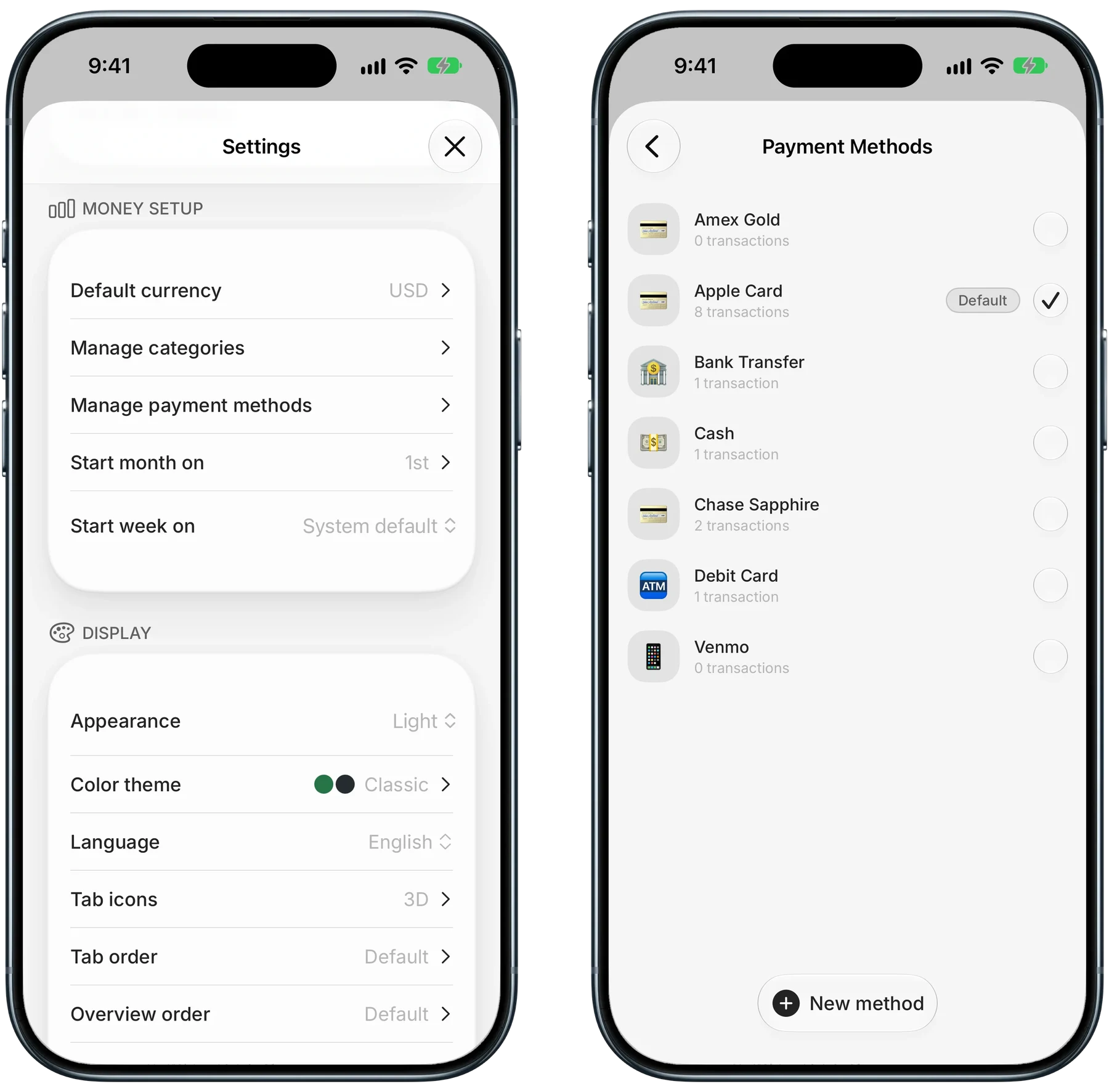
Finny app's payment methods feature
In Finny, that means adding the shared card once under payment methods in Settings, next to the cards and cash you already use. Each of you then picks it when you log a purchase on it. A search for the card's name in History shows a receipt-style total for that card, broken down by category, which is handy when the statement lands. Our guide to seeing your spending by credit card goes deeper on reading spending per card.
In a spreadsheet, the same principle applies: one column for who made the purchase, one for the card, and a monthly subtotal. The method matters less than both of you recording charges close to when they happen.
Seeing Both Sides of the Shared Card
Each partner's own spending is only half the picture. The other half is seeing what the other person put on the card, without passing a phone back and forth or forwarding screenshots.
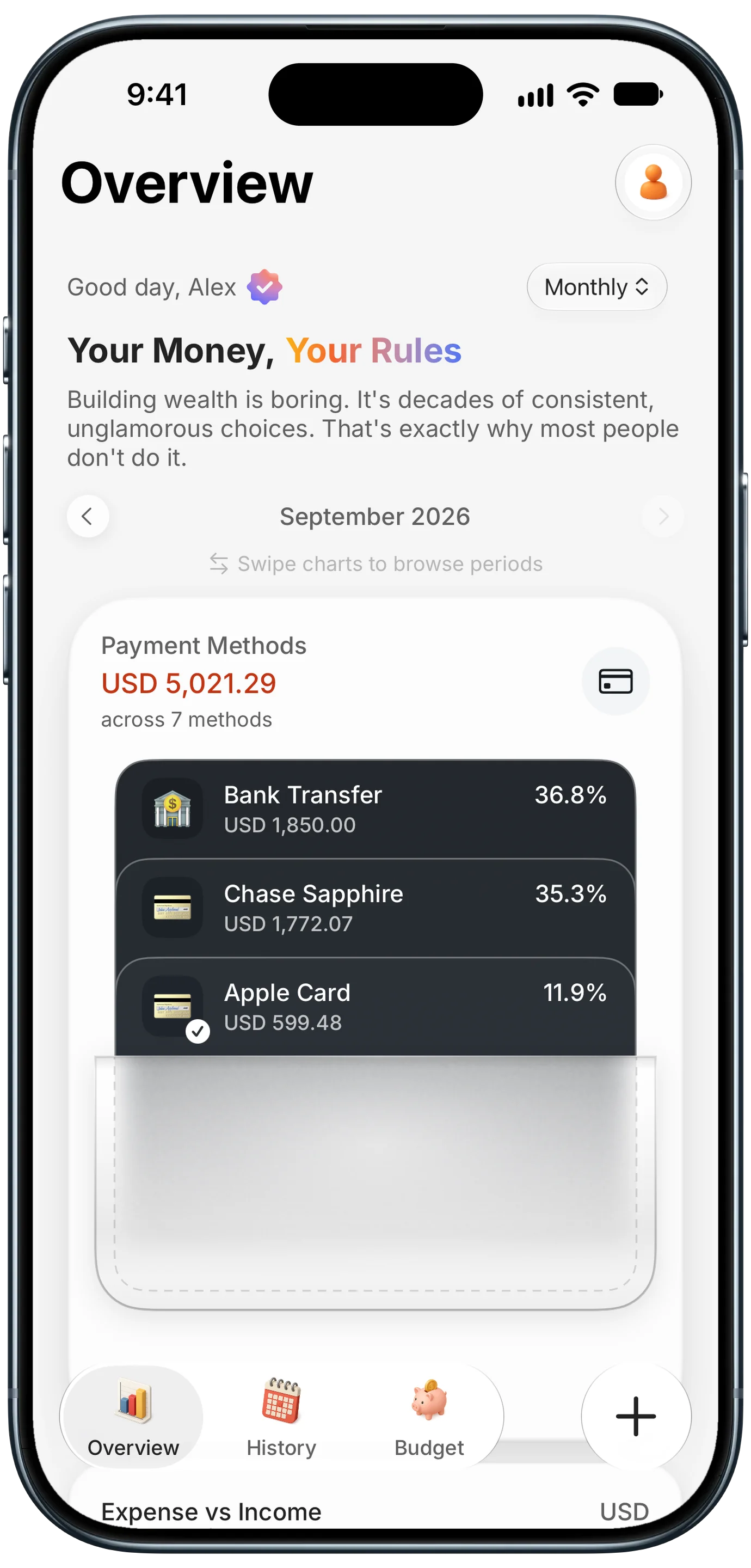
Finny app's Payment Methods feature
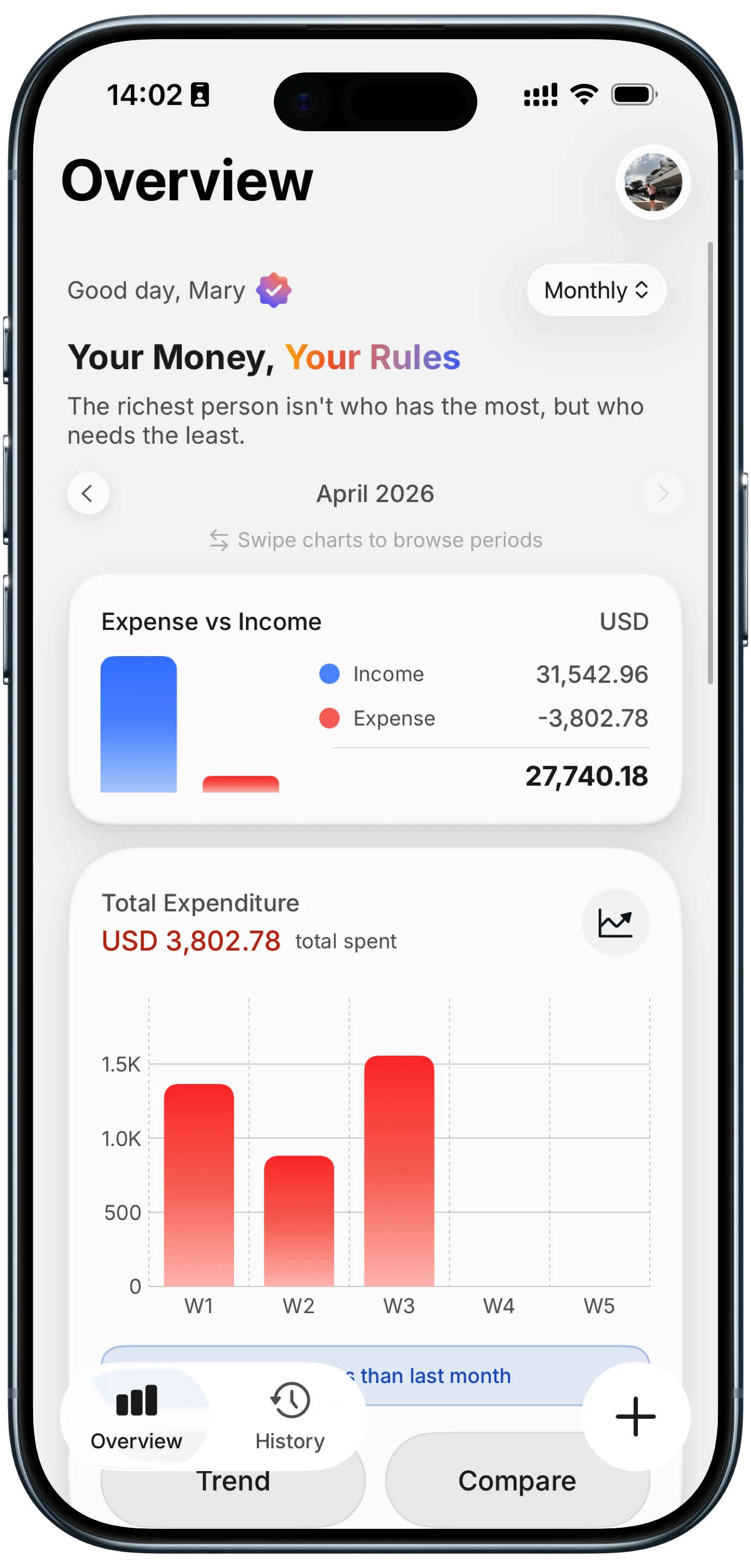
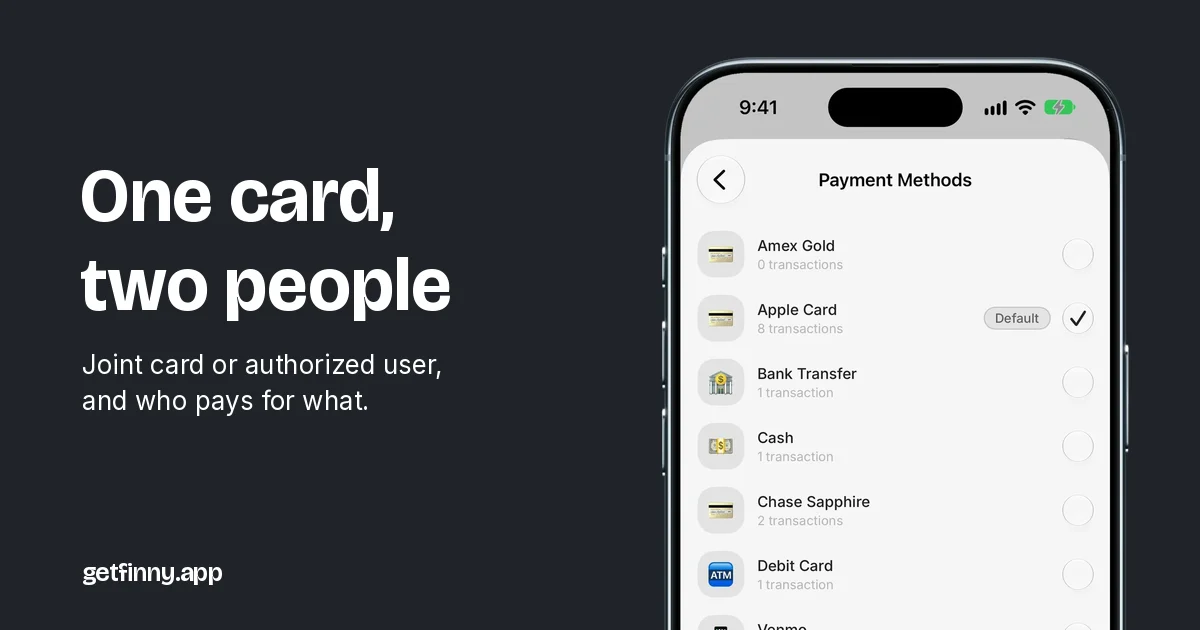
On your own Finny Overview, the payment methods wallet shows each card with its share of what you spent in the period, so the shared card's slice of your own spending is right there. To see your partner's charges on it too, you can create a household in Finny. Each of you chooses which entries to share, and shared entries appear in History with the initial of whoever logged them, including the payment method, so every charge on the shared card shows who made it. The Balance menu can switch between everyone, just you, or one partner, and search follows that pick. Your partner's entries stay out of your Overview and budgets, which remain yours.
Here is a quick look at Households in action:
One thing Finny does not do is settle up. It shows who paid for what; how you even things out is between the two of you. Households need Finny Pro for each member, and a family plan can cover up to six people in the same Apple family. The Households launch post covers setup and what stays private.
Common Questions About Sharing a Credit Card
Is it a good idea for couples to share a credit card?
It can be, especially for couples who already pool household costs and pay their cards in full. A shared card simplifies bills and concentrates rewards. The risks are shared liability on a joint account, credit damage to both partners if payments slip, and confusion over who spent what. Many couples split the difference: one shared card for agreed household costs and separate cards for personal spending.
Does being an authorized user build credit?
Often, yes, but it depends on the issuer. Many issuers report authorized users to the credit bureaus, and when they do, the account's on-time payments and low balance can help the authorized user's credit history. Late payments or a high balance can hurt it just as easily. Ask the issuer whether it reports authorized users before counting on the benefit, and remember the primary holder controls the account.
What happens to a joint credit card if we break up?
The debt does not split itself. According to the CFPB, each joint account holder is responsible for the full balance, and closing the account does not erase what is already owed. Joint holders often cannot be removed without closing the account entirely. Rules around divorce and debt also vary by state, so if you are separating, talk to the issuer and consider a professional.
Want a shared card that doesn't need a weekly detective session?
Finny lets each partner log purchases on the shared card and share them, so every charge shows who made it, with no bank connection required.