Joint vs Separate Accounts for Couples: How to Decide
At some point the question comes up, usually around a lease, a wedding, or a grocery bill that keeps landing on the same card. Should you put everything in one account, keep your money apart, or do something in between? There is no single right answer, and plenty of happy couples sit in each camp.
This guide walks through joint vs separate accounts in plain terms: the three common setups, their tradeoffs, how much each person puts into a shared pot, and what to know about insurance, breakups and death before you open anything. If you are in the first weeks of merging money, our guide to the first month after combining finances pairs well with this one.
Setup 1: Everything joint
In the all joint setup, both paychecks land in one checking account, and every bill, grocery run and dinner out comes from it. Many married couples, and couples with kids, end up here because it matches how they already think: one household, one pot.
What works well:
- It is simple. One balance, one set of bills, one place to look.
- Nobody tracks who paid for what, because it all comes from the same place.
- Shared goals, like a down payment or an emergency fund, grow faster when everything flows to them by default.
What needs care:
- Both of you see every purchase. That is the point for some couples and uncomfortable for others.
- A gift for your partner is hard to keep a surprise when it shows up on the shared statement.
- If one person is a saver and the other a spender, the joint balance becomes the place where that difference plays out.
Couples who choose this often agree on a "no questions" amount each person can spend without checking in first.
Setup 2: Everything separate
In the all separate setup, each person keeps their own checking and savings, and shared costs are split by paying each other back or taking turns. One pays rent, the other covers utilities and groceries.
What works well:
- Full independence. Your spending, savings and debts stay your own.
- It suits new couples, people who married later with established finances, and couples with very different money habits.
- There is less to untangle if the relationship ends.
What needs care:
- Someone has to keep score. Without a shared record, the "who paid last time" question comes back every month.
- Large shared goals are harder to fund, because each contribution is a separate decision.
- If incomes differ a lot, splitting everything evenly can quietly squeeze the lower earner.
It works best when you agree on a short list of what counts as shared and how it gets paid, so paying each other back never turns into a weekly negotiation. A shared record, even a simple running note, keeps it calm.
Setup 3: Yours, mine and ours
The hybrid setup keeps two personal accounts and adds one joint account for shared costs. Each person moves an agreed amount into the joint account every payday. Rent, utilities, groceries and shared subscriptions come out of it. Whatever stays in your personal account is yours to spend or save without explaining it.
What works well:
- It separates shared life from personal life with a clear line.
- Bills are predictable, because the joint account is funded on a schedule.
- Each person keeps privacy over personal spending, which removes a lot of small arguments.
What needs care:
- You need a written list of what the joint account pays for. Date nights, vacations and gifts for family are the usual gray areas.
- When a shared cost lands on a personal card, someone needs to note it so the joint account can cover it or the next contribution can adjust.
| Setup | Best for | Main tradeoff |
|---|---|---|
| All joint | Couples who see money as fully shared | Less personal privacy |
| All separate | New couples, established finances, very different habits | Someone keeps score |
| Yours, mine and ours | Most long term couples who want both | Needs a clear "ours" list |
How much goes into the joint pot
If you use a joint account at all, you need a rule for how much each person puts in. There are two common approaches.
Equal contributions. Each person puts in the same amount. Say shared costs are $3,000 a month: each of you transfers $1,500. This feels fair when incomes are close. When they are not, it weighs very differently. With take home pay of $4,000 and $6,000, the first person is putting in 37.5 percent of their pay and the second only 25 percent.
Proportional contributions. Each person puts in the same share of their income. With $4,000 and $6,000, combined pay is $10,000, so the split is 40 percent and 60 percent. On $3,000 of shared costs, that is $1,200 and $1,800. Both of you now put in 30 percent of your pay, and both keep 70 percent for personal spending and saving.
Neither is more correct. For the full math, including a worked yours, mine and ours example, see how to split bills fairly on different salaries.
Whichever you pick, recheck it when either income changes, since a raise or parental leave can quietly make a fair split uneven.
How to decide together
The right setup depends less on a formula and more on how the two of you already handle money. A few questions help.
- How do you each feel about privacy? If either of you would feel watched with every purchase visible, all joint is a hard sell.
- How close are your incomes? A big gap makes proportional contributions, or a hybrid, worth a look.
- Do you bring debt or big commitments? Student loans, child support or a parent you help can make separate or hybrid easier to manage.
- What are you saving for together? A shared house fund or wedding fund often works better in a joint savings account, even if checking stays separate.
- Who will do the admin? Every setup needs someone to watch the balances. Agree on who, and when you will look together.
Treat the first choice as a trial: run it for three months, then ask what worked. A short, regular check in, like a money date, makes that review feel routine instead of tense. Many couples start separate and move toward more joint money over time.
What to know before opening a joint account
A few facts are worth knowing up front.
Deposit insurance. The FDIC insures deposits up to $250,000 per depositor, per ownership category, at each insured bank. Joint accounts are their own category. Each co-owner's share of all joint accounts at the same bank is insured up to $250,000, so two people can be covered up to $500,000 in joint deposits there, as long as the requirements are met: both owners are people, both have equal withdrawal rights, and the bank's records show the co-ownership. Your individual accounts at that bank are insured separately.
Breakups. In most cases, either owner of a joint account can withdraw the money or close the account, as the CFPB explains. For married couples, how money is divided in a divorce depends on state law. Rules vary by state, so check with your bank and a local attorney.
Death. Most joint accounts are held with rights of survivorship, so the money goes to the surviving owner. Some are titled differently, and then the deceased owner's share can go to their heirs. The CFPB suggests checking your account agreement or asking the bank which applies to you.
Seeing shared spending without merging everything
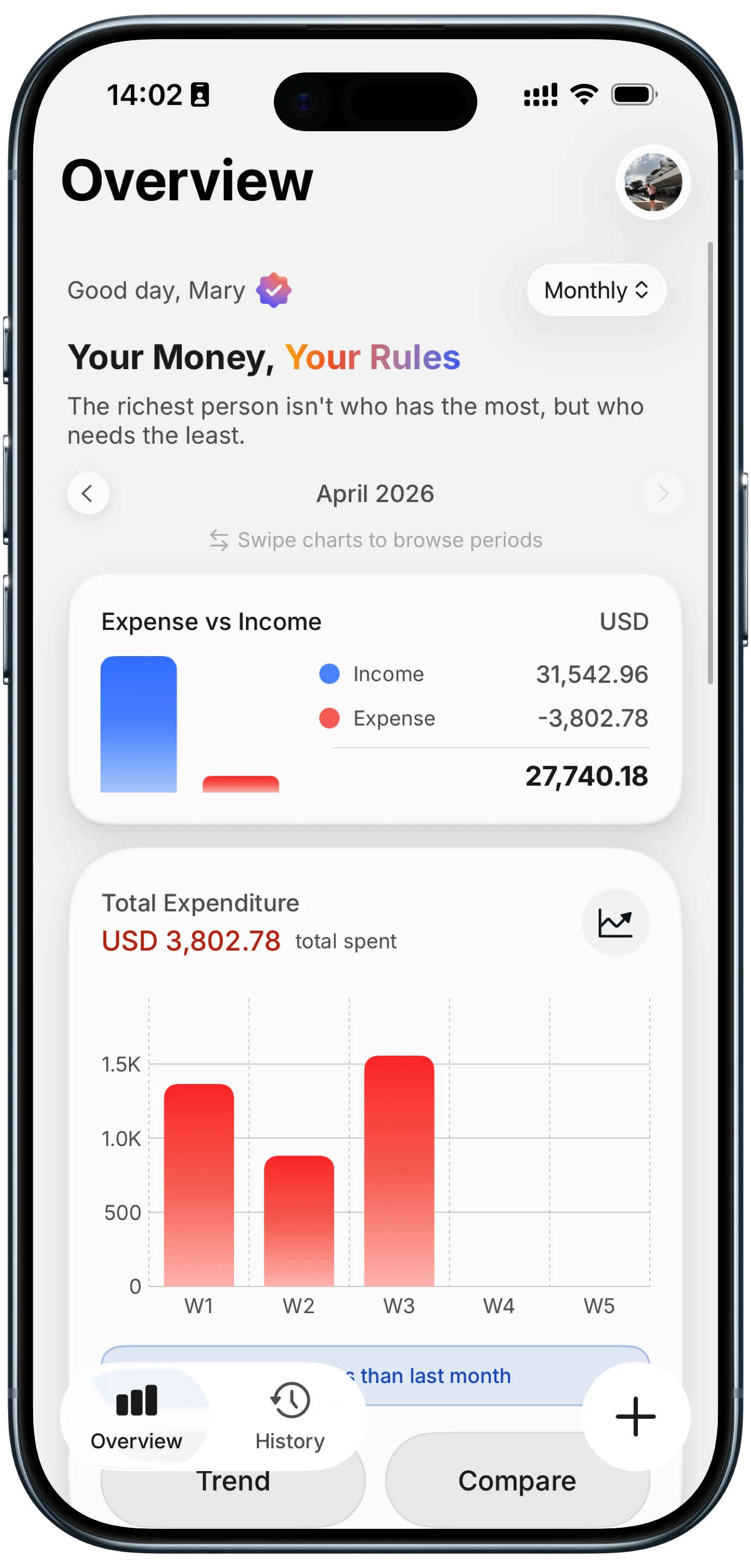
Whatever setup you choose, shared spending ends up spread across several cards. A joint card covers groceries, a personal card covers a dinner you agreed to share, and a partner pays a utility bill from their own account. Each statement shows one account, so "what did our life cost this month" is hard to see. A couples budgeting app can pull it into one view.
A Finny household is one way to see it without merging accounts or connecting banks. Up to six people each log their own spending and choose which entries to share. Nobody hands over a bank login, and anything not shared stays private.
Here is a quick look at Households in action:
Share only the "ours" entries
Every entry has a Share with household switch. Turn it on for the things that belong to both of you, and leave it off for the rest. Here, a lunch at Fushimi Inari on a Japan trip, paid in yen on an Apple Card and tagged #Tokyo, is shared with the household.
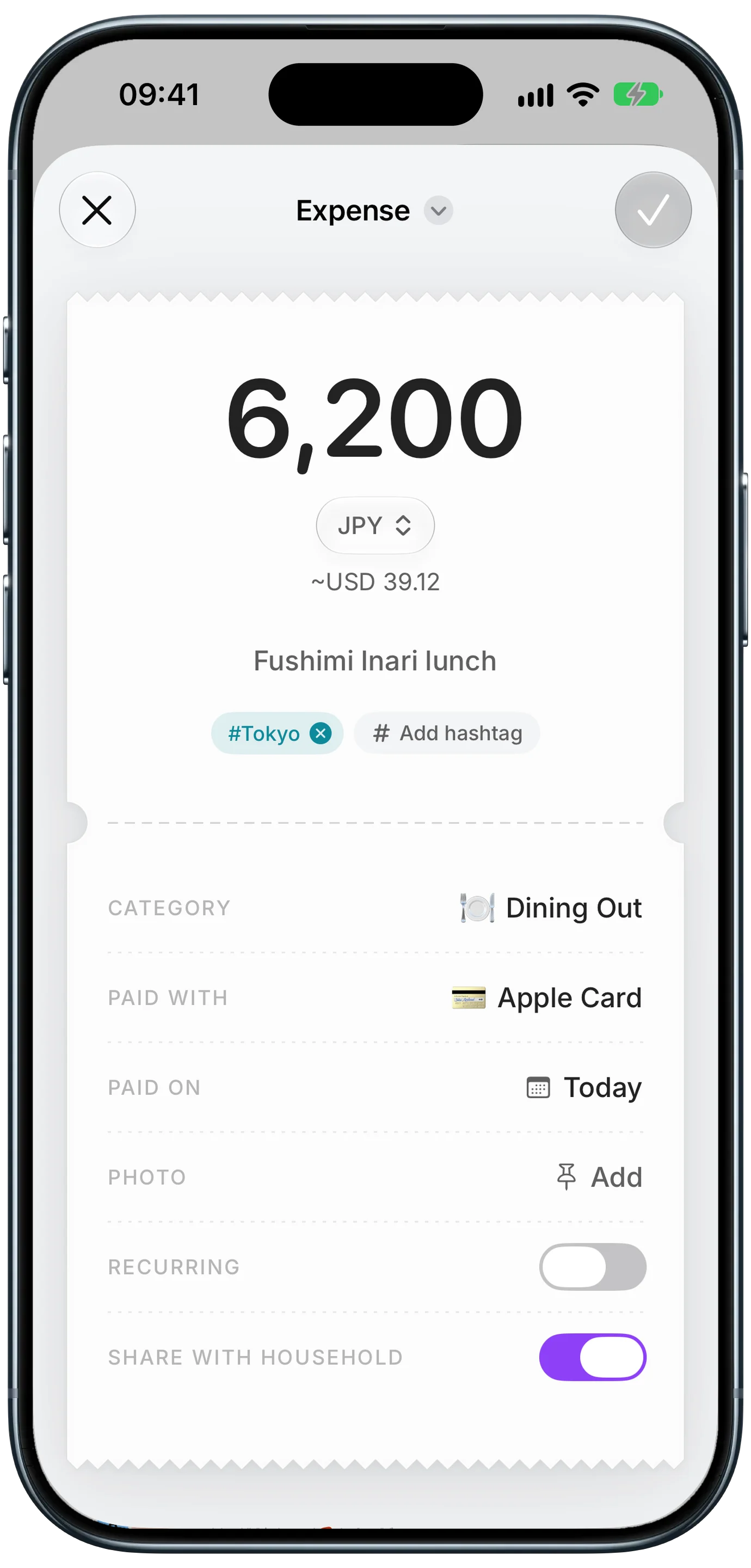
Finny app's Households feature
Set what is shared by default
The Household screen lists who is in it and lets you choose whether new expenses and new income are shared automatically. The household sees each shared entry's amount, note, category, payment method and hashtags, while photos stay private.
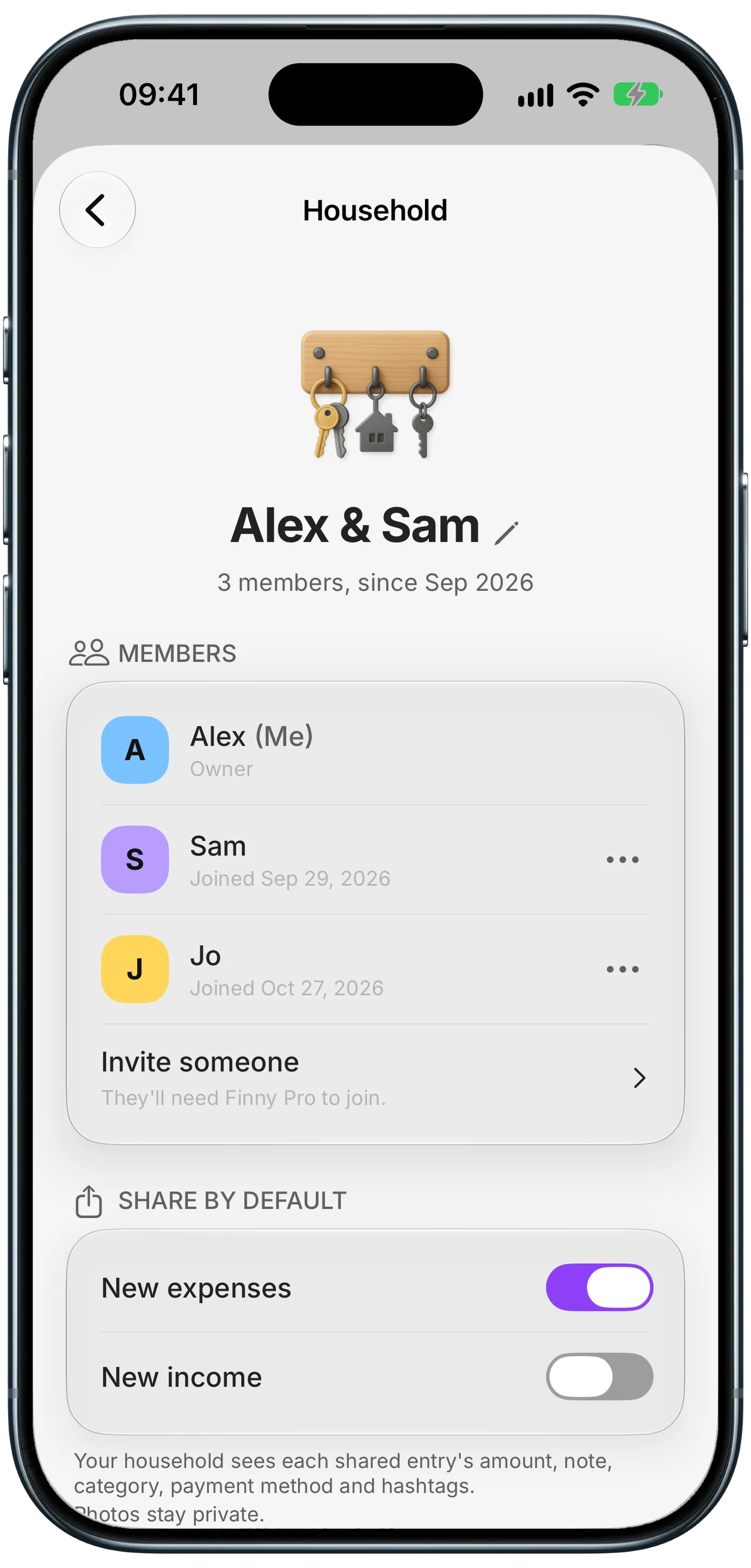
Finny app's Households feature
See the month in one place
History shows the month as a calendar, with each day's total and the categories you spent on. In a household, the Balance label becomes a menu, so you can view everyone, just yourself, or one member. It shows who paid for what. It does not calculate who owes whom, so settling up stays between you.
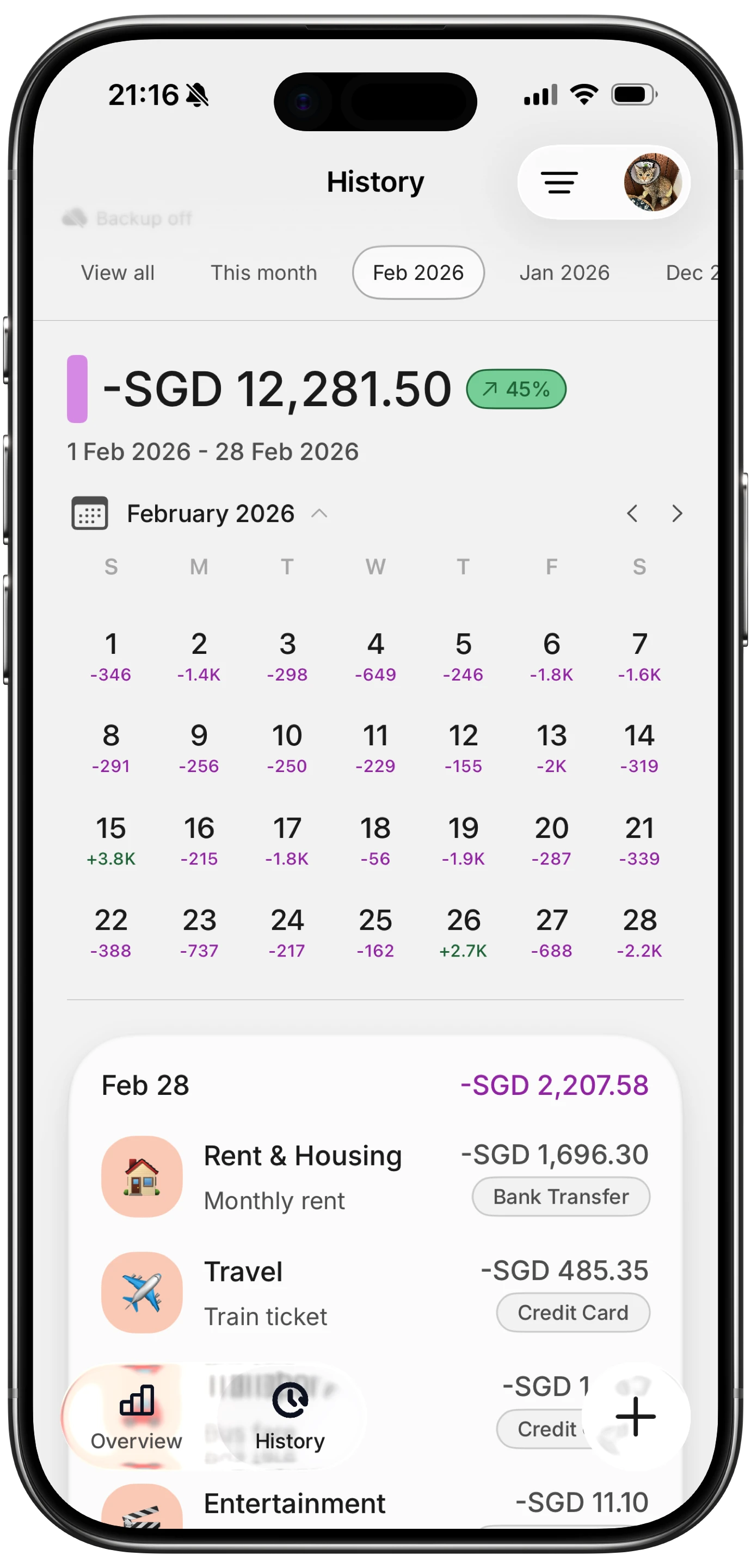
Finny app's History calendar feature
Everyone in a household needs Finny Pro, which is a low monthly or yearly price. A family plan covers up to 6 people through Apple Family Sharing. The Households guide has the full setup.
Common Questions About Joint vs Separate Accounts
Is it better for couples to have joint or separate accounts?
Neither is better for everyone. All joint suits couples who see money as fully shared. All separate suits couples who value independence. The yours, mine and ours hybrid is popular because it shares the bills while keeping personal spending private. The best choice is the one you both understand and agree to revisit when life changes.
How much should each partner put in a joint account?
Either the same amount each, or the same share of income each. Equal amounts are simple when incomes are close. Proportional amounts mean each person puts in the same percentage of their pay, which feels fairer when one person earns much more. Start by adding up monthly shared costs, then split that total using the rule you chose, and recheck it whenever an income changes.
Are joint accounts insured for more than individual accounts?
At an FDIC insured bank, joint accounts are a separate ownership category. Each co-owner's share of all joint accounts at that bank is insured up to $250,000, so a couple can be covered up to $500,000 in joint deposits there. That coverage is in addition to each person's individual accounts at the same bank. The FDIC's Electronic Deposit Insurance Estimator can check a specific situation.
Can my partner take money out of our joint account without asking?
In most cases, yes. Either owner of a joint account can usually withdraw funds or close the account without the other's approval, because both have equal access. Some state laws offer limited protection, and divorce rules vary by state. If you are worried about this, a yours, mine and ours setup keeps most of each person's money in their own account.
Share the "ours" without merging the rest.
Download Finny to log your own spending and share just the household entries with your partner, with no bank connection.