Paying Off Debt as a Couple: Yours, Mine or Ours?
Most couples bring some debt into the relationship: a student loan, a car payment, a credit card that crept up during a hard year. Then life adds more. At some point one of you asks the question nobody likes asking: whose debt is this, and who is paying it off?
There is no single right answer. Paying off debt as a couple works when both of you see the whole picture, agree on whose debt is whose, pick a payoff order together, and decide what each person puts in. If you have not talked about money in a structured way before, our guide to what a money date is is a gentle place to start.
Start With the Honest Conversation
The first step is a complete list. Not a summary, not "a few thousand on a card," but every debt each of you has, written down in one place. Shame tends to make people round down or leave things off, so agree up front that the list is information, not a verdict on anyone's past.
For each debt, write down five things:
- Who owes it: whose name is on the account, or both
- Balance: what is owed today, from the latest statement
- Interest rate: the APR, not the monthly payment
- Minimum payment: what must be paid each month to stay current
- Due date: the day of the month it is due
Here is an example couple, Alex and Sam, to use through the rest of this guide:
| Debt | Owner | Balance | APR | Minimum |
|---|---|---|---|---|
| Store card | Sam | $900 | 29% | $35 |
| Credit card | Alex | $4,200 | 24% | $120 |
| Car loan | Alex | $9,800 | 6.5% | $310 |
| Student loan | Sam | $18,000 | 5.5% | $195 |
Pull your free credit reports from AnnualCreditReport.com too, since they can show accounts one of you forgot about. The minimums add up to $660 a month, and that amount has to be covered before any extra payment makes sense.
Whose Debt Is It?
Debt in a relationship usually falls into two groups: debt one person brought in, and debt you took on together. The gray area is debt one person took on for the household, like groceries on one partner's card during a job gap. Name those out loud and agree how to treat them.
Some legal context, with a caution: rules vary by state, and this is not legal advice.
Marriage does not merge credit reports. The Consumer Financial Protection Bureau explains that credit scores are calculated on each person's own credit history, so a spouse's score does not change yours. Joint accounts are different: a joint credit card appears on both reports, and a late payment affects both of you. Apply for a loan together and lenders weigh both scores and your combined debt-to-income ratio.
Community property states can treat debt differently. The IRS lists nine community property states in Publication 555: Arizona, California, Idaho, Louisiana, Nevada, New Mexico, Texas, Washington and Wisconsin. In these states, debt taken on during a marriage may be treated as belonging to both spouses even when only one name is on it, while debt from before the marriage is generally treated as separate. The details depend on your state, so if it matters for a big decision, ask a local attorney.
Legal responsibility and fairness are separate questions. Plenty of couples pay off "your" debt together anyway, because it frees up money for both of you sooner.
Snowball or Avalanche: Choose a Method Together
Next, pick an order. The two common methods are the snowball (smallest balance first) and the avalanche (highest rate first), compared in detail in our guide to debt snowball vs avalanche.
With either method, you pay the minimum on everything and put every extra dollar toward one target debt. When it is paid off, its payment rolls into the next.
For Alex and Sam, the two methods agree on the first two steps:
- Snowball order: store card ($900), credit card ($4,200), car loan ($9,800), student loan ($18,000)
- Avalanche order: store card (29%), credit card (24%), car loan (6.5%), student loan (5.5%)
That overlap is common, because small store cards and credit cards often carry the highest rates. Where they differ, the avalanche usually costs less in interest. The snowball gives you quicker wins, which matters when two people need to stay motivated, not just one.
A good way to decide is to ask what would make each of you quit. If one partner gets discouraged when nothing seems to change, the snowball may keep you both going. If one partner hates paying 24% while a low-rate loan gets attention, the avalanche will feel right. A good debt vs bad debt lens can help too: a low-rate student loan may sit last no matter which method you pick.
Decide Who Contributes What
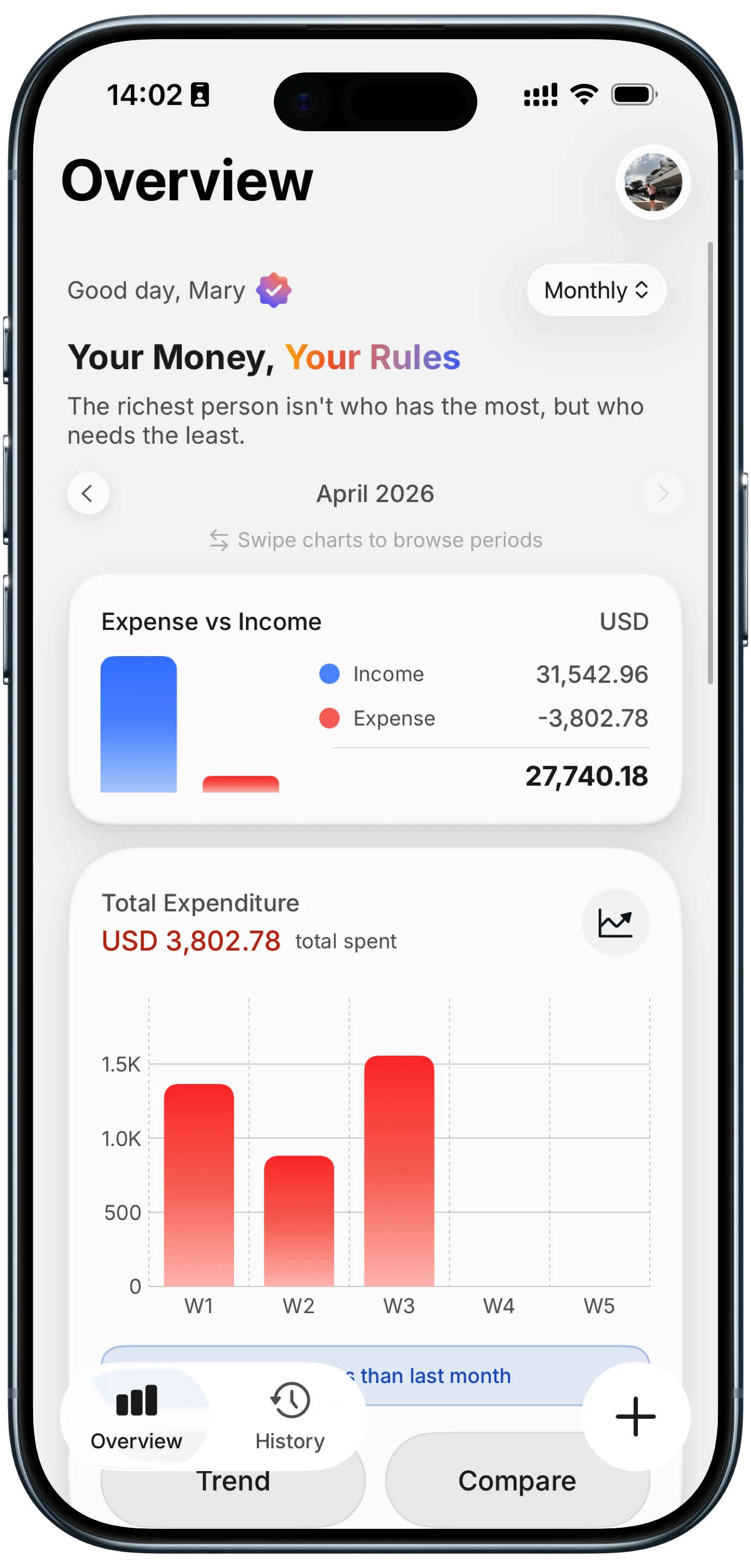
First, each of you needs to know where your own money goes. In an expense tracker like Finny, the Overview shows your total spending for the period by week, and whether it came in higher or lower than last period, which is a quick way to spot room for an extra payment.
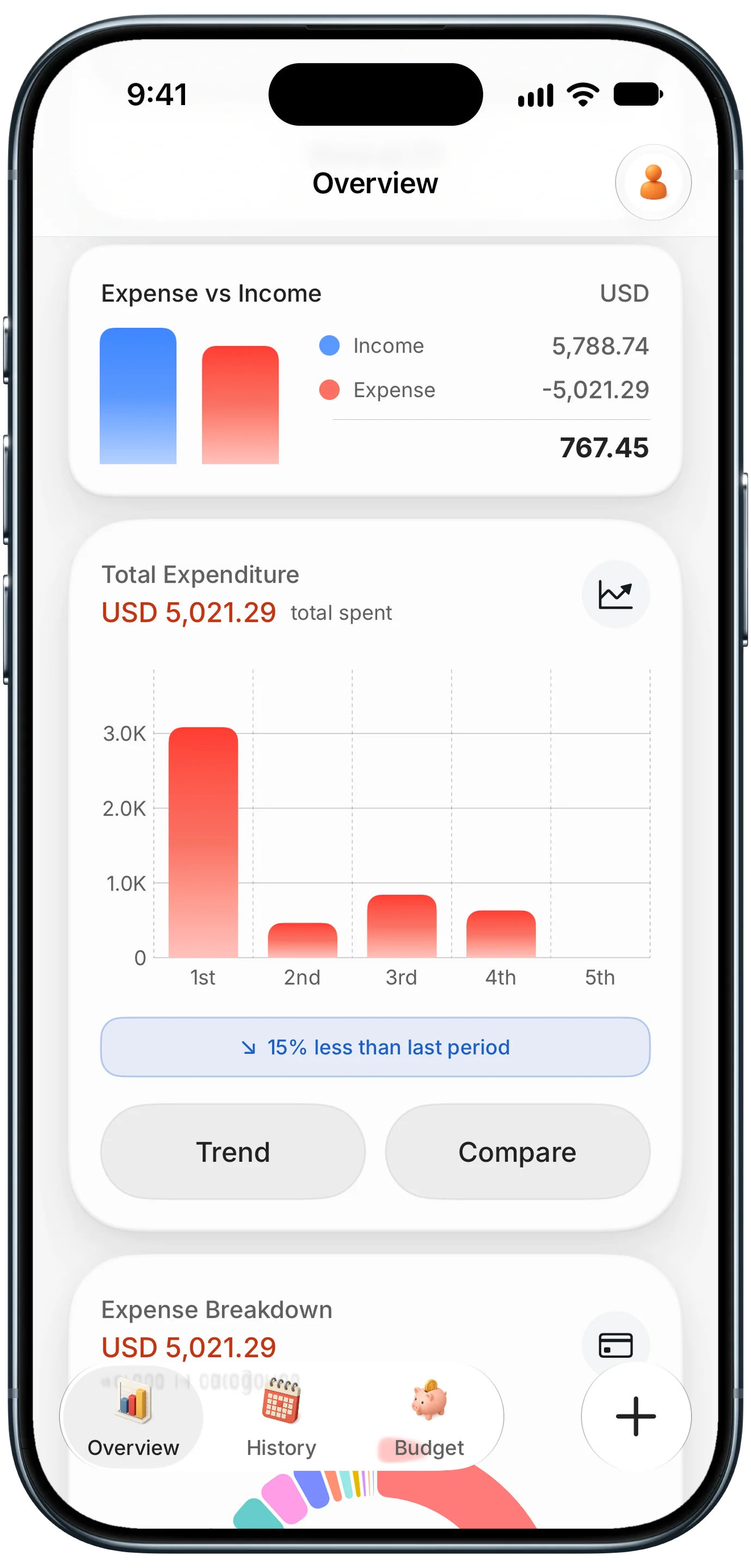
Finny app's Overview feature
Couples usually land on one of three setups:
- Each pays their own. Simple and clear, but the partner with more debt can fall behind on savings.
- One shared payoff pot. Both contribute to one debt budget that pays every debt in the chosen order. Usually the fastest route, and it takes the most trust.
- A mix. Each person pays the minimums on their own debts, and a shared amount goes toward the target debt.
If your incomes differ, a proportional split often feels fairest. With $5,000 and $7,000 in monthly take-home pay, the lower earner covers about 42% of the shared amount and the higher earner about 58%. Our guide to splitting bills fairly on different salaries walks through that math.
Write the agreement down in a sentence or two, and set a date to revisit it, such as every six months or after any raise or job change.
Put Every Payment on a Schedule
The quiet risk in a debt plan is a missed minimum. In Finny, you can log each loan payment once and turn on the Recurring switch on the entry form, so it repeats on its due date and comes with a reminder before it is due.
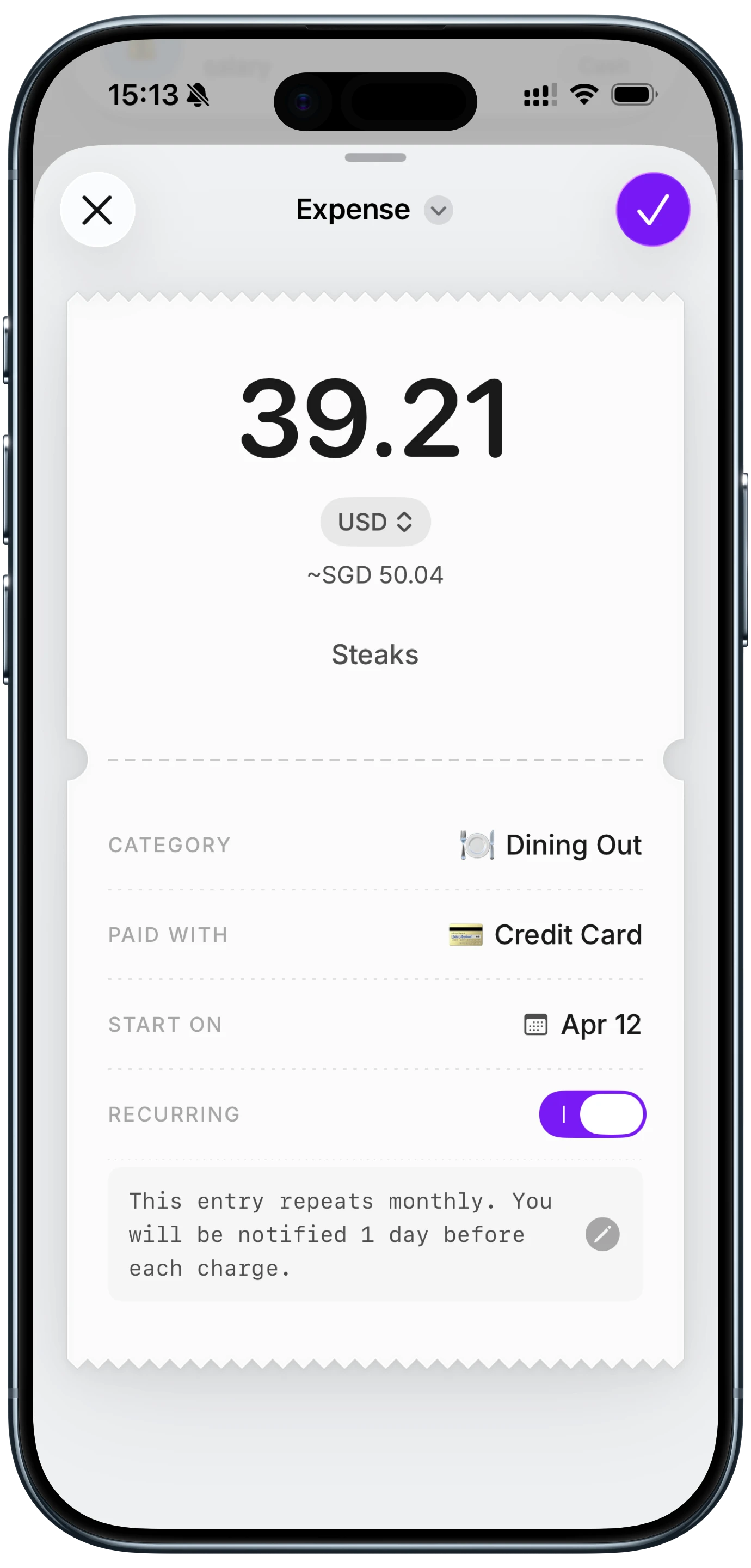
Finny app's expense entry feature
Recurring rules are free, and the upcoming bills card shows which payments are coming up next, so neither of you has to remember four due dates. Autopay with your lender is still a good safety net for minimums; the reminder is for the extra payment you choose to send on top.
Two notes so expectations are clear. Finny tracks the payments you make, not your loan balances, and it does not connect to your bank or lender. Keep the balances on your original list and update them once a month from each statement. That five-minute update becomes your progress check.
Tagging every extra payment with a hashtag like #DebtFree (a Pro feature) also helps. Search the tag later and the total shows how much you have paid toward the plan so far, split by category.
Share the Progress, Not Just the Plan
Debt plans often fall apart quietly: one partner pays, the other assumes it is fine, and months later nobody knows where things stand. A shared view fixes that, and several free budgeting apps for couples provide one without adding another bill. Finny Households lets up to 6 people share the entries they choose. On the Household screen, you can invite your partner and set new expenses to be shared by default, so loan payments reach both of you without an extra step.
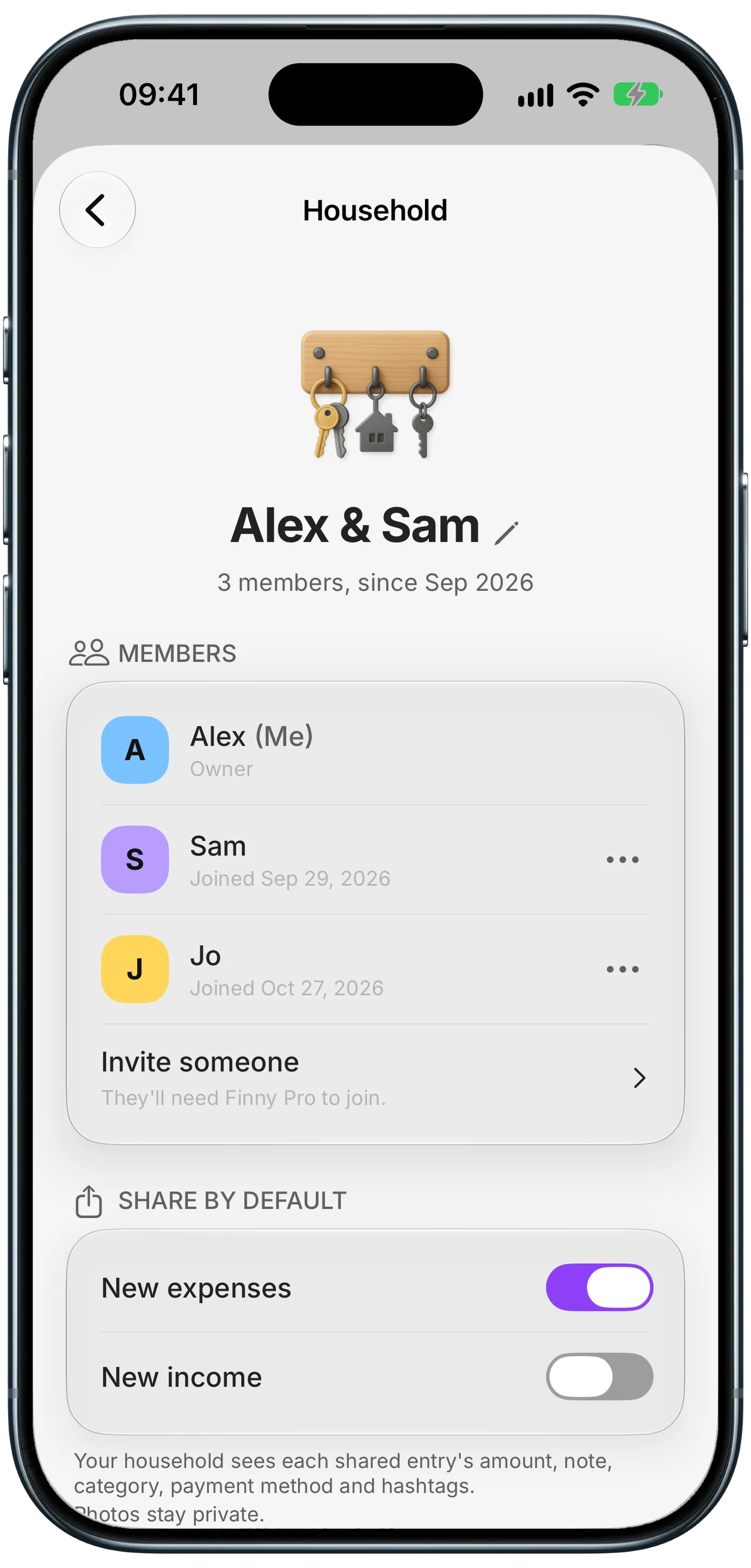
Finny app's Households feature
Shared payments show up in both of your Histories, marked with the initial of whoever paid. The household sees each shared entry's amount, note, category, payment method and hashtags, while photos and anything you do not share stay private. Only the person who logged a payment can edit or delete it. You can also keep sharing off by default and flip the Share with household switch only on loan payments.
Here is a quick look at Households in action:
Everyone in a household needs Finny Pro, and a family plan can cover your household through Apple Family Sharing. The Households launch post has the full details. One limit worth knowing: Finny shows who paid what, but it does not calculate who owes whom, so the agreement you wrote down stays the source of truth.
Stay Motivated for the Long Haul
Paying off debt together can take years, and motivation fades long before the balances do. A few habits help:
- Check in monthly, briefly. Update the balances, look at what each of you paid, and move on. Twenty minutes is plenty.
- Mark milestones. The first debt paid off, the halfway point of the total, the last card closed or paid to zero. Celebrate with something small that does not go on a card.
- Plan for setbacks. A car repair or a slow month will happen. Agree in advance that you drop to minimums for a month rather than abandoning the plan.
- Keep some personal money. A plan with zero room for either of you to buy a coffee without asking tends to break. Small personal amounts protect the bigger goal.
For shared habits beyond the payoff, our guide to tracking spending as a couple has a simple weekly routine.
Common Questions About Paying Off Debt as a Couple
Should we pay off debt or save first?
Most couples do both in a small way: keep a starter emergency fund so a surprise bill does not land on a credit card, then put extra money toward high-interest debt. Paying off a card charging 24% is a guaranteed return that savings rarely match. Lower-rate debt, like many student or car loans, can sit at its minimum while you build savings. The right balance depends on how stable both incomes are.
Am I responsible for my partner's debt?
Usually not for debt they took on alone, especially from before the relationship. Unmarried partners generally are not responsible for each other's debts unless they co-signed or share a joint account. For married couples, community property states can treat debt taken on during the marriage as shared. Rules vary by state, so for a specific situation, check your state's guidance or speak with a local attorney.
Does getting married affect my credit score?
No. The CFPB explains that credit scores are calculated on each person's own credit history, so marriage does not combine your reports. A spouse's low score does not lower yours. Joint accounts do appear on both reports, though, and a missed payment on one affects both partners. When you apply for credit together, lenders consider both scores.
Is it fair to pay off my partner's debt?
It can be, if you both agree to it and it fits your goals. Many couples see clearing one partner's high-interest card as a shared win, because it frees up money for both. Others prefer each person covering their own. What matters is that you decide on purpose, write it down, and revisit it if the relationship or your finances change.
Pay it down together, without sharing a bank login.
Finny keeps every loan payment on a schedule with reminders, and Households lets both of you see the payments the other has made.