Holiday Travel Budget 2026: Fly or Drive, Real Costs
Holiday trips rarely go over budget because of the flight. The fare is the number everyone looks at, so it gets planned. What breaks the budget is everything around it: the bag fees, the airport parking, the dog sitter, the rental car, the rideshare home at midnight, and the gifts that no longer fit in the suitcase.
This guide builds a holiday travel budget that counts all of it. We cover what fares look like this season, when to book, how to compare driving and flying with real per-mile numbers, the costs people forget, and a sample budget for a family of four. It leans on Christmas and New Year trips, since Thanksgiving is close. If you are working on a Thanksgiving travel budget or hosting the meal, our Thanksgiving budget guide covers the meal and the travel basics. For gifts, food and the rest of December, pair this with our holiday budget planner.
What Holiday Travel Costs in 2026
Start with a realistic picture of prices, because this is not a cheap year. Hopper's 2026 Holiday Travel Index, released at the end of September, found domestic round-trip fares averaging $402 for Thanksgiving, up 31% from last year, and $452 for Christmas, up 23%. Hopper said the season is on track to be the most expensive in a decade and pointed to high jet fuel costs as the main driver. Domestic hotel rates were flat at $170 a night for Thanksgiving but up 18% to $197 a night for Christmas.
Treat those as floors, not quotes. Hopper's index focuses on lower-priced tickets, so a family flying on peak days from a smaller airport will usually see higher numbers. Other trackers put typical holiday fares well above Hopper's averages for the same reason.
Driving is not immune either. AAA's 2026 Your Driving Costs study, published in September, notes that regular gas averaged $4.152 a gallon over the twelve months ending in May 2026. That raises the cost of every road trip compared with recent years.
The practical takeaway: price your actual route on your actual dates before you set the budget, and build in a buffer of about 10% for the costs you cannot see yet.
When to Book Holiday Flights
Timing matters more than any single trick. Google Flights published its 2026 holiday guidance on October 5, based on five years of its own fare data:
- Thanksgiving: fares typically hit their low point 34 days before departure, with a low-price range of 21 to 57 days out.
- Christmas: fares typically hit their low point 56 days before departure, with a low-price range of 33 to 67 days out.
As of today, October 31, Thanksgiving on November 26 is 26 days away. That is still inside the low range but past the typical bottom, so book soon if you have not. Christmas Day is 55 days away, which puts you right at the sweet spot. Counting back 33 days from December 25, the low-price window for Christmas trips closes around November 22.
Google's data also found that flying out on a Monday and returning on a Tuesday or Wednesday saved about 14% compared with weekend flights. The day you book barely matters: Wednesday came out cheapest, but only about 1.4% below Sunday. Hopper's advice points the same way, suggesting the Monday or Tuesday before Christmas for the lowest fares.
For New Year trips, the same logic applies. Midweek departures beat weekend ones, and flying on the holiday itself is often cheaper because fewer people want to.
Driving vs Flying: The Real Math
For a family, driving often wins on cost, but you need the right per-mile number to know by how much. AAA's 2026 study puts the average new vehicle at 17.3 cents per mile for fuel and 11.7 cents per mile for maintenance, repairs and tires. Together that is about 29 cents per mile in costs that actually rise with each mile you drive.
AAA's headline figure of 86 cents per mile at 15,000 miles a year includes depreciation, insurance and finance costs. Most of those you pay whether you take the trip or not, so 29 cents is the better number for a trip decision. If your car is a large SUV or a pickup, budget higher, and if your local gas price is below the study's average, lower.
A worked example for a 450-mile trip each way:
- Driving: 900 miles at 29 cents is about $261, plus tolls and food on the road.
- Flying: four tickets at Hopper's $452 Christmas average is $1,808 before bags, parking, a rental car and rides.
The gap narrows when the drive needs an overnight hotel each way, when it eats extra vacation days, or when only one or two people are traveling. A solo traveler going 900 miles each way may find flying cheaper and far less tiring. A family of four going 400 miles almost never will.
The Hidden Costs That Break Holiday Budgets
These are the lines most travel budgets leave out. Add each one that applies before you decide the trip is affordable.
- Checked bags. After spring 2026 fee increases, the first checked bag on American, Delta and United runs about $45 each way when paid in advance, and more at the airport. A family checking two bags pays $180 round trip.
- Seats together. Basic economy fares often charge to choose seats. If you need to sit with young children, price the fare that includes seat selection.
- Airport parking or rides. A week in an airport lot, or two rideshares at holiday surge prices, can add $80 to $200.
- Rental car at the destination. Holiday weeks are peak demand. Book early and compare with borrowing a family car.
- Pet care. Boarding or a sitter for five nights over Christmas often costs more than a plane ticket, and holiday spots fill early.
- Gifts in the suitcase. Gifts take space, which can mean an extra bag or shipping costs. TSA also warns that wrapped gifts may have to be unwrapped at screening, so wrap on arrival.
- Rideshare surge. Late-night arrivals and New Year's Eve are classic surge windows. Plan a pickup or budget for it.
- Host contributions. Groceries, a host gift, a dinner out to say thanks. These are real travel costs.
- Delays. Winter weather can mean airport meals or an unplanned hotel night. Your buffer exists for this.
Sample Holiday Travel Budget for a Family of Four
Here is an illustrative Christmas travel budget: a family of four visiting relatives 450 miles away for four nights, staying with family. Airfare uses Hopper's 2026 average, bags use the major airlines' prepaid fee, and driving uses AAA's 2026 per-mile figures. Every other line is an example estimate, so replace it with your own quotes.
| Category | Flying | Driving |
|---|---|---|
| Airfare (4 round trips at $452) | $1,808 | $0 |
| Checked bags (2 bags, both ways) | $180 | $0 |
| Seat selection | $80 | $0 |
| Car costs (900 miles at 29 cents) | $0 | $261 |
| Tolls | $0 | $40 |
| Airport parking or rides | $100 | $0 |
| Rental car at destination | $240 | $0 |
| Food in transit | $80 | $120 |
| Pet care (5 nights) | $250 | $0 (pet rides along) |
| Shipping gifts | $60 | $0 (they go in the trunk) |
| Host contribution and outings | $200 | $200 |
| Buffer (about 10%) | $300 | $60 |
| Total | $3,298 | $681 |
The difference is stark, and it is why so many families drive at the holidays. If the drive were 900 miles each way, you would add two hotel nights and more food, and the gap would shrink but still favor the car. If you need a hotel at the destination, add four nights at Hopper's $197 Christmas rate, about $788 before taxes.
Set the budget, then split it into the categories you plan to track. Those same categories make the post-trip review easy.
How to Track Spending During the Trip
A budget only helps if you can see where you stand mid-trip, and that depends on logging purchases as they happen rather than reconstructing them from a card statement in January. Small holiday costs are exactly the ones memory drops: the airport coffee, the gas station snacks, the parking meter outside the mall.
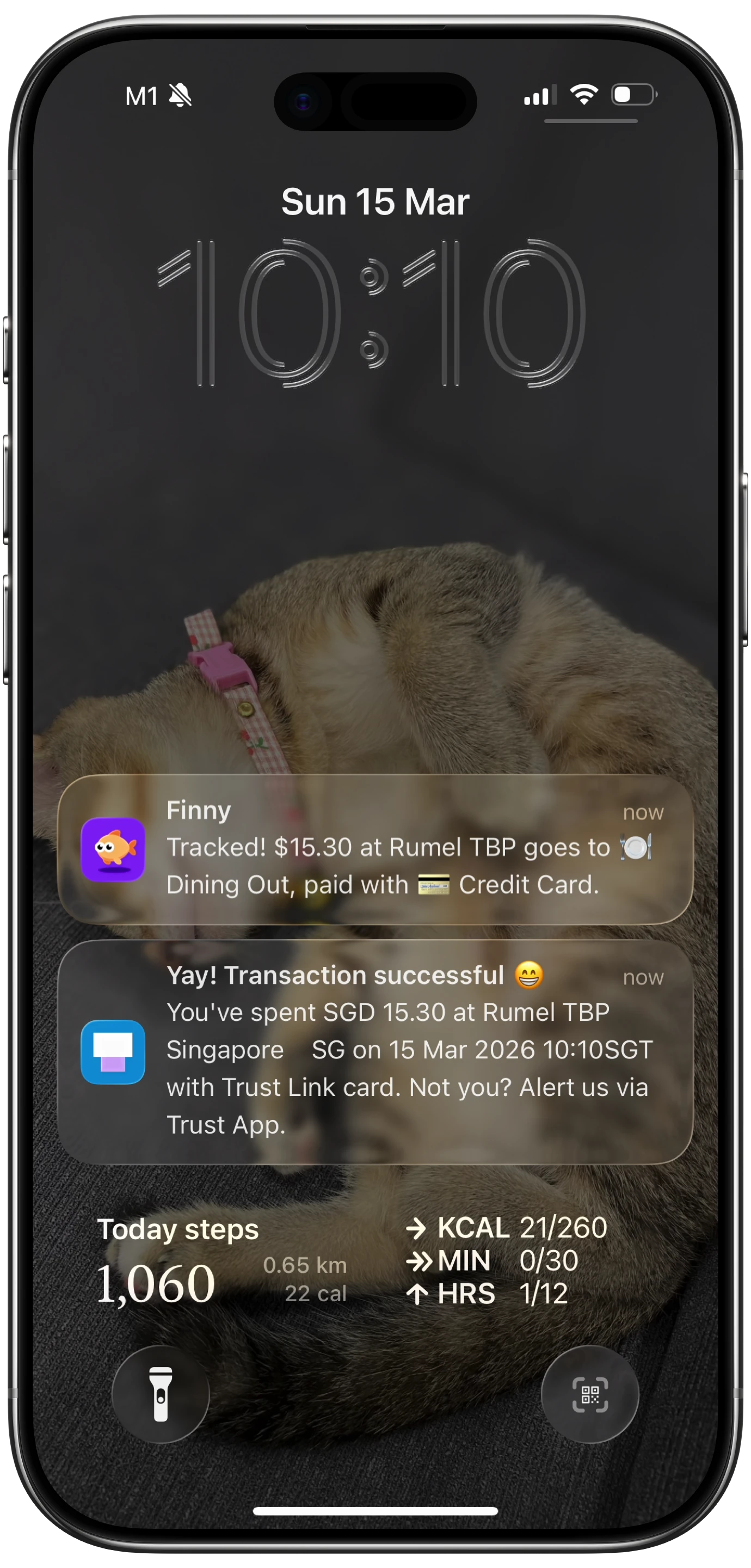
Finny app's Tap to Track feature
The simplest method is one tag per trip. Give every expense from the trip the same label, such as #xmas26, so you can total the whole trip at any time without moving entries out of their normal categories. Dinner out still counts as Dining, and it also adds into what Christmas cost.
In Finny, that tag is a hashtag (a Pro feature), and searching for it shows a receipt-style total for the whole trip in your home currency, broken down by category and payment method. Card payments get logged as you make them, with a short confirmation like the one above, so nothing depends on remembering later. Here is what that looks like:
Check the running total every day or two. If the trip is trending over, you still have time to swap a dinner out for a meal at home or skip one paid outing.
International Legs: Keep the Original Currency
If any part of the trip crosses a border, such as New Year's in Canada, Mexico or Japan, log every expense in the currency you actually paid rather than converting it in your head.
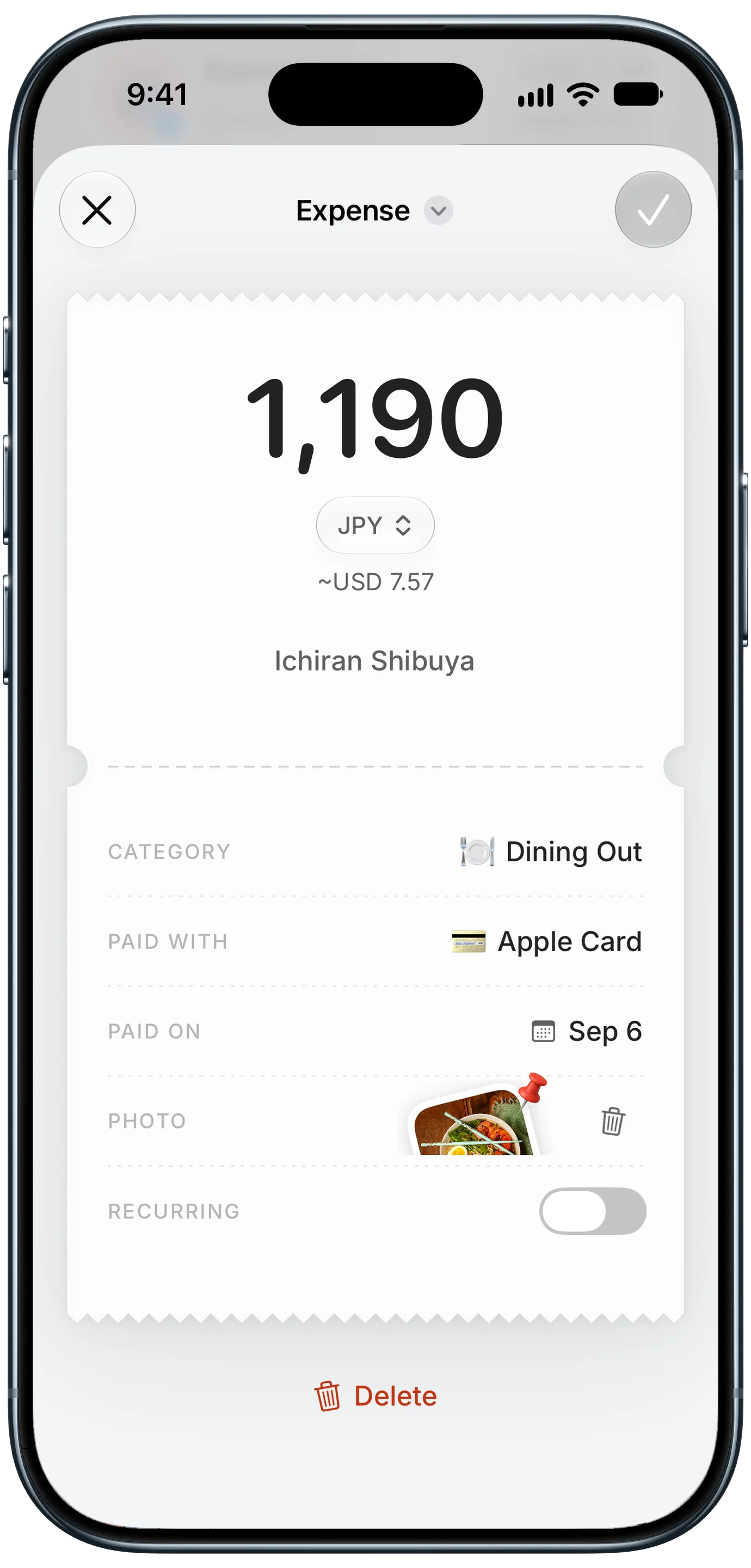
Finny app's multi-currency feature
A ramen bowl stays 1,190 yen in the record, with the dollar value shown underneath, and the trip total still adds up in dollars. Finny's Unified Currency View works this way: each entry keeps its original currency, and every total converts to your home currency. Converting at the register leads to rounding errors that compound over a week, and it makes your records impossible to match against receipts.
Watch for two other international costs. Foreign transaction fees can add around 3% on cards that charge them, so pack a card that does not. And when a card terminal offers to charge you in dollars instead of the local currency, decline: that conversion usually comes with a worse rate. Our guide to exchange rates in a travel budget explains why the original amount matters when your card statement arrives, and our travel budget app comparison covers dedicated trip apps if you want one just for the journey.
The Post-Trip Review
Within a week of getting home, while you still remember the details, compare what you planned with what you spent. It takes fifteen minutes and makes next year's budget far more accurate.
- Pull the trip total. Search your trip tag or filter by the trip dates and get one number.
- Compare by category. Which lines came in over plan? For most families it is food, rides and the small purchases nobody wrote down.
- Settle up. If relatives shared costs like groceries, gas or a cabin, square them now. Our guide on splitting expenses on a trip covers fair methods.
- Write three notes for next year. When you booked, what the fare was, and the one cost that surprised you. Save them with the budget.
- Close the gap. If the trip ran over, decide where the difference comes from in December or January rather than letting it ride on a card.
If the overspend is large, our guide to recovering from an overspent vacation walks through a calm plan to absorb it over the next few months. The goal is not a perfect trip budget. It is a better one each year.
Common Questions About Holiday Travel Budgets
How much should I budget for holiday travel?
Price your own route first, then add the extras. For a domestic family trip in 2026, start with airfare at roughly $400 to $450 per round-trip ticket based on Hopper's averages, or about 29 cents a mile if you drive. Then add bags, parking, pet care, a rental car, host contributions and a 10% buffer. Our sample family of four came to about $3,300 flying and under $700 driving for a 450-mile trip.
When should I book Christmas flights in 2026?
Google Flights data published in October 2026 shows Christmas fares typically bottom out about 56 days before departure, with a low-price range of 33 to 67 days out. For a December 25 trip, that means booking between late October and about November 22. Flying out on a Monday and returning on a Tuesday or Wednesday saved about 14% compared with weekend travel in Google's data.
Is it cheaper to drive or fly for the holidays?
For families, driving is usually much cheaper on trips up to several hundred miles. AAA's 2026 figures put the per-mile cost of fuel plus maintenance at about 29 cents, so a 900-mile round trip costs roughly $261 in car costs. Four plane tickets at holiday prices often top $1,600 before bags and parking. Flying wins for solo travelers and very long distances.
How do I track spending on a holiday trip?
Give every trip expense the same tag, log purchases as they happen rather than from memory, and keep foreign expenses in the currency you paid. Check the running total every day or two so you can adjust before the trip ends. When you get home, compare the total and each category against your plan and note what to change next year.
Want the whole trip's cost in one number?
Download Finny to tag every expense from a trip, see the total in your home currency, and log card payments as you make them, with no bank connection. Free to start, with Pro at a low monthly or yearly price.