How to Make a Budget for 2027: A 10-Step Reset
Most new-year budgets are written on January 1, fall apart by the second week, and get abandoned by February. The problem is rarely discipline. It is that the budget was built in a hurry, from guesses, with no room for the bills that only show up once a year.
This guide covers how to make a budget for 2027 the calmer way: start in late fall, use your real 2026 numbers, and have the whole plan working before the first paycheck of January. The ten steps fit into a few evenings in November and December, and include a sample annual budget you can copy.
Step 1: Review What You Actually Spent in 2026
A budget built on guesses is a wish list. Before you set a single number for 2027, pull your 2026 totals by category.
Use your statements or tracking app to total the big groups: housing, groceries, dining out, transportation, subscriptions, shopping, travel, and gifts. Rounded category totals for January through October, multiplied by 1.2 to estimate the full year, are enough to start.
Note which categories ran higher than you guessed, which expenses happen once a year, and which months broke the pattern. Our year-end money review walks through this in about an hour, and it is the best prep step for everything below.
Step 2: List Every Source of Income, Including the Irregular Ones
Write down what lands in your account each month after taxes and deductions. Budget with take-home pay, not salary, because take-home is the only number you can actually spend.
Then list the income that does not arrive on a schedule: freelance work, commissions, bonuses, tax refunds, side gigs, and cash gifts. A sensible rule is to build the monthly budget on your reliable base income only, and treat irregular money as a top-up that goes straight to a goal when it arrives.
If most of your income is variable, budget from your lowest typical month instead of your average. Good months then fill savings and sinking funds rather than raising your spending. Our guide on how to budget with variable income covers the baseline method in detail.
Step 3: Pick a Budgeting Method That Fits You
The method matters less than whether you stick with it. Three approaches cover most people:
| Method | How it works | Best for |
|---|---|---|
| 50/30/20 | 50% needs, 30% wants, 20% savings and debt | Beginners who want a simple guardrail |
| Zero-based | Every dollar gets assigned until income minus plan equals zero | Tight budgets, paying off debt |
| Envelope | Fixed amounts per category; when an envelope is empty, spending stops | Overspenders, shared households |
The 50/30/20 rule is the lightest touch. You track only three buckets. See what is the 50/30/20 rule for how to adjust the split in high-cost areas.
Zero-based budgeting asks you to give every dollar a job before the month starts. Our zero-based budgeting guide walks through a first month.
Envelope budgeting sets a hard limit per category and stops spending there when it runs out. It is the most visual of the three, explained in what is envelope budgeting. You can also mix methods, such as 50/30/20 for the big picture and envelopes for the two categories you tend to overspend.
Step 4: Turn Annual and Irregular Expenses Into Sinking Funds
This is the step most budgets skip. Car registration, holiday gifts, annual subscriptions, insurance premiums, back-to-school costs, and the vet visit are all predictable. They just do not happen monthly, so they wreck whichever month they land in.
The fix is a sinking fund: divide each yearly expense by 12 and set that amount aside every month. A $1,200 holiday budget becomes $100 a month. A $480 car registration and inspection becomes $40 a month. When the bill arrives, the money is already sitting there.
Use your 2026 review from Step 1 to build the list. Go month by month and write down every expense that is not part of a normal month, then total them. Our explainer on what a sinking fund is covers how to hold the money, whether in one savings account or several.
Step 5: Build Your Sample Annual Budget
Now put the pieces together. Here is a sample annual budget for a single earner taking home $5,200 a month ($62,400 a year). Adjust each line to your own 2026 numbers.
| Category | Monthly | Annual |
|---|---|---|
| Rent or mortgage | $1,560 | $18,720 |
| Utilities, internet, and phone | $260 | $3,120 |
| Groceries | $520 | $6,240 |
| Transportation (car payment, gas, insurance) | $520 | $6,240 |
| Debt payments | $260 | $3,120 |
| Dining out and entertainment | $390 | $4,680 |
| Subscriptions | $60 | $720 |
| Personal and household | $230 | $2,760 |
| Giving | $100 | $1,200 |
| Sinking funds (gifts, car upkeep, travel, annual fees) | $400 | $4,800 |
| Emergency fund | $300 | $3,600 |
| Retirement savings (IRA) | $300 | $3,600 |
| Buffer | $300 | $3,600 |
| Total | $5,200 | $62,400 |
The $400 sinking fund line breaks down as $100 a month for holiday gifts, $100 for car maintenance and registration, $150 for travel, and $50 for annual memberships and fees. Unspent buffer gets swept into savings.
Retirement contributions taken out of your paycheck, such as a 401(k), are already excluded from take-home pay, so they do not appear here. The IRS usually announces next year's 401(k) and IRA contribution limits in the fall, so check the official 2027 figures before setting your contribution rate for January. For building the emergency line, see how to build an emergency fund.
Step 6: Set Category Limits You Can Actually Track
An annual plan only works if you can see, during the month, how close you are to each limit. Turn the monthly column into spending limits for the categories that move: groceries, dining out, shopping, and entertainment.
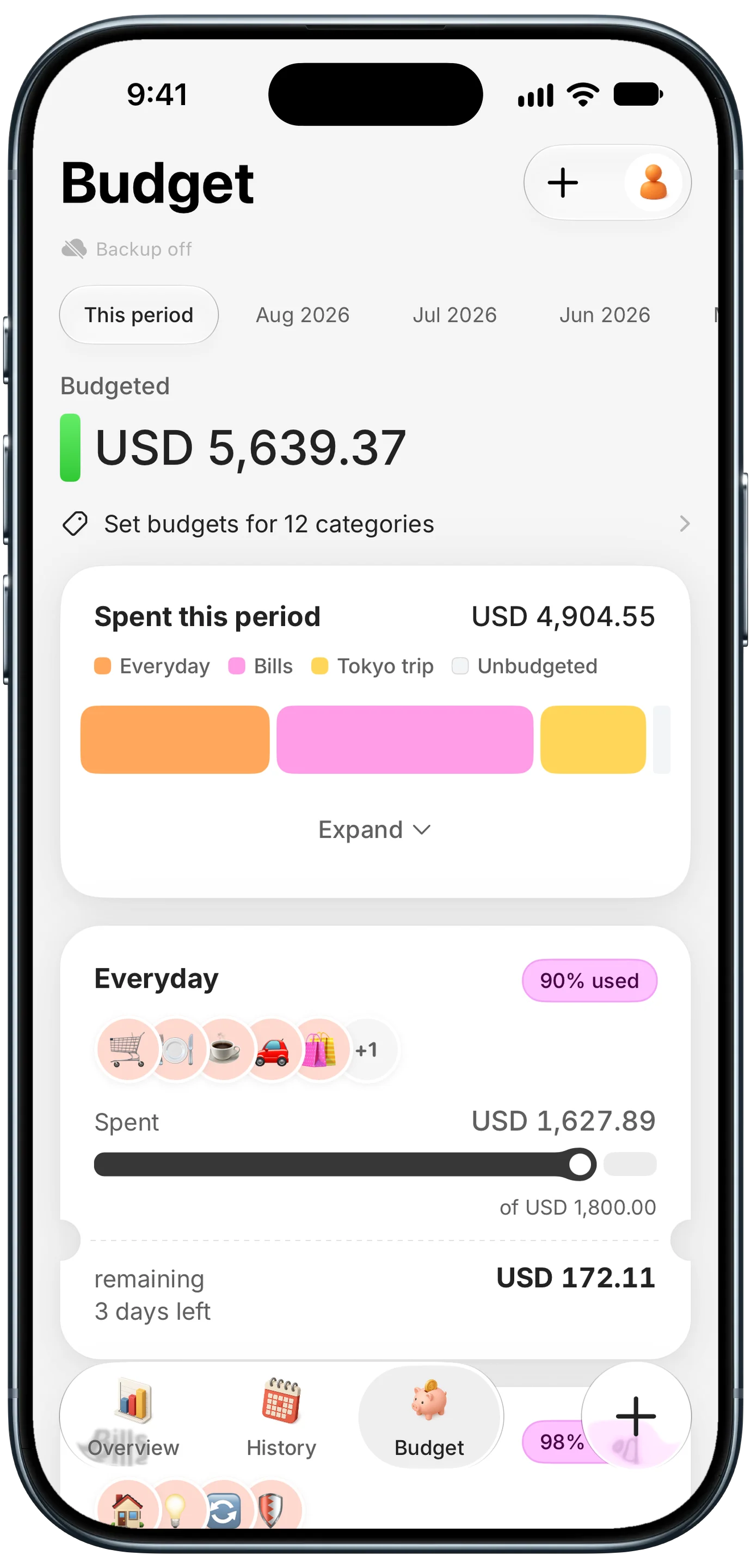
Finny app's Budgets feature
Keep the number of tracked categories small. Three to six limits is plenty for most people, and grouping related spending (say, one "Everyday" budget for groceries, coffee, and household basics) is easier to follow than fifteen narrow ones. Set the limit slightly below what you spent in 2026 if you want to cut back, and never more than 10% to 15% lower in one jump. Aggressive cuts tend to snap back by March.
Check your limits at least weekly. Hitting 90% in week three is useful; finding out at month end is not.
Step 7: Align Your Budget Month With Your Payday
If you get paid on the 25th, a budget that runs from the 1st to the 31st splits each paycheck across two months. The last week looks like overspending and every comparison is slightly off. The fix is to start your budget month on payday.
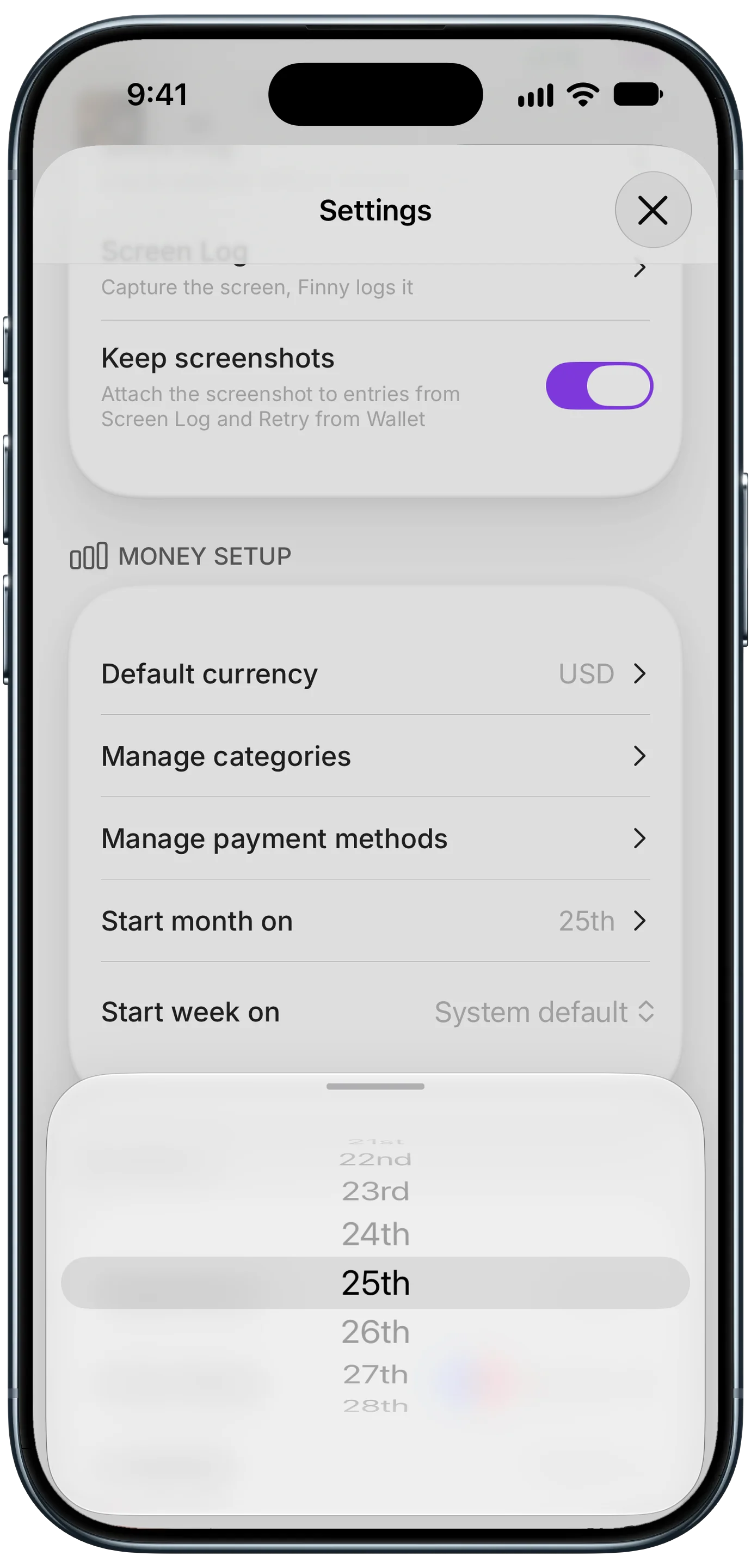
Finny app's custom month start feature
Most budgeting apps lock you into calendar months, so check before you commit to one; our best budgeting apps for 2027 compares the main options. In Finny, the custom month start is part of Pro (a low monthly or yearly price) and lets your month begin on any day from the 1st to the 28th, so budgets, charts, and totals all follow your pay cycle. Our roundup of budget apps that let you change the month start goes app by app, and why budget apps split your paycheck explains the underlying problem.
If you are paid every two weeks, pick the payday closest to the start of the month and accept that two months a year will have a third paycheck. Treat that extra paycheck as irregular income from Step 2.
Step 8: Audit Your Subscriptions Before January
Subscriptions are the easiest money to recover and the easiest to forget. Prices also rise quietly.
Go through the last three months of card and bank statements and list every recurring charge, including annual renewals. For each one, ask whether you used it in the last month and whether you would sign up again today at the current price. Cancel the clear no's, set calendar reminders a week before annual renewals you are unsure about, and put the total of what is left in the subscriptions line of your budget. Our guide to auditing your subscriptions in 20 minutes walks through it without paying for a cancellation service.
If many of your subscriptions are billed to cards or online accounts, logging those charges as they appear makes the next audit much faster. This video shows a payment on your iPhone screen being logged without a bank connection:
Step 9: Set Three Money Goals for 2027
A budget with a goal feels like progress rather than restriction. Pick no more than three for the year, and make each one specific, dated, and funded by a line in your budget.
Good examples: "Build a $5,000 emergency fund by December 2027" ($417 a month), "Pay off the $3,600 credit card balance by June" ($600 a month), or "Save $1,800 for a September trip" ($150 a month as a sinking fund). If a goal does not map to a monthly number in Step 5, it is a wish, not a goal.
Order matters. Most people do best with a small emergency fund first, then high-interest debt, then longer-term saving. Automating the transfer on payday, sometimes called paying yourself first, removes the monthly decision entirely.
Step 10: Schedule a Monthly Check-In
The budget you write in December is a draft; the monthly check-in turns it into a system. Put a recurring 20-minute appointment on your calendar for the day after each payday or the first weekend of each budget month.
Use the same short agenda every time:
- Compare each category's spending to its limit and note the two biggest gaps.
- Adjust next month's limits if a category is consistently over or under.
- Fund your sinking funds and goals, and move any leftover buffer into savings.
- Check for new recurring charges or price increases.
- Write down one thing to do differently next month.
Expect the first few months to be messy. That is the reason to start in the fall: by January, your plan has already survived a test month.
Common Questions About Making a 2027 Budget
When should I start making my 2027 budget?
Start in November or early December. That gives you nearly a full year of 2026 spending to work from and time to run a test month before January. Starting early also lets you catch December costs, such as holiday gifts and travel, that often derail a budget written on New Year's Day. If you are reading this in January, it is still fine: use your last three months of statements as the starting point and refine the numbers as the year goes on.
What is the easiest budgeting method for beginners?
The 50/30/20 rule is usually the easiest, because it only asks you to track three buckets: needs, wants, and savings or debt payments. You do not need to plan every category in detail to get started. Once you are comfortable, you can move to zero-based budgeting for tighter control, or add envelope limits to the one or two categories where you tend to overspend. The best method is the one you will still be using in April.
How much should I put in sinking funds?
Add up every expense from 2026 that did not happen monthly, such as gifts, car registration, insurance premiums, annual subscriptions, and travel, then divide the total by 12. That monthly figure is your sinking fund contribution. Many households land somewhere between $200 and $600 a month, but your number depends entirely on your own list. If the total feels too high, fund the most certain expenses first and add others over the year.
How do I make a budget if my income changes every month?
Build your monthly plan on your lowest typical month of take-home pay, not your average. Cover essentials and minimum debt payments with that base amount. When a better month arrives, send the extra to a buffer account first, then to sinking funds and goals. Over time, the buffer lets you pay yourself a steady amount each month regardless of when the money comes in. Avoid raising your spending limits based on one good month.
Ready to start 2027 with a budget that follows your paycheck?
Download Finny to set category budgets, track spending with AI, receipts, or text, and start your month on payday. No bank connections, offline support, and full control over your financial data.