Holiday Budget Planner: Track Christmas Spending 2026
Most holiday overspending is not caused by one extravagant purchase. It is caused by twenty reasonable ones spread across eight weeks, none of which felt like a decision at the time. By the time the January statement arrives, the total is a surprise, and nobody can point to where it came from.
A holiday budget planner fixes that by doing two things: fixing a number before the season starts, and tracking against it while the season is happening. The second half is where most plans fail. This guide covers both, with a category split you can copy and a way to keep the running total honest without spreadsheet homework.
For the broader method behind this, see our guide to sinking funds, which is the mechanism that makes holiday budgets work in the first place. The first big expense of the season usually lands in November, and our Thanksgiving budget guide covers it line by line.
Start With a Number You Can Defend
Pick the total before you pick the gifts. Working the other way around guarantees the total is whatever the gifts happened to cost.
A defensible number answers one question: what can leave your accounts between now and December without borrowing? If the honest answer is $600, the plan is $600, regardless of what you spent last year or what anyone else is spending.
Two ways to land on it:
- Work back from cash. Count the paychecks left before the holidays. Decide what portion of each can go to holiday spending. Multiply. That is your ceiling.
- Work back from January. Picture the statement you want to open in January. Whatever total would not ruin the month is your ceiling.
Write the number down somewhere you will see it again. A budget that lives only in your head is not a budget.
For context on where your number sits, our breakdown of how much Americans spend on Christmas covers the national averages and why they are a poor target.
Split the Total Before You Spend Any of It
Gifts are the obvious category and rarely the whole story. The categories that break holiday budgets are the ones nobody planned for.
| Category | Typical share | Why it gets missed |
|---|---|---|
| Gifts | 55 to 65% | The only one most people plan |
| Food and hosting | 10 to 15% | Spread across many small grocery trips |
| Travel | 10 to 20% | Flights are planned, everything around them is not |
| Decorations and cards | 5% | Feels too small to count, adds up |
| Shipping and wrapping | 3 to 5% | Almost never budgeted |
| Tips and donations | 3 to 5% | Arrives all at once in December |
Take your ceiling and assign every dollar to one of these before December starts. If the split does not fit, the ceiling was too low or the gift list is too long, and it is far easier to fix that in September than on December 18th.
If you have never allocated by category before, envelope budgeting is the simplest version of this idea.
Fund It Over Time, Not All at Once
Here is the part that separates a plan from a wish. A $900 holiday budget starting in September is $100 a week for nine weeks. The same $900 starting December 1st is $300 a week, which is exactly the pressure that puts holidays on a credit card.
Set the weekly amount now and move it somewhere separate. A dedicated savings account works. So does simply not spending it. The point is that the money exists before the shopping starts, so December becomes a spending decision rather than a borrowing decision.
Track As You Go, Not At the End
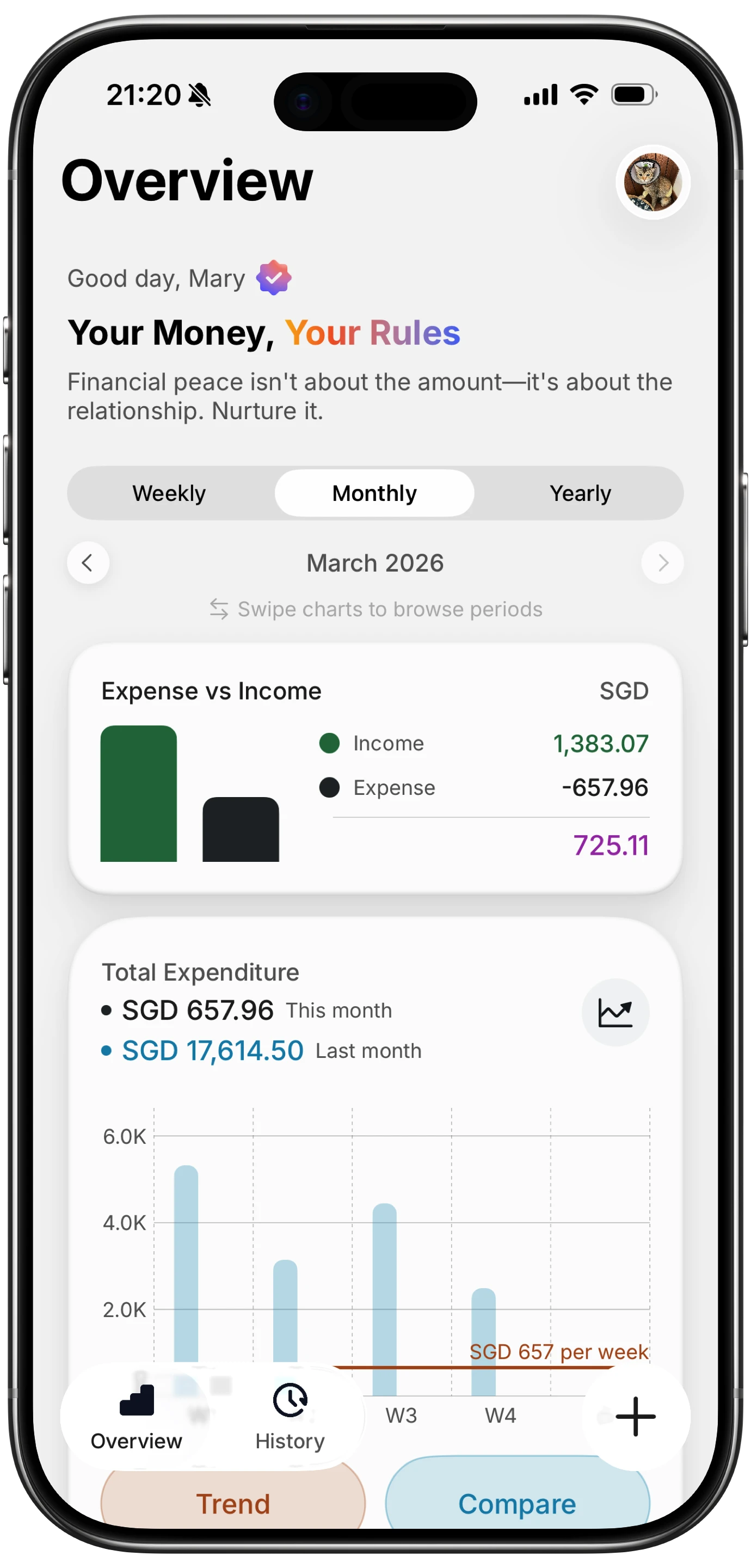
A holiday budget planner is only useful if the running total is current. This is where most people lose, because holiday spending is unusually fragmented: online orders, in-store taps, cash to a relative, a grocery run for the party, a last-minute gift on the way to dinner.
Finny app's Overview feature
Three approaches, honestly compared:
Bank app alone. Free and automatic, but transactions post one to three days late and arrive with merchant names that tell you nothing. In a normal month that is fine. In December, a three-day lag means you find out you blew the gift budget after you blew it.
Spreadsheet. Total control, and it works if you actually update it. Most people update it twice and stop around the second week of December.
A tracking app that captures in the moment. Logging at the point of spending keeps the running total accurate, which is the only thing that changes behavior while there is still time to change it.
We compared the options for this specific job in the best apps to track holiday spending, and the single largest spending weekend has its own guide in the Black Friday budget.
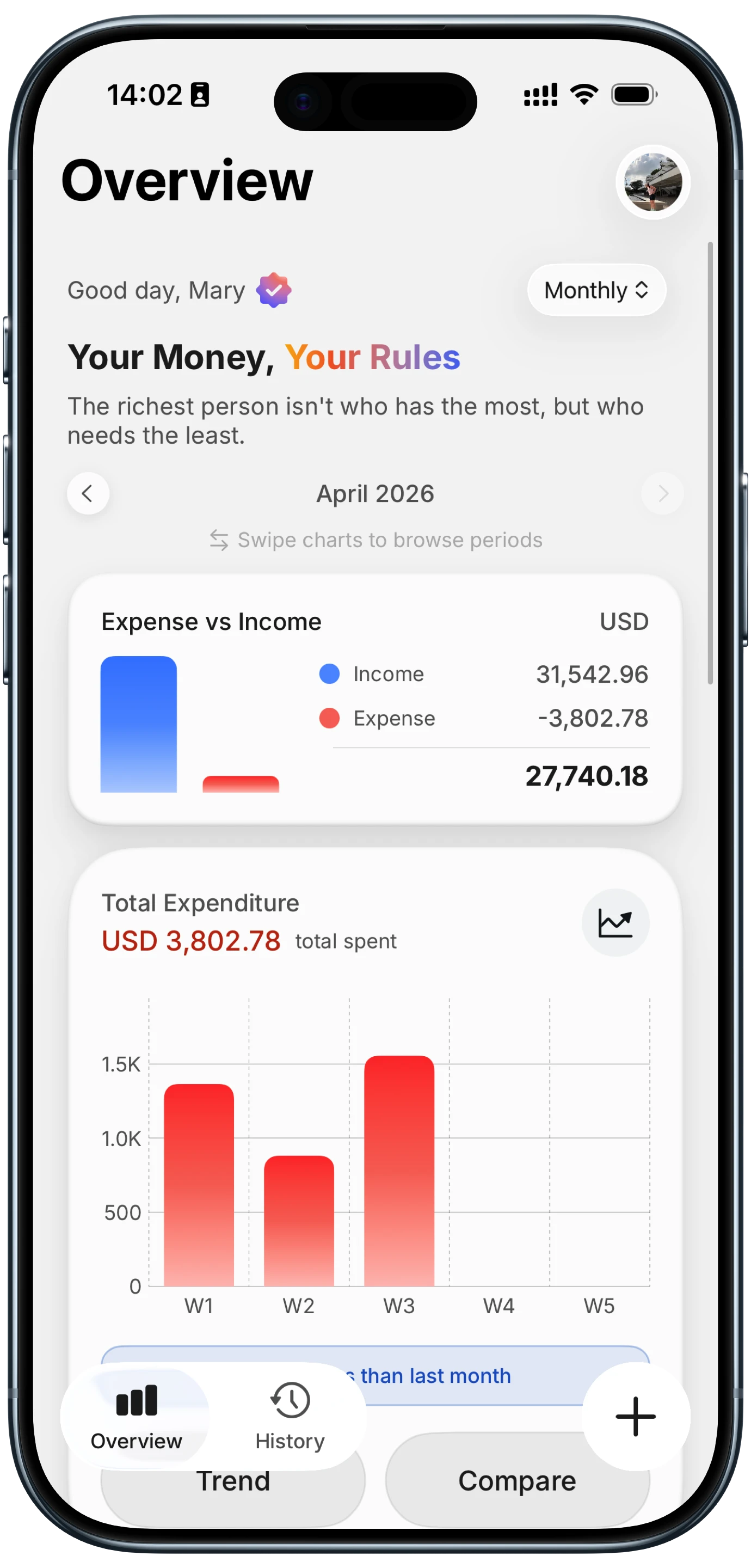
Finny handles the capture side: card payments get logged as you make them, receipts get captured from your photo library, and online orders can be logged straight from what is on screen, all without a bank connection. Set a holiday category in September and the running total stays current through December.
Online orders are most of holiday shopping, and this video shows how a payment on screen gets logged:
Run a Weekly Check, Not a Daily One
Daily checking turns into anxiety and then avoidance. Weekly is enough to catch drift while there is still room to correct.
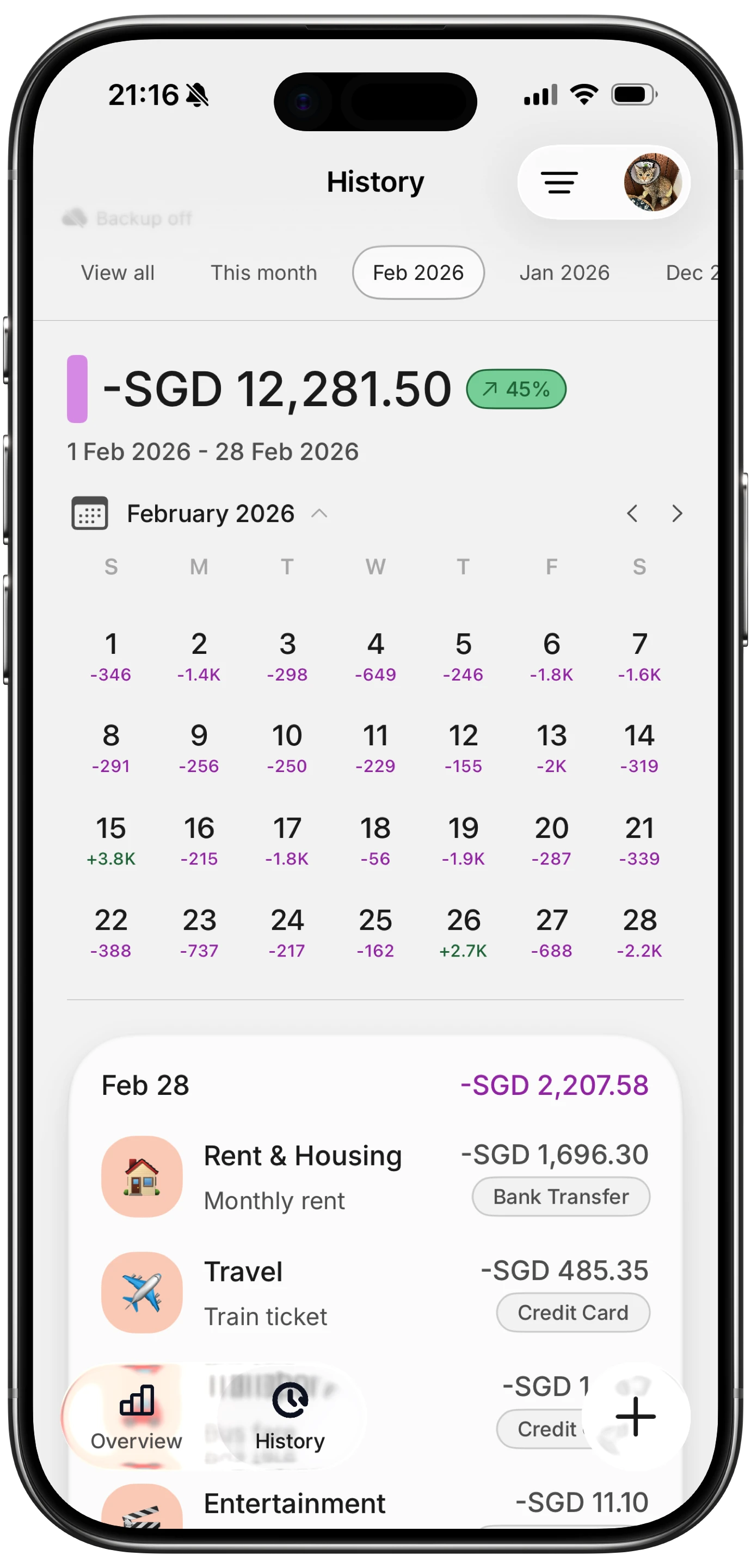
Five minutes, once a week, on the same day:
- Open the running total for the holiday category.
- Compare it against where you planned to be by this week.
- Look at the largest three purchases since the last check.
- Adjust the remaining gift list if you are ahead of pace.
- Close it and go do something else.
Finny app's History calendar feature
The adjustment step is the whole point. Being over budget on December 5th is a solvable problem. Being over budget on December 26th is just information.
What To Do When You Go Over Anyway
You may still go over, and the plan should survive it.
Do not respond by abandoning tracking, which is the standard reaction and the expensive one. Spending you refuse to look at does not stop. Instead, recalculate what is left, cut from the categories with the least emotional weight (decorations, wrapping, cards, your own incidental purchases), and protect the ones that matter.
If the season ends over budget, our guide on recovering from overspending applies directly, and how to stop overspending covers the patterns that cause it.
The Bottom Line
A holiday budget planner is three decisions and one habit. Decide the ceiling in September, split it by category before December, fund it weekly, and keep the running total current enough that you can still change course.
The tracking is the part people skip and the only part that changes an outcome. A perfect plan with no tracking produces the same January statement as no plan at all.
Common Questions About Holiday Budget Planning
When should I start a holiday budget?
September or October is ideal, because it lets you fund the total across ten to twelve weeks instead of two. Starting in November still works but concentrates the pressure, and starting in December usually means financing part of the season on credit. If you are reading this in December, set a ceiling for what remains rather than skipping the exercise entirely. A partial budget applied to the last three weeks still prevents the worst outcomes.
How much should I spend on Christmas?
There is no correct figure, only a figure your January can absorb. The practical test is whether the total can leave your accounts without borrowing and without touching your emergency fund. Work back from the paychecks remaining before the holidays rather than from last year's spending or from what the people around you appear to spend. A budget you set from your own cash flow is one you can actually hold.
What is the best way to track holiday spending?
The best method is whichever one you will keep current in December, since accuracy matters more than sophistication. Bank apps are automatic but lag by a few days, which is too slow when spending is concentrated. Spreadsheets work if you maintain them. Apps that log purchases at the moment they happen keep the running total honest, which is what lets you adjust while there is still time.
Should I use a credit card for holiday shopping?
A credit card is fine if the balance is already funded and you clear it in full, and it adds fraud protection and rewards. It becomes a problem when it substitutes for a budget, because the bill arrives after the season ends and the spending decisions are no longer reversible. The safer pattern is to fund the holiday total in cash first, then put the spending on a card and pay it off immediately.
Ready to track expenses with less friction?
Download Finny to log expenses using AI, receipts, or text. No bank connections, offline support, and full control over your financial data.