Actual Budget Review 2026: The Free Open-Source YNAB
Every time a budgeting app raises its price, the same name surfaces in the replies: Actual Budget. Free, open source, MIT licensed, and built on the same envelope method that made YNAB popular. It is the app people recommend when they are done paying $109 a year to categorize their own transactions.
It is genuinely good. It also asks something of you that a subscription app does not, and the reviews that skip that part are not being straight with you.
What Actual Budget Is
Actual Budget is an open-source, local-first budgeting app. It began as a commercial product, and the original author later bought it back and released it under the MIT license. Development now happens in the open with a large contributor base.
Two words in that description do the heavy lifting:
Open source means the code is public, free to run, and cannot be taken away from you, repriced, or shut down by a company decision. The Mint shutdown made a lot of people care about this for the first time.
Local-first means your budget file lives on your device, not on someone's server. The app works with no internet connection. Sync is optional, and when you use it, data is encrypted on your device before it leaves, so a sync server stores blobs it cannot read.
The Budgeting Method
Actual uses envelope budgeting, and specifically the zero-based flavor: you assign every dollar you currently have to a category until nothing is unassigned. You budget money you actually hold, not income you expect.
If that method is new to you, our explainers on envelope budgeting and zero-based budgeting cover the mechanics. If you already used YNAB, you will be at home within an hour. The concepts map almost directly, including the practice of covering overspending by moving money between categories rather than pretending it did not happen.
The interface is dense and spreadsheet-like. Whether that is a feature depends entirely on you. People coming from spreadsheets tend to love it. People coming from a polished mobile app often find it cold.
What It Does Well
It is free, permanently. Not a free tier with a cap. The full application, no feature gates.
It is fast. Because the data is local, the app responds instantly. No spinner while a server fetches your transactions.
It handles complex budgets. Multiple accounts, transfers, scheduled transactions, rules for automatic categorization, and reports you can build yourself. The depth is closer to a spreadsheet than to a consumer app.
You own the data. A budget file you can copy, back up, and read without the app's permission. There is no export process, because there is nothing to export from.
It runs offline. Genuinely useful when travelling. Our guide to offline expense tracking covers why that matters more than people expect.
What It Costs You (Not in Money)
This is the part the enthusiastic reviews gloss over.
Sync means running a server
Actual on one device is simple. Actual on your laptop and your phone means a sync server. The server ships as a single Docker container and runs comfortably on a small VPS, but "runs comfortably on a 512 MB VPS" is a sentence that assumes you know what a VPS is, are willing to rent one for a few dollars a month, and will apply updates.
There are hosted options that run it for you for a small monthly fee, which is a fair trade. But note what has happened: the free app now has a bill and a maintenance task attached.
Bank sync is not free and not simple
Actual can import transactions automatically, but not through its own service:
- In North America, the common route is SimpleFIN, which costs roughly $15 a year.
- In Europe, the GoCardless route now requires a paid business account for new signups in 2026, since the free personal tier is gone.
So the free app costs $15 a year plus a server if you want the automatic imports a paid app includes. That is still far cheaper than YNAB. It is not zero, and the setup is a genuine project.
Plenty of people skip bank sync entirely and import CSV files from their bank once a week, which is free and works fine if you are disciplined about it.
Mobile is the weak point
The mobile experience has improved but remains secondary to the desktop and web app. If your budgeting habit is "log the coffee while standing at the counter," this is not the app that will support it. Actual is built for a weekly sit-down session, not for capture in the moment.
Who Should Use Actual Budget
Use it if you:
- Already budget with the envelope or zero-based method and want to stop paying for it
- Are comfortable with Docker, a VPS, or a hosted provider
- Care about owning your data and not being repriced
- Do your budgeting at a desk, weekly, in a real session
Skip it if you:
- Want to open an app, log an expense in five seconds, and close it
- Have no interest in running or renting a server
- Need reliable automatic bank imports with no setup
- Would describe yourself as budget-curious rather than budget-committed
That last one is the honest dividing line. Actual rewards people who already have the habit. It is not a good place to build one, because the friction that gets between you and a new habit is exactly the friction it asks you to accept up front.
Actual Budget vs the Paid Alternatives
| App | Cost | Method | Bank sync | Data location | Mobile |
|---|---|---|---|---|---|
| Actual Budget | Free, plus ~$15/yr for sync services and any server cost | Envelope, zero-based | Via SimpleFIN or GoCardless | Yours | Secondary |
| YNAB | $109/yr | Envelope, zero-based | Included | Their servers | Strong |
| Monarch Money | $99.99/yr | Flexible categories | Included | Their servers | Strong |
| Finny | Free tier, Pro a low monthly price | Track then review | None by design | On device | Primary |
The YNAB comparison is the one people actually want. Actual is a deliberate reimplementation of the same method, so the question is not which budgets better. It is whether $109 a year buys you enough polish, support and mobile quality to be worth it. For someone who enjoys running their own tools, obviously not. For someone whose budget dies when setup gets complicated, obviously yes. Our roundup of best YNAB alternatives covers the wider field, and best budget apps Reddit recommends explains why Actual keeps coming up in those threads. Our Actual Budget vs YNAB comparison breaks that trade-off down, including the real yearly cost of sync.
The Habit Problem No Budgeting App Solves
Finny app's Quick Log feature
Here is the thing that sinks most budgets, whichever app you choose: the budget is accurate on Sunday and fiction by Wednesday, because expenses happen away from your desk and get remembered later, badly.
Actual is excellent at the Sunday part. It is not built for Wednesday.
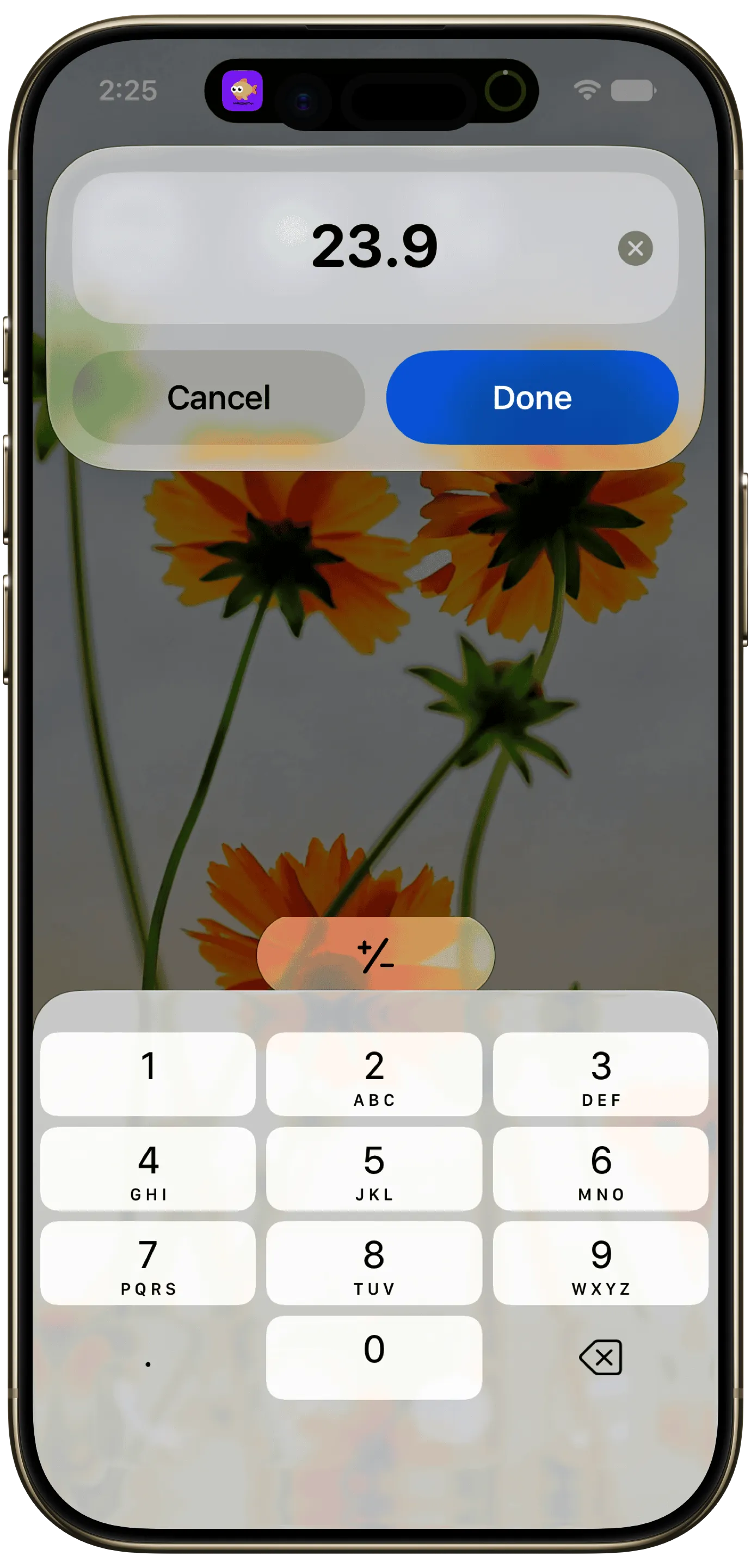
Wednesday looks more like this, with the purchase recording itself as it happens:
Finny app's History calendar feature
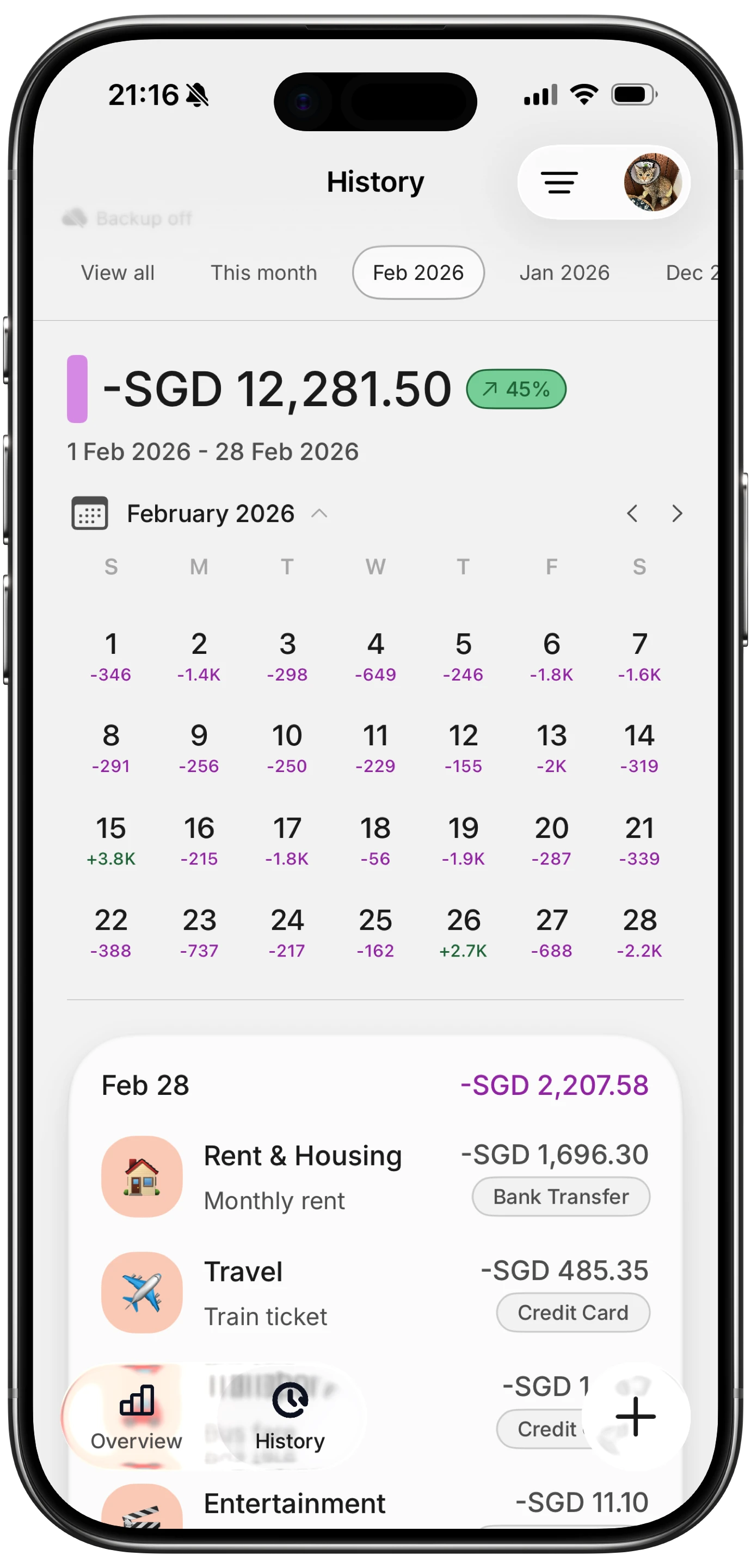
That gap is why some people run a fast capture app on their phone alongside a serious budgeting tool on their desktop. Finny is built for capture: log an expense in a few seconds, in the currency you paid in, with no bank connection and no server to run. Export to CSV whenever you want to reconcile it against your real budget. It does have budgets, with monthly limits per category group and optional rollover, but it is not a zero-based envelope system and does not try to be. What it mainly does is make sure Wednesday's spending is still in the record on Sunday.
Common Questions
Is Actual Budget really free?
The application is free and open source under the MIT license, with no paid tier. Costs appear only if you want extras: a server for syncing across devices, or a bank aggregation service such as SimpleFIN at roughly $15 a year.
Is Actual Budget a good YNAB alternative?
It is the closest one available. It implements the same zero-based envelope method, and people migrating from YNAB usually adapt within a session or two. The gaps are mobile polish, official support, and bank sync being something you configure rather than something that works out of the box.
Do I have to self-host Actual Budget?
No. On a single device it works with no server at all. You only need a server to sync between devices, and you can either run it yourself or pay a hosted provider a few dollars a month.
Is my data safe with Actual Budget?
Your budget file stays on your device, and sync data is encrypted before it leaves, so a sync server holds data it cannot read. The trade-off is that backups are your responsibility. Nobody else has a copy.
Does Actual Budget work on iPhone?
Yes, there is a mobile app, but it is the weaker half of the product. Actual is designed around desktop and web sessions, so treat mobile as a companion rather than the main way you use it.
Need something for the moments away from your desk? Finny logs an expense in seconds, in any currency, with no bank connection and no server to maintain. Free to start, Pro at a low monthly price.