FSA Deadline 2026: Use It or Lose It Before Dec 31
Every January, a lot of people discover they left money in a flexible spending account and their employer kept it. Nobody spent it on anything frivolous. They just forgot the balance existed, or assumed they had until tax season, or could not find the receipts to file a claim.
The FSA deadline 2026 works the same way it has for years: for most plans, money you set aside for 2026 has to be spent on eligible expenses by December 31, with a small safety net that depends on your employer. This guide covers the 2026 limits, the difference between a grace period, a carryover and a run-out period, what is worth buying before the year ends, and how to track eligible spending so the claim is easy when you file it.
This is general information, not tax or medical advice. Your plan document is what actually governs your account, so check it or ask your benefits administrator before you rely on any date below.
How the FSA Deadline Works in 2026
A health flexible spending account lets you set aside pre-tax salary for medical, dental and vision costs. For 2026, the IRS caps that salary reduction at $3,400 per employee, up from $3,300 in 2025, under Rev. Proc. 2025-32. Your employer can set a lower cap, and some add their own contribution on top.
The catch is the use it or lose it rule. IRS Publication 969 describes FSAs as generally "use-it-or-lose-it" plans: whatever is left at the end of the plan year is forfeited unless your plan offers one of the two exceptions covered below. Forfeited money goes back to the employer, not to you.
Two details catch people out:
- Your full election is usually available on day one. Health FSAs are generally front-loaded, so you can spend the year's whole amount in January even though it comes out of your paycheck gradually. That makes a big early expense, like a dental crown, easier to plan.
- Not every plan runs on the calendar year. Most do, which is why December 31 is the date everyone repeats. If your plan year runs July to June, your deadline is June 30, and everything in this guide shifts by six months.
As of late October 2026, the IRS has not yet announced the 2027 health FSA limit. It usually arrives with the fall inflation adjustments, so if you are choosing a 2027 election during open enrollment right now, your employer's enrollment materials are the place to check.
The deadline is also the main thing that separates an FSA from a health savings account: HSA money is yours and rolls over every year, while FSA money belongs to the plan year. If you are weighing the two at open enrollment, our HSA vs FSA guide compares eligibility, limits and rollover rules side by side.
Grace Period, Carryover or Neither
Employers can soften the deadline in one of two ways, but not both. Publication 969 is explicit that a plan adopting a carryover provision is not permitted to also offer a grace period for a health FSA. Many plans offer neither.
| Option | What it does | 2026 figure | Typical date for a calendar-year plan |
|---|---|---|---|
| Carryover | Rolls a capped amount of unused money into next year | Up to $680 (plan may set less) | Leftover rolls into 2027 |
| Grace period | Lets you keep incurring eligible expenses after year end | Up to 2.5 months | March 15, 2027 |
| Neither | Unused money is forfeited | None | December 31, 2026 |
The FSA carryover 2026 cap is $680 for amounts rolling from a 2026 plan year into 2027, up from $660 the year before. Anything above your plan's carryover cap is still forfeited. Carried-over money also does not count against next year's contribution limit.
The FSA grace period works differently. Instead of moving money forward, it extends the spending window by up to two and a half months, so an eye exam on March 3 can be paid from 2026 funds. Your employer cannot pay out an unused balance as cash at the end of a grace period either.
If you do not know which one you have, assume neither until you confirm otherwise. That assumption costs you nothing and protects the whole balance.
The Run-Out Period Is for Paperwork, Not Spending
A run-out period is the third date in the picture, and it is the one most often confused with the other two. It gives you extra time to submit claims for expenses you already incurred during the plan year. It does not give you extra time to spend.
For a calendar-year plan, a run-out commonly ends around March 31, but the length is set by your employer and can be 30, 60 or 90 days or longer. A receipt from a December 18 pharmacy visit can be submitted in February. A pharmacy visit in February, on a plan without a grace period, cannot be paid from 2026 money at all.
This matters for budgeting because the run-out period is where receipts become the bottleneck. If you spent $900 of eligible money across the year but only kept receipts for $500, the run-out period will not help. You need the documentation, and administrators often ask for an itemized receipt showing what was bought, not just a card statement line showing where.
The practical rule: treat December 31 as the spending deadline and the run-out date as the filing deadline, and do not plan on using the second one as a buffer for the first. Our guide on how long to keep receipts covers what is worth holding onto after the claim is paid.
Dependent Care FSA Rules Are Different
A dependent care FSA covers childcare, day camp and adult day care so that you can work. It sits under different rules from a health FSA, and mixing them up is an easy way to lose money.
The limit changed for 2026. Legislation passed in 2025 raised the dependent care FSA cap to $7,500 per household, or $3,750 if married filing separately, the first increase since the 1980s. It is a household limit, so two working parents cannot each put in $7,500. Employers had to adopt the higher limit in their plans, so confirm yours did.
Three other differences:
- No carryover. The carryover option applies only to health FSAs. A dependent care FSA can offer a grace period of up to two and a half months, but leftover money does not roll forward.
- Not front-loaded. You can generally only be reimbursed up to what has been contributed so far, unlike a health FSA.
- Timing follows the care. The expense counts when the care is provided, not when you pay. Prepaying January daycare in December does not use up a 2026 balance.
If you have both accounts, track them separately. They have different deadlines in practice, and a single "FSA" label hides that.
What to Buy Before December 31
Most FSA eligible expenses fall into a few groups. Since 2020, over-the-counter medicines and menstrual care products no longer need a prescription, which makes topping up the medicine cabinet the easiest way to use a small leftover balance. Your administrator publishes its own eligible list, and it is the final word.
Commonly eligible without extra paperwork:
- Copays, deductibles and coinsurance for doctor, dental and vision visits
- Prescription medicines
- Over-the-counter pain relievers, allergy, cold and flu medicine, antacids
- Menstrual care products
- First-aid kits, bandages, thermometers, blood pressure monitors
- Prescription glasses, contact lenses and solution, reading glasses
- Broad-spectrum sunscreen of SPF 15 or higher, at most administrators
- Pregnancy tests, condoms, and many fertility and family planning products
- Dental work such as cleanings and fillings, and orthodontia
Usually needs a letter of medical necessity:
- Vitamins and supplements
- Massage therapy
- Gym memberships or fitness programs tied to treating a condition
- Weight-loss programs, which IRS Publication 502 treats as medical only when they treat a specific diagnosed disease
- Air purifiers and similar dual-purpose items
Generally not eligible: cosmetic procedures, teeth whitening, and everyday toiletries.
A letter of medical necessity is a note from your provider explaining why the item treats a condition. Ask for it before you buy, since administrators can deny a claim that arrives without one.
How to Spend FSA Money Before the End of the Year
If you are wondering how to spend FSA money before end of year, the order matters more than the list. Medical appointments fill up in December, and stocking up on bandages is the least valuable way to use a large balance.
- Check your balance and your plan type. Log into your administrator's portal and confirm the remaining balance, whether you have a carryover or grace period, and the run-out date.
- Book appointments first. An eye exam, a dental cleaning or a specialist visit you have been putting off is worth more than shelf items. Schedule before mid-November if you can.
- Fill prescriptions and refills. A 90-day supply bought in December counts as a 2026 expense.
- Replace glasses or contacts. A year's supply of contacts can use several hundred dollars sensibly.
- Then stock up. Medicine cabinet, first aid and sunscreen are good for the last $50 to $150.
- Leave room for the carryover. If your plan carries over up to $680, there is no need to spend down to zero. Spend down to the carryover cap and let the rest roll.
Do not buy things you would not use just to avoid forfeiting money. Losing $40 is better than spending $40 on something that expires in a drawer.
Track Eligible Spending Through the Year
The people who lose FSA money are rarely the ones who spent too little. More often they spent plenty on eligible things and could not total them or find the receipts when it was time to claim. The fix is to mark eligible spending at the moment it happens, not to reconstruct it in March.
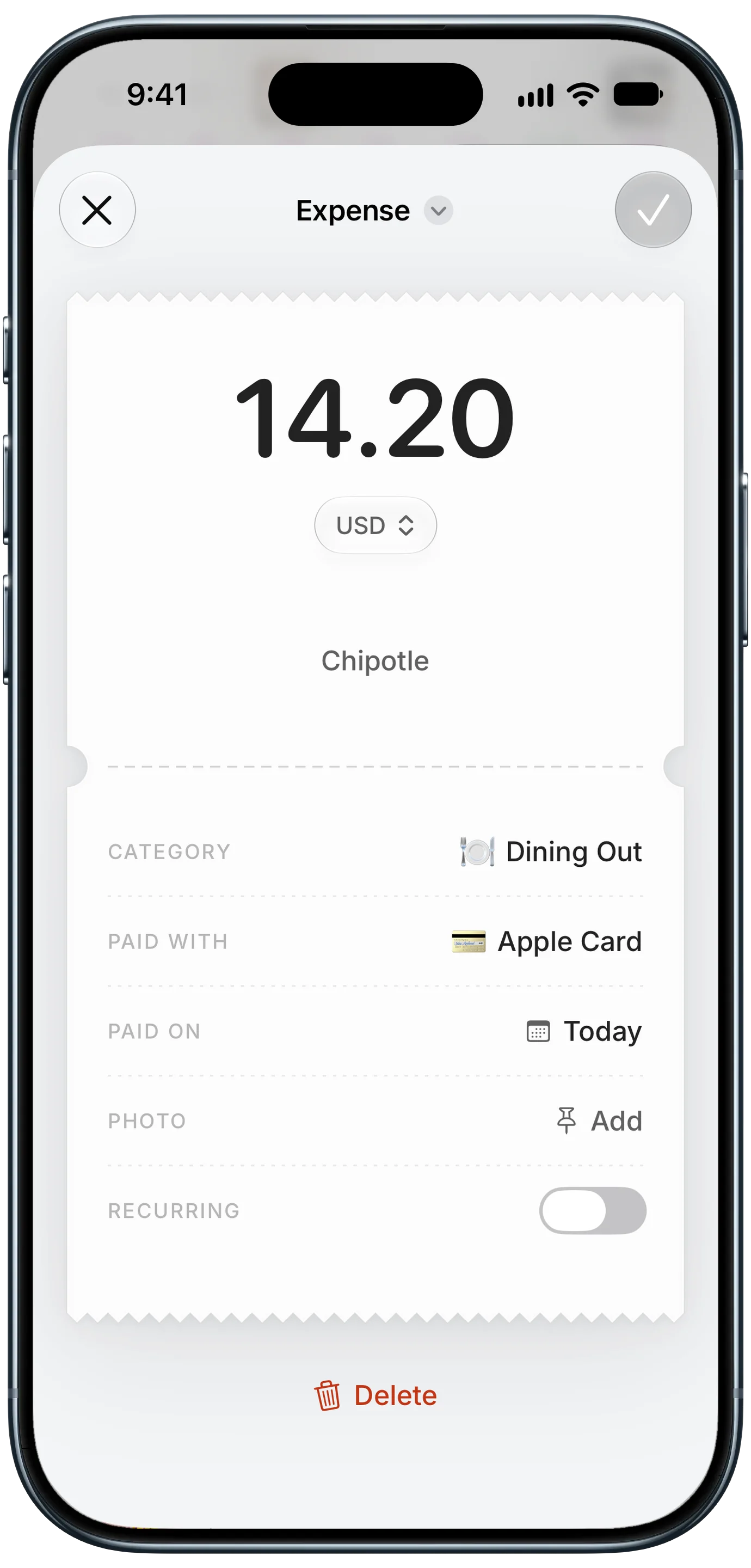
Finny app's expense entry feature
Two habits do most of the work:
- Keep every itemized receipt. Pharmacy receipts, optometry invoices and dental statements, saved somewhere you can find them. A photo the same day beats a paper slip in a coat pocket. Our guide on how to store receipts digitally compares the options on iPhone.
- Tag each eligible purchase. Whatever category the purchase belongs in, Health or Pharmacy or Groceries, add a tag that marks it as FSA eligible. Categories answer "what was it", the tag answers "can I claim it", and you need both.
In Finny, that tag is a hashtag. Add #fsa to each eligible entry, and searching #fsa later shows every tagged entry with the total at the top, whatever category each one sits in. That total is the number you compare against your FSA balance in December and against what you have already claimed. Hashtags and receipt capture are part of Pro (a low monthly or yearly price, with a 3-day free trial). Finny does not file claims or connect to your FSA administrator: it keeps the record you file from.
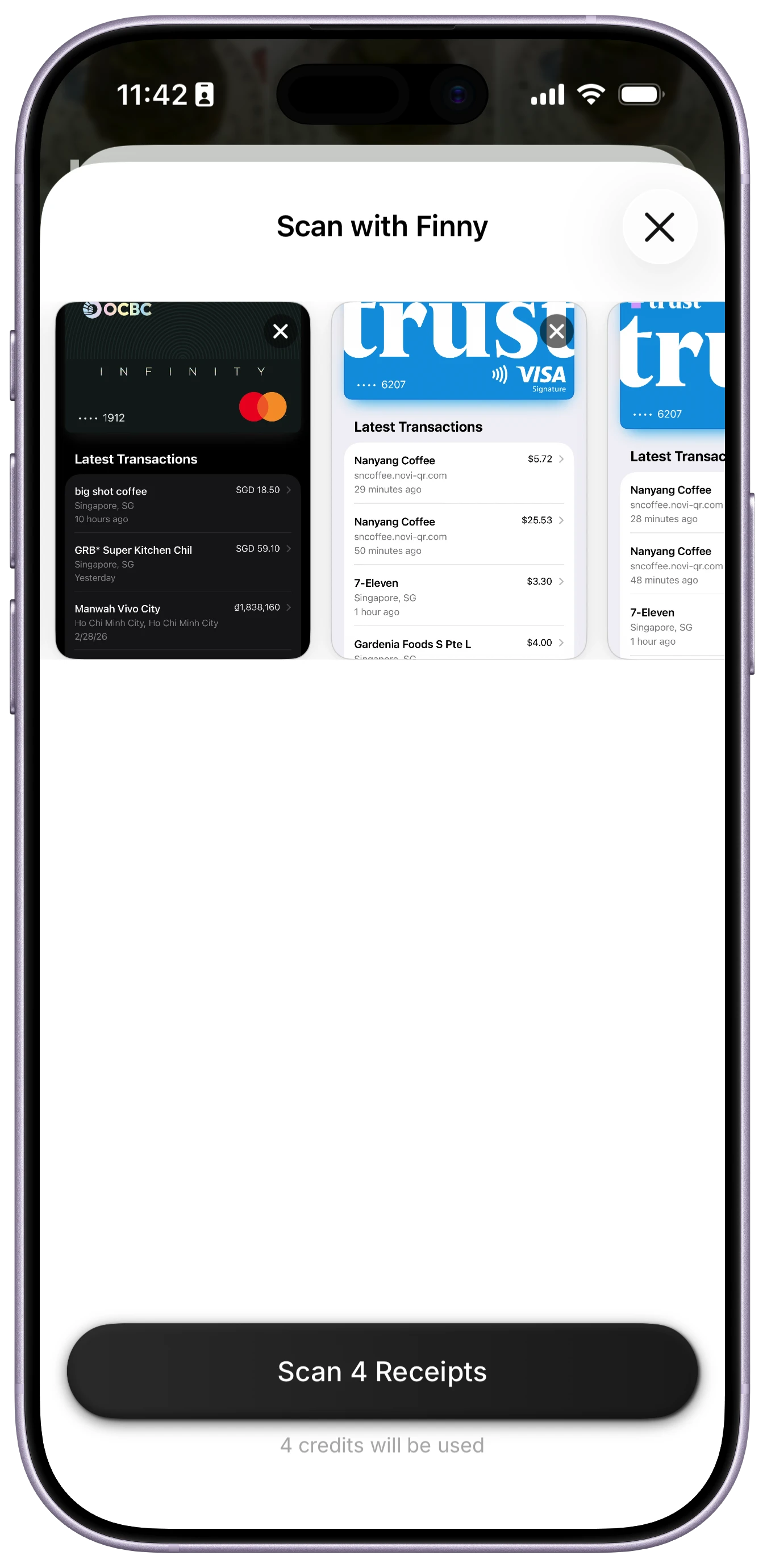
Finny app's batch scanning feature
If receipts pile up, scanning several at once turns them into entries in one pass, and attaching the receipt photo keeps it with the entry for claim time. For a batch of December pharmacy runs, that is the difference between doing it and not. We cover the approach in more depth in batch receipt scanning.
December pharmacy runs and copays are mostly card payments at a counter. This video shows how card payments get logged as you make them, so the entry exists before the receipt goes missing:
Add the FSA balance check to your year-end money review so it gets looked at before December, not after.
Common Questions About the FSA Deadline
When is the FSA deadline in 2026?
For a calendar-year plan, the spending deadline is December 31, 2026. If your plan offers a grace period, you can keep incurring eligible expenses until as late as March 15, 2027. If it offers a carryover instead, up to $680 rolls into 2027 and the rest is forfeited. The claim filing deadline is separate: the run-out period, often around March 31, set by your employer. Plans on a non-calendar year have their own dates, so check your plan document.
Can I have both an FSA grace period and a carryover?
No. IRS rules say a health FSA that adopts a carryover cannot also offer a grace period, so your employer picks one, or neither. Separately, almost every plan has a run-out period, which is extra time to submit claims for expenses you already incurred during the year. A run-out period does not let you spend after the deadline, so do not treat it as a grace period when planning December purchases.
What is the FSA limit for 2026, and has the 2027 limit been announced?
The 2026 health FSA limit is $3,400 per employee, set by IRS Rev. Proc. 2025-32, and the maximum carryover into 2027 is $680. The dependent care FSA limit rose to $7,500 per household for 2026. As of late October 2026, the IRS has not yet published the 2027 health FSA limit, which normally comes with its fall inflation adjustments. Check your employer's open enrollment materials for the figure your plan will use.
Do I need receipts to use my FSA?
Usually, yes. Many FSA debit card swipes at pharmacies and doctors' offices are approved automatically, but administrators can still ask for an itemized receipt to substantiate a purchase, and manual claims always need one. A card statement line is rarely enough because it shows the store, not the item. Keep receipts for every eligible purchase until the claim is paid and the plan year is closed, and keep letters of medical necessity with them.
Ready to know exactly what you can claim before the deadline?
Download Finny to tag eligible spending as it happens and see the running total in one search. No bank connection, nothing to profile, and your data stays under your control.