Open enrollment asks you to choose between acronyms in a week or two. The HSA and the FSA both let you pay medical costs with pre-tax money, but they work very differently, and the wrong pick can mean forfeiting money in December.
This guide walks through HSA vs FSA in plain terms: who can open each account, the 2026 and 2027 contribution limits, what happens to unspent money, whether you can have both, and how to keep the receipts that prove your spending was qualified. If you are also reviewing retirement options this fall, our explainer on what a Roth IRA is covers the other big tax-advantaged account most workers can use.
HSA vs FSA: The Short Answer
A health savings account (HSA) is a personal account you own, available only if you are covered by a qualifying high-deductible health plan. Money rolls over forever, can be invested, and follows you between jobs. A flexible spending account (FSA) is an employer account available with most health plans, but unspent money is generally forfeited after the plan year.
Both cover qualified costs like prescriptions, dental work, and glasses. The difference is in the strings attached.
- An HSA is closer to a savings or investment account with a medical purpose. You keep it if you change jobs, retire, or switch plans.
- An FSA is closer to a prepaid annual allowance. You choose an amount, your employer makes the full amount available from the first day of the plan year, and you need to use it within that year (with limited exceptions).
HSA vs FSA Comparison Table
Here is how the two accounts line up as of October 2026. The 2027 HSA limits come from IRS Revenue Procedure 2026-24. The 2027 health FSA limit had not been announced at the time of writing, so check your benefits portal before you finalize your election.
| Feature | HSA | Health FSA |
|---|---|---|
| Who owns it | You | Your employer |
| Eligibility | Must be covered by an HSA-eligible high-deductible health plan (HDHP), not enrolled in Medicare | Offered by employer, works with most health plans |
| HDHP minimum deductible | 2026: $1,700 self / $3,400 family. 2027: $1,750 / $3,500 | Not required |
| 2026 contribution limit | $4,400 self-only, $8,750 family | $3,400 per employee |
| 2027 contribution limit | $4,500 self-only, $9,000 family | Not yet announced (projections cluster around $3,500) |
| Catch-up contribution | Extra $1,000 at age 55 or older | None |
| Unused money | Rolls over every year, no limit | Use it or lose it, unless the plan offers a carryover or grace period |
| Carryover limit | Not applicable | Up to $680 into 2027 (plan option) |
| Grace period | Not applicable | Up to 2.5 extra months (plan option, instead of carryover) |
| Portability | Goes with you when you leave a job | Usually ends when you leave (COBRA may apply) |
| Investing | Yes, once a balance threshold set by your provider is met | No |
| Tax treatment | Triple tax advantage | Pre-tax contributions and tax-free qualified spending |
| Money available | As you contribute | Full annual election available on day one |
Two related accounts are worth knowing:
- Limited Purpose FSA (LPFSA): Covers only dental and vision costs. It is designed to sit next to an HSA without breaking your HSA eligibility, and it generally shares the regular health FSA limit.
- Dependent Care FSA: Covers child care and dependent adult care, not medical costs. Starting in 2026, the household limit is $7,500 ($3,750 if married filing separately), up from $5,000. It is a separate pot from a health FSA and does not affect HSA eligibility.
How an HSA Works
You can only contribute to an HSA for months you are covered by an HSA-eligible plan and have no other disqualifying coverage, such as a general-purpose health FSA or Medicare. Starting in 2026, bronze and catastrophic plans purchased through the ACA marketplace are also treated as HSA-compatible, which opened the account to many more people who buy their own insurance.
The HSA is often called the only triple tax-advantaged account:
- Contributions go in tax-free. Payroll contributions skip federal income tax and FICA. Direct contributions are deductible on your return.
- Growth is tax-free. Interest and investment gains are not taxed inside the account.
- Qualified withdrawals are tax-free. Spending on eligible medical costs is never taxed.
A few states, including California and New Jersey, do not follow the federal treatment, so residents there may owe state tax on contributions or earnings.
You can also pay a bill out of pocket today and reimburse yourself years later, as long as the expense happened after you opened the HSA and you kept the receipt. After age 65, non-medical withdrawals are taxed as ordinary income without the 20% penalty that applies to younger account holders.
How an FSA Works
During open enrollment you choose an annual FSA amount, split evenly across your paychecks. Because of the uniform coverage rule, the full annual amount is available from day one. If you elect $2,400 and have a $1,800 dental bill in January, the FSA covers it even though you have only contributed a fraction so far.
The catch is the deadline. Each plan can choose one of three approaches for unspent money:
- No relief: Anything left at the end of the plan year is forfeited.
- Carryover: Up to $680 of unused 2026 funds can roll into the 2027 plan year.
- Grace period: You get up to two and a half extra months to spend the prior year's balance.
A plan can offer a carryover or a grace period, but not both, and many add a run-out period for submitting claims on expenses already incurred. Read your plan summary before choosing an amount.
Who Should Pick an HSA and Who Should Pick an FSA
An HSA usually fits if you:
- Are generally healthy and choose a high-deductible plan with a lower premium
- Can cover the deductible from savings if something unexpected happens
- Want an account you keep across jobs and into retirement
An FSA usually fits if you:
- Chose a traditional PPO or HMO plan that does not qualify for an HSA
- Expect specific medical, dental, or vision costs next year and can estimate them
- Prefer having a full year of medical money available in January
If your employer deposits money into an HSA, count it as part of your pay when comparing plans: a higher deductible plus a $1,000 employer deposit can cost less overall than a richer plan.
Before enrolling, add up what you actually spent on health care this year. If your records are scattered, our guide on how to track expenses for taxes shows how to pull a year of spending into one place.
Can You Have an HSA and an FSA at the Same Time?
Usually not with a regular health FSA. A general-purpose health FSA counts as other health coverage, which makes you ineligible to contribute to an HSA for those months. That includes a spouse's general-purpose FSA that can reimburse your expenses. Two combinations do work:
- HSA plus Limited Purpose FSA: The LPFSA covers dental and vision, so you can use it for predictable costs like cleanings and glasses while your HSA builds for everything else.
- HSA plus Dependent Care FSA: The dependent care account covers child care and does not interfere with your HSA at all.
How to Keep Medical Receipts for an HSA or FSA
Pre-tax money comes with paperwork. FSA administrators often ask for substantiation after a benefits card swipe, and without a receipt the charge can be reversed or treated as taxable. With an HSA, no one checks at purchase, but if the IRS asks, you must show each withdrawal paid for a qualified expense.
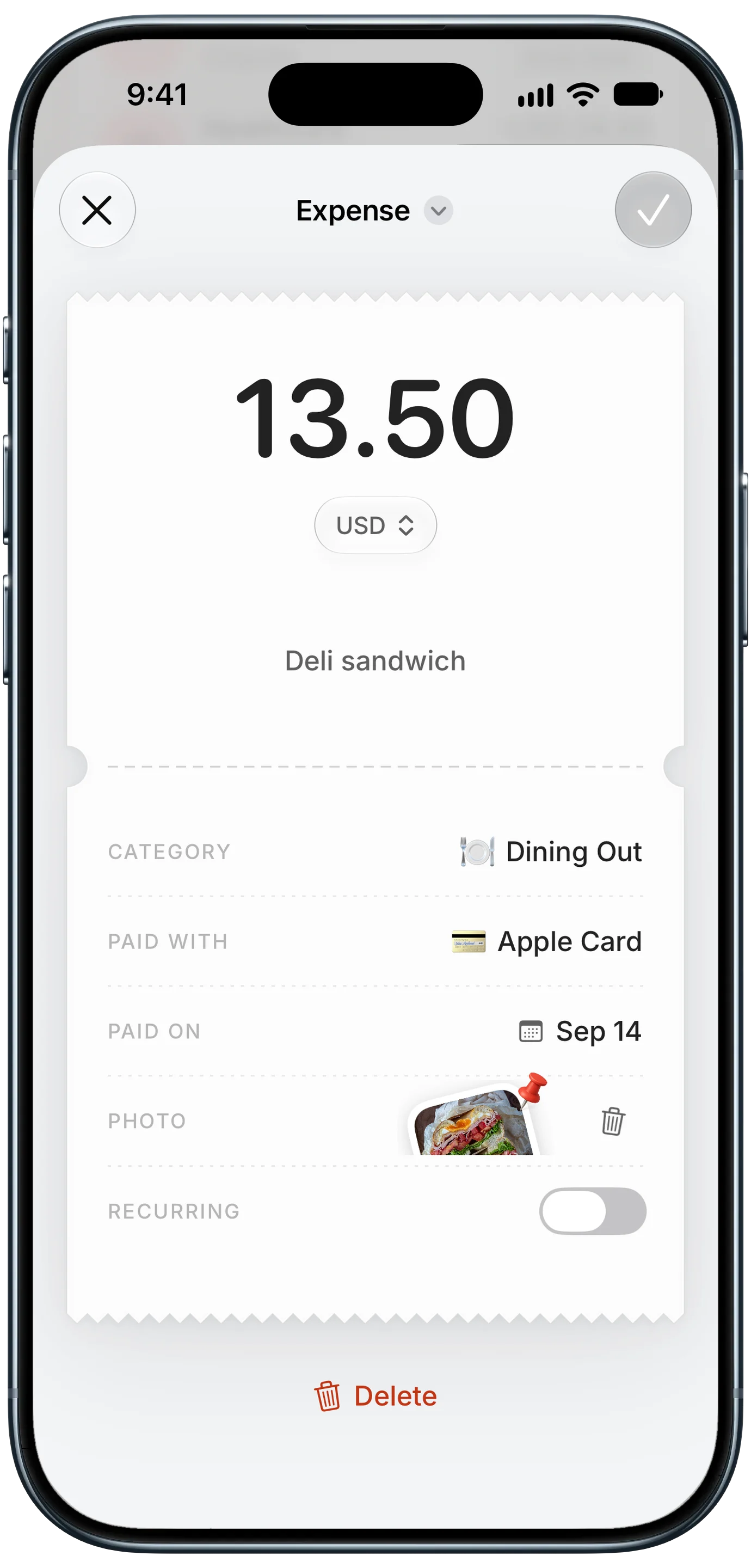
Finny app's photo attachments feature
A good receipt or explanation of benefits (EOB) shows the date, provider, patient, service or item, and amount paid. A card slip alone is usually not enough.
How long to keep them:
- FSA: Keep receipts at least until the plan year is closed and every claim is approved, then keep them with that year's tax records.
- HSA: Keep receipts for as long as you have money in the account, plus the usual tax record period after the withdrawal. If you plan to reimburse yourself years later, that receipt is your proof.
Our guide on how long to keep receipts covers retention periods in more detail. Paper fades, so a digital copy is the safer option. See how to store receipts digitally for a simple folder and naming system. Mark each receipt "reimbursed" or "unreimbursed" so you never claim the same expense twice.
Tracking Medical Spending in Your Budget
Track medical costs as their own category rather than mixing them into general shopping.
- Create a Medical category: Log every copay, prescription, and dental bill, whichever account paid it.
- Note the payment source: HSA card, FSA card, or your own card. Personally paid expenses can be reimbursed from an HSA later.
- Review monthly: Compare FSA spending against your election so you are not left with a large balance in November.
- Set next year's election from real numbers: Your yearly Medical total is the best starting point.
Many health costs are paid online: pharmacy orders, telehealth visits, and portal bills. This short video shows how a payment on your iPhone screen can be logged without a bank connection.
An expense tracker like Finny lets you attach a receipt photo to each medical entry, so the expense and its proof live together. That makes it easier to reimburse yourself from an HSA later or answer an FSA documentation request in a few minutes.
The Bottom Line
The HSA vs FSA decision starts with your health plan. With an HSA-eligible high-deductible plan, open the HSA: it rolls over, travels with you, and carries the strongest tax treatment available. With a traditional plan, an FSA still cuts the cost of predictable medical expenses, as long as you elect a realistic amount. Either way, start from this year's real spending and keep every receipt.
Common Questions About HSA vs FSA
Is an HSA or FSA better?
An HSA is generally stronger because the money rolls over, can be invested, and stays with you between jobs, but you need an HSA-eligible high-deductible plan to contribute. An FSA works with most employer plans and gives you the full annual amount on day one, which helps with planned expenses. If you can handle an HDHP deductible, the HSA usually wins. Otherwise, a carefully sized FSA still saves real money.
What happens to my FSA if I don't use it?
Unused FSA money is generally forfeited to your employer at the end of the plan year. Plans can soften this in one of two ways: a carryover of up to $680 from 2026 into 2027, or a grace period of up to two and a half months to spend the remaining balance. Plans cannot offer both, and some offer neither. Many also allow a run-out period to submit claims for expenses already incurred. Check your plan summary before choosing an election amount.
Can I use my HSA for non-medical expenses?
Yes, but it costs you. Before age 65, non-medical withdrawals are taxed as income plus a 20% penalty. After 65, the penalty goes away and non-medical withdrawals are taxed as ordinary income, much like a traditional IRA. Medical withdrawals stay tax-free at any age, which is why many people pay small bills out of pocket, keep the receipts, and let the HSA grow.
Do I need to keep receipts for HSA purchases?
Yes. HSA providers usually do not ask for receipts, but the IRS can, and you must prove each withdrawal paid for a qualified medical expense. Keep itemized receipts or explanations of benefits showing the date, provider, service, and amount. Store digital copies by year for as long as the account is open plus the normal tax record period, especially if you plan to reimburse yourself later.
Ready to keep medical spending and receipts in one place?
Download Finny to log health costs with a receipt photo attached, see your medical category at a glance, and plan next year's HSA or FSA election from real numbers. No bank connections required, and your data stays under your control.