YNAB vs Monarch Money 2026: $109 vs $99.99, Who Wins?
Nine dollars a year separates them. That is the least useful fact in this comparison, and it is the one every roundup leads with.
YNAB vs Monarch Money is not a price decision. It is a decision about what you want an app to do to you. YNAB is a method that happens to ship as software: it tells you what to do with every dollar, and it works because it is demanding. Monarch is a dashboard: it shows you the whole picture, accurately and beautifully, and asks very little.
Pick the wrong one and you will not use it, whichever way the $9 went.
The Short Answer
Choose YNAB if you overspend, carry debt, or have tried tracking apps before and drifted away from them. You need the method, not the reporting.
Choose Monarch Money if your finances are basically under control and spread across many accounts, you have investments worth watching, and you want one place that shows all of it without homework.
Choose neither if you mainly want to know where your money went, do not want to link bank accounts, and would rather not pay $100 a year for a dashboard you check on Sundays.
Pricing, Properly Compared
| YNAB | Monarch Core | Monarch Plus | |
|---|---|---|---|
| Monthly | $14.99 | $14.99 | Not offered |
| Annual | $109 (~$9.08/mo) | $99.99 (~$8.33/mo) | $199, annual only |
| Free trial | 34 days, no card required | 7 days | 7 days |
| Free tier | None | None | None |
| People included | Up to 6 | 2 (household) | 2 (household) |
| Students | $4.99/mo, or 12 months free with a .edu address | No discount | No discount |
Three things this table shows that the headline price hides.
The trial lengths are not comparable. YNAB gives you 34 days without a card. Monarch gives you 7. Budgeting habits take longer than a week to test, and YNAB knows its product needs a few pay cycles to click. If you are genuinely unsure, the longer trial is worth more than the $9.
YNAB covers six people, Monarch covers two. For a couple, both work. For a family running money together, or roommates, or parents including adult kids, YNAB's six seats change the per-person maths completely.
Students should not be paying for either. YNAB is $4.99/mo with a .edu address, and has run 12-months-free periods through its college program. That is the single biggest discount in this category.
For Monarch's tier split specifically, see our Monarch Core vs Plus breakdown, and for the full cost picture, Monarch Money pricing and YNAB pricing.
The Real Difference: Method vs Picture
YNAB makes you decide before you spend
YNAB runs on zero-based budgeting. Money arrives, and you assign every dollar of it a job before any of it moves. Nothing sits unallocated. When you overspend a category, you do not get a warning, you get a decision: which other category is covering it?
That friction is the product. It is why people report changing behaviour on YNAB rather than just observing it, and why the community around it is unusually intense for budgeting software. Our explainer on zero-based budgeting covers the method independent of the app.
The cost is real. YNAB asks for weekly participation. It has a learning curve measured in weeks. If you will not do the work, you are paying $109 a year to feel guilty, and plenty of people do exactly that.
Monarch shows you what already happened
Monarch connects to everything: checking, savings, credit cards, loans, investments, property. It categorizes automatically, tracks net worth, projects cash flow, and puts it in an interface that is genuinely the best-looking in the category. It has an AI assistant you can ask "how much did I spend on restaurants in April" and get a straight answer.
It was co-founded by Mint's first product manager, and it shows. This is the Mint successor most Mint refugees actually wanted.
The cost is that it will not make you change anything. It reports faithfully and leaves the judgment to you. For someone already in control, that is exactly right. For someone overspending, a beautiful chart of the overspending is not an intervention.
Head to Head, Feature by Feature
| YNAB | Monarch | |
|---|---|---|
| Budgeting method | Zero-based envelope, strict | Flexible categories |
| Bank syncing | Yes | Yes, broader coverage |
| Investment tracking | Minimal | Strong, deeper on Plus |
| Net worth | Basic | Strong |
| Cash flow projection | No | Yes |
| AI assistant | No | Yes |
| Behaviour change | Its entire purpose | Not the goal |
| Learning curve | Weeks | An evening |
| Works offline | No | No |
| Multi-currency | Manual rate handling | Limited |
| Best at | Getting out of debt, breaking overspending | Seeing everything in one place |
Where Monarch clearly wins: automation, investments, net worth, setup speed, and the sheer breadth of what it shows you. If you have eight accounts and a portfolio, Monarch is the better instrument.
Where YNAB clearly wins: debt payoff, behaviour change, structured budgeting depth, family seats, and the trial. If money is leaking and you do not know why, YNAB is the better intervention.
Neither works offline, and both require linking your accounts.
The Comparison Nobody Runs
Both apps assume the same two things: that you will link your bank accounts, and that around $100 a year for a financial dashboard is normal.
Question both and the field looks different.
Bank linking means an aggregator holds credentials to your accounts and a company holds a complete picture of your finances. That is a considered trade, not a free one, and our guide to finance app security and privacy covers what it exposes. It also breaks: connections drop, banks change authentication, and a dashboard quietly showing stale numbers is worse than no dashboard.
And $100 a year buys a lot of reporting for a problem that is often much simpler than it looks. Most people who finally track a full month discover their fixed costs were exactly what they assumed, and the variable spending was the surprise. That does not need investment analytics. It needs the coffee to get logged.
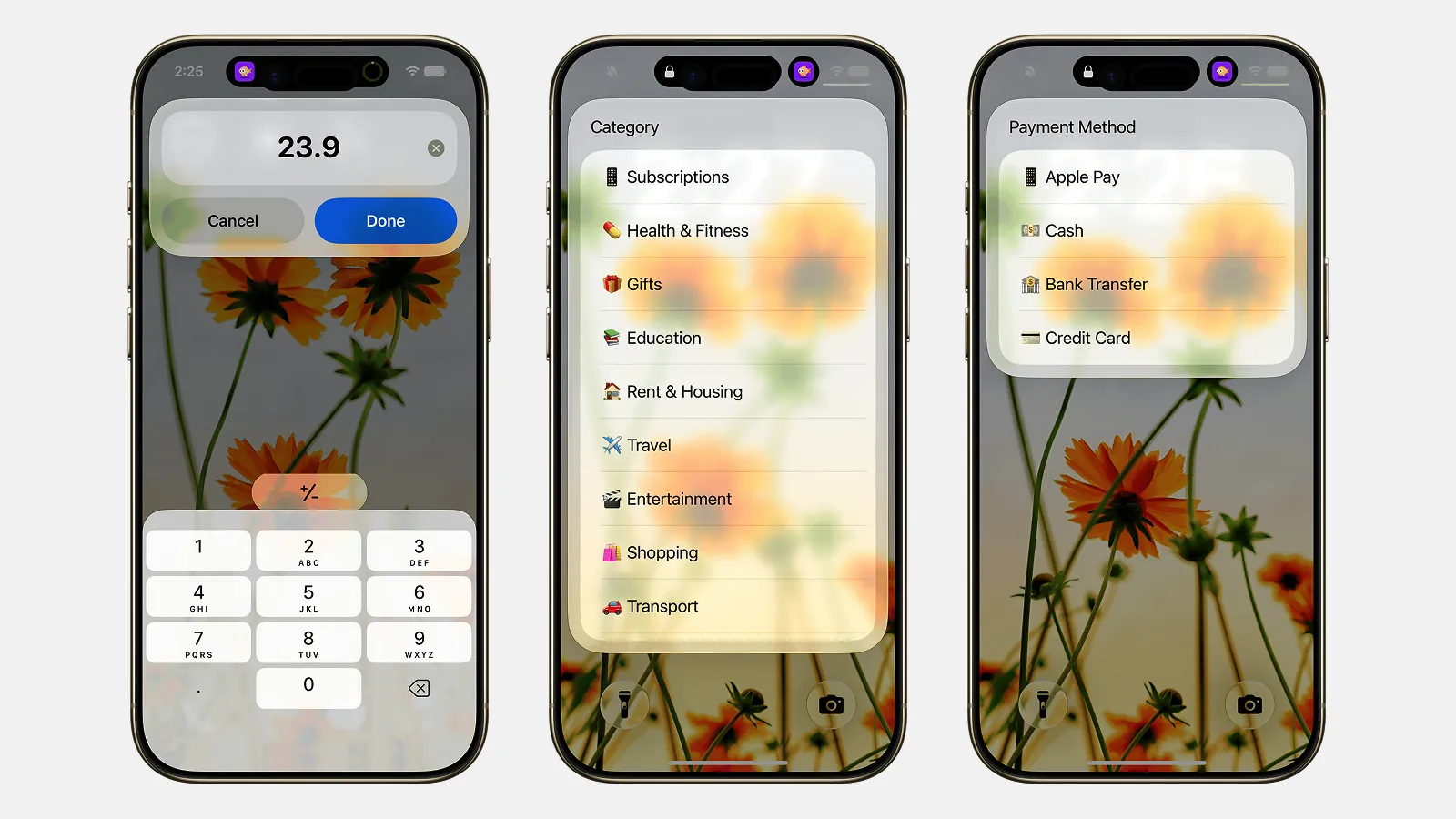
Finny app's Quick Log feature
Finny is built for that narrower job: log what you spend in a few seconds as it happens, in any currency, with no bank connection on any plan, and Apple Pay purchases log themselves. It does not track investments, does not project cash flow, and is not a zero-based budgeting system. It costs a small fraction of either app here. If what you actually need is an accurate record of where the money went, that is the whole product.
How to Choose in Two Minutes
- Are you trying to change a habit, or watch a portfolio? Habit means YNAB. Portfolio means Monarch.
- How many people are on it? Three or more means YNAB, which includes six seats to Monarch's two.
- Will you sit down with it weekly? If no, YNAB will not work regardless of how good it is. Monarch survives neglect. YNAB does not.
- Are you a student? YNAB, at $4.99/mo or free with a .edu address. This is not close.
- Do you want to link your bank at all? If no, neither app is for you, and that is fine. See expense trackers with no bank login.
Use the trials in the right order: start YNAB's 34-day trial first, since it is longer and free of a card requirement, and start Monarch's 7 days only when you are ready to give it a real week.
Common Questions
Is YNAB or Monarch Money better?
They win at different things. YNAB is better for changing spending behaviour, paying down debt, and structured budgeting, and it includes six people. Monarch is better for seeing everything at once: many accounts, investments, net worth, and cash flow projection, with far less effort.
Which is cheaper, YNAB or Monarch?
Monarch Core is $99.99 a year against YNAB's $109, so Monarch is $9 cheaper. Both are $14.99 billed monthly. Monarch's Plus tier is $199 a year. Students make YNAB dramatically cheaper at $4.99 a month with a .edu address.
Does YNAB or Monarch have a free version?
Neither has a permanent free tier. YNAB offers a 34-day free trial with no credit card required, and Monarch offers 7 days. If a free-forever option matters, see our best free budgeting apps roundup.
Can you use YNAB and Monarch together?
People do, using YNAB for active budgeting and Monarch for net worth and investments. It costs about $209 a year and means categorizing in two places, so it is hard to justify unless both jobs genuinely matter to you.
What is a good alternative to both?
It depends what you are replacing. For the zero-based method without the price, Actual Budget is free and open source. For net worth and investments without paying, the Empower Personal Dashboard is free. For fast tracking with no bank connection, Finny.
Not sure you need a $100 dashboard? Finny logs your spending in seconds a day, in any currency, with no bank connection. Free to start, Pro at a low monthly price.