Empower Personal Dashboard Review 2026: Free, With a Catch
If you have been tracking net worth for more than a few years, you probably knew this product as Personal Capital. It was renamed Empower Personal Dashboard in 2023, and in 2026 it remains the most capable free net worth and portfolio tracker available.
It is also, unmistakably, a lead generator for a wealth management business. That is not a scandal, it is the business model, and understanding it is the difference between using this tool well and being annoyed by it.
This review covers what the free dashboard actually does, what the catch costs you, and who should use something else.
What Empower Personal Dashboard Is
A free web and mobile dashboard that aggregates your financial accounts and analyzes them. You link checking, savings, credit cards, loans, mortgages and, most importantly, investment accounts including 401(k)s and IRAs. Empower pulls balances and holdings and builds a single picture of your finances.
The emphasis matters: this is an investment tool that also shows your bank balances, not a budgeting app that also shows investments. Most of the product's depth sits on the portfolio side.
What It Does Well
Net worth tracking
The core feature, and still the best free version of it. Every account in one chart, tracked over time, updated automatically. For anyone who has maintained a net worth spreadsheet by hand, the appeal is obvious: the same number, updated daily, without the monthly ritual of typing in balances.
If you are new to the metric, our explainer on what net worth is and our guide to net worth tracking for wealth building cover why it is worth watching.
Investment fee analysis
The Fee Analyzer inspects the expense ratios inside your funds and projects what they cost you over time. For anyone with an old employer 401(k) full of expensive funds, this single free report can be worth thousands. It is the most genuinely useful thing in the product.
Our explainer on expense ratios covers the underlying concept if the numbers do not mean much to you yet.
Allocation and retirement planning
The allocation checkup shows how your holdings actually break down across asset classes, which is often a surprise for people holding several overlapping funds. The retirement planner runs scenarios against your real balances instead of round numbers.
Both are better than free tools usually are.
The Catch: What Free Actually Costs
Empower makes money by managing money. Its advisory service charges an annual fee, typically in the range of 0.49% to 0.89% of assets under management, and the free dashboard is how it meets prospective clients.
In practice, that means:
You will get a phone call. Users with meaningful investable assets commonly report contact from an advisor shortly after linking accounts. It is not a hard sell for most people, but it is a real call from a real salesperson, and declining once does not always end it.
Your account data is the qualifier. The dashboard knows exactly how much you have, which is what makes the outreach targeted.
The free tools are not going away, but they are not the priority. Reviewers have noted for several years that the experience feels increasingly oriented toward conversion: a clunky login flow, redirects across domains, and prompts toward advisory services.
If you are comfortable with a sales call and a phone number in a CRM, the free tools are excellent value. If that trade makes you uneasy, this is the wrong product, and it is worth saying so plainly.
Where It Falls Short
Budgeting is an afterthought
Empower has spending tracking, but it is thin next to dedicated budgeting apps. There is no meaningful envelope or zero-based system, category management is limited, and the monthly view is a summary rather than a tool you act on. If your goal is to spend less this month, this is not the app that will help.
For that job see our roundup of best budget planner apps, or what zero-based budgeting is if you want the method first.
Everything requires a bank connection
There is no manual mode. The entire product is built on account aggregation, which means handing over credentials for every account you want tracked, including retirement accounts. Aggregation also breaks: connections drop, banks change authentication, and a dashboard is only as current as its weakest link.
Our guide to finance app security and privacy covers what linking actually exposes.
It is US-centric
Account coverage is strongest for US institutions. If your accounts are outside the US, expect gaps.
Who Should Use It
Use Empower Personal Dashboard if you:
- Have investment accounts worth analyzing, especially old 401(k)s with unknown fees
- Want automated net worth tracking without maintaining a spreadsheet
- Are comfortable linking accounts and fielding an occasional sales call
- Bank primarily with US institutions
Use something else if you:
- Mainly want to control monthly spending
- Prefer not to link bank credentials at all
- Have a simple portfolio where a fee analyzer will tell you nothing new
- Want a mobile-first tool for logging expenses as they happen
Empower Compared to the Alternatives
| Tool | Cost | Strength | Bank link | Weakness |
|---|---|---|---|---|
| Empower Personal Dashboard | Free | Net worth and portfolio analysis | Required | Sales calls, weak budgeting |
| Monarch Money | $99.99/yr | Full household dashboard | Required | No free tier |
| Copilot Money | $95/yr | Polished Apple experience | Required | iOS and Mac only |
| Finny | Free tier, Pro a low monthly price | Fast expense logging, multi-currency | Not required | No investment tracking |
The comparison people most often want is Empower against Monarch, and the answer is that they solve different problems. Empower analyzes what you own. Monarch manages what you spend and owe, across a household, for $99.99 a year. Plenty of people run Empower free for the portfolio side and pay for something else for budgeting, which is a perfectly sensible setup. If you are weighing Monarch's tiers for investment features specifically, our Monarch Core vs Plus comparison is relevant, because Empower free covers a good deal of what Plus charges $199 a year for.
The Gap Empower Leaves
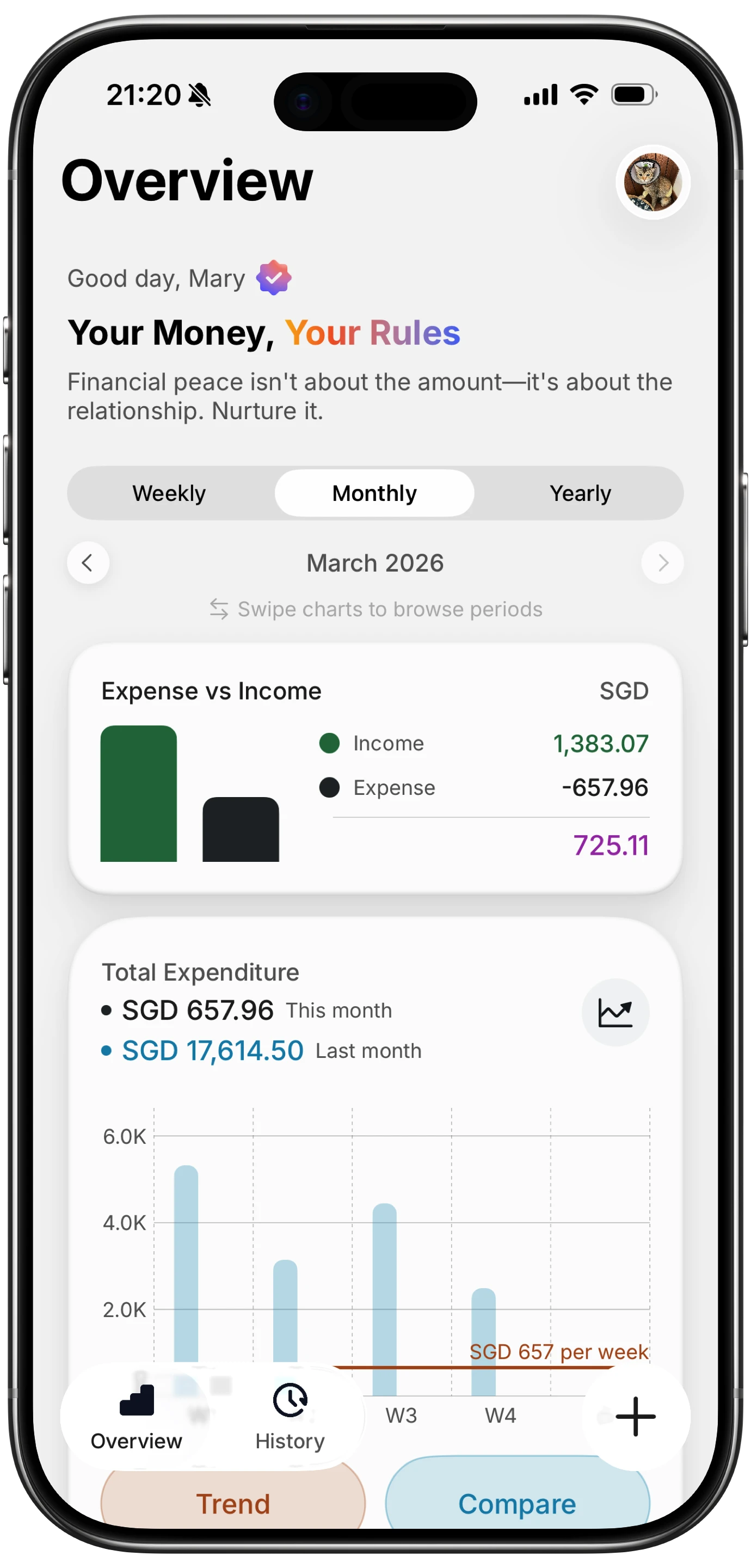
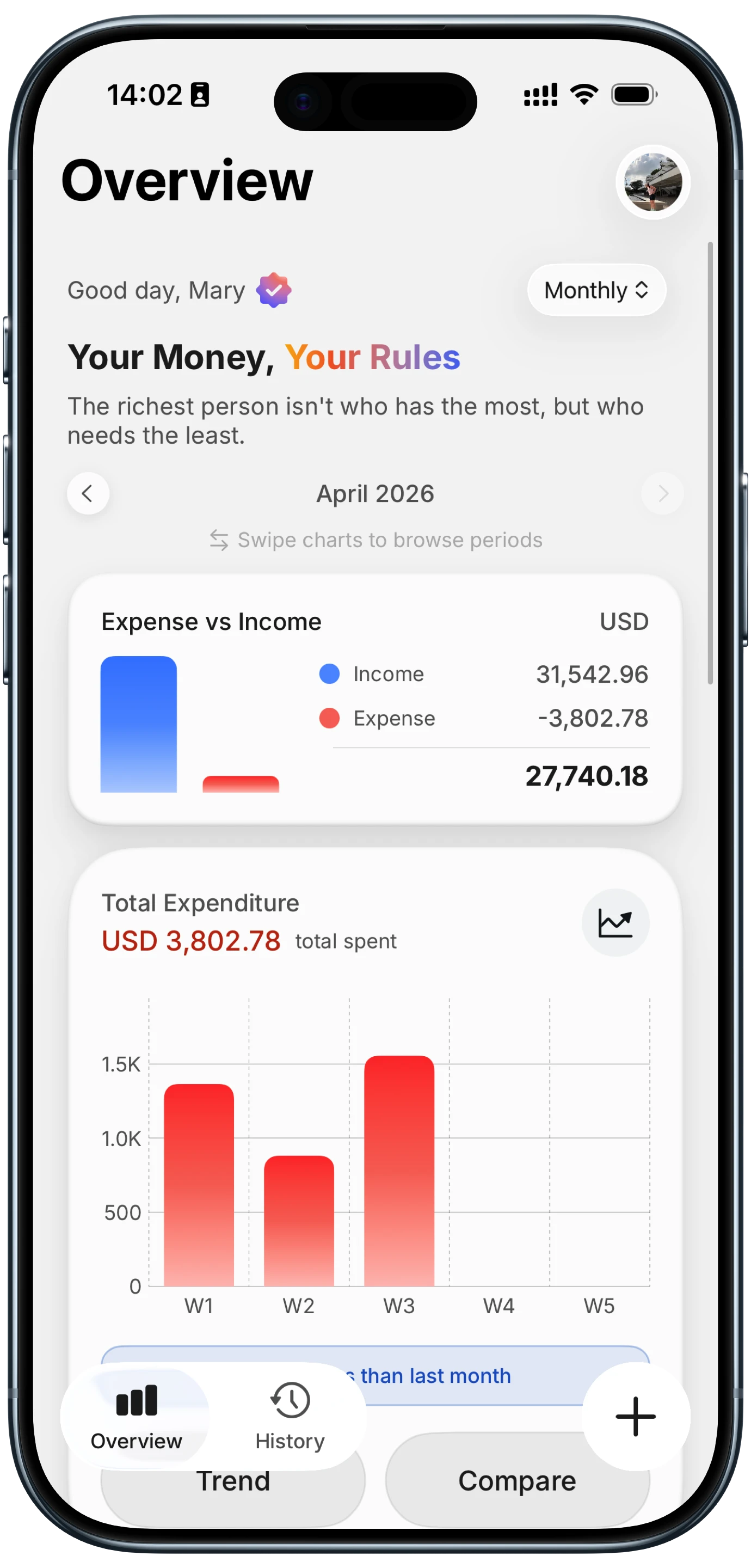
Finny app's Overview feature
A dashboard tells you where you stand. It does not change what you do on Tuesday afternoon.
That is the honest limit of aggregation tools. They are retrospective by design: they show you a number after the money has moved. The behavior that actually changes a budget happens at the point of spending, and no dashboard is open at that moment.
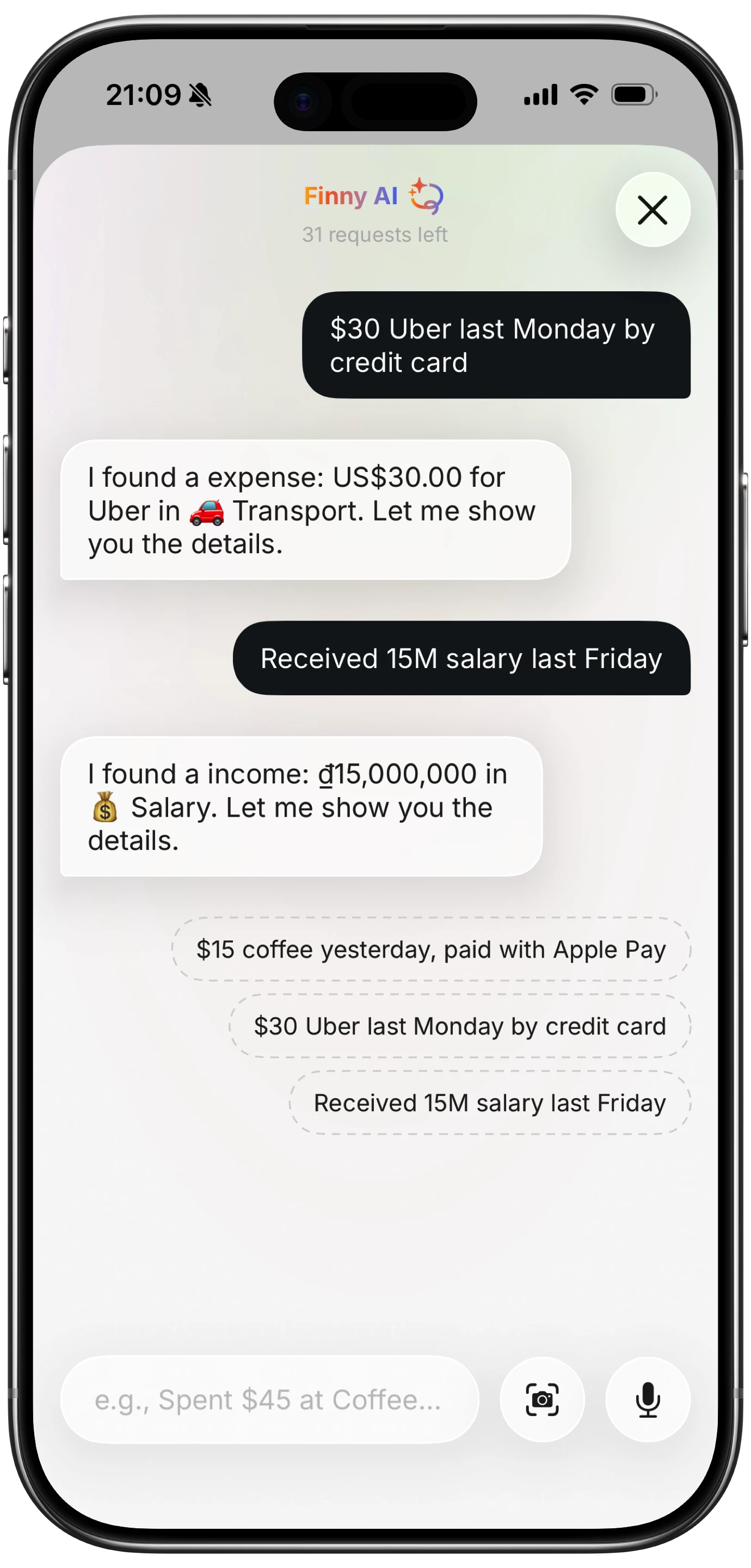
Finny app's AI chat feature
This is why a lot of people pair a free net worth dashboard with something fast on their phone for daily logging. Finny fills that second slot: log an expense in a few seconds by typing or speaking it naturally, in whatever currency you paid in, with no bank connection required. It will not analyze your portfolio, and it does not pretend to. It covers the part of the month where a dashboard has nothing to say.
Common Questions
Is Empower Personal Dashboard really free?
Yes. The dashboard, net worth tracking, fee analyzer, allocation checkup and retirement planner are all free with no subscription. Empower monetizes through its paid advisory service, which charges roughly 0.49% to 0.89% of assets managed.
Is Empower the same as Personal Capital?
Yes. Personal Capital was acquired and rebranded as Empower, with the free tools becoming the Empower Personal Dashboard in 2023. The product lineage is the same.
Will Empower call me if I sign up?
Very likely if you link accounts with meaningful balances. The free dashboard is how the advisory business finds clients. You can decline, but expect at least one call.
Is Empower good for budgeting?
Not particularly. Spending tracking exists but is shallow compared with dedicated budgeting apps, with limited category control and no real envelope or zero-based system. Use it for net worth and investments, and pair it with a budgeting tool.
Is it safe to link accounts to Empower?
Empower uses standard read-only aggregation, so the connection cannot move money, and credentials are encrypted and held at Envestnet Yodlee rather than by Empower directly. The broader question is whether you want your full balance picture held by a company whose business is selling wealth management. We go through the encryption, the aggregator and the sales relationship in is Empower safe, and our guide on tracking expenses without linking a bank covers the alternative approach.
For the head-to-head against the paid alternative most people also consider, see Empower vs Monarch Money.
Want the daily half of the picture? Finny logs expenses in seconds with no bank connection, no aggregation to break, and no sales calls. Free to start, Pro at a low monthly price.