How to Budget as a Blended Family Without Keeping Score
When two families become one household, the money rarely merges as neatly as the furniture. One partner pays child support, the other receives it. One set of kids has always had a phone at twelve, the other has not. There is an ex's household on the calendar and two different ideas of what "normal" spending looks like.
None of that means anyone is doing it wrong. It means a blended family needs a budget built for its actual shape. This guide covers how to budget as a blended family: a structure that keeps shared costs simple, a fair way to handle stepkids' expenses, where child support fits, and how to talk to kids about the changes. For general family budgeting ideas, see our guide to the family budget app.
What Makes Blended Family Money Different
A first-time family usually starts from one set of habits that grows over time. A blended family starts with two or more sets of habits already in place, plus commitments that existed before the new household did.
The common differences:
- Two sets of kids, often on different schedules. Some children live with you full time, some every other weekend, some only in summer. Grocery and activity costs swing with the custody calendar.
- Child support moving in, out, or both. One partner may pay it while the other receives it, and the amounts rarely match.
- Another household in the picture. An ex may share costs like braces or school trips, and those agreements predate your partner.
- Different spending norms. Allowances, birthday budgets, screen time purchases and clothing all carry expectations each family built separately.
The goal is not to make everything identical overnight. It is to agree on what the new household pays for together, what stays with each parent, and how to talk about the gaps.
A Structure That Works: One Household Pot, Personal Money for Each Adult
The structure that suits most blended families is a version of "yours, mine and ours." Shared household costs come out of one pot. Each adult keeps personal money, and each parent keeps some control over costs tied to their own children.
The household pot usually covers:
- Rent or mortgage, utilities, internet and insurance
- Groceries and household supplies
- Shared family outings, vacations and the family car
Each adult funds the pot monthly, often in proportion to income, so a partner earning 40% of the household's take-home pay puts in 40% of the shared costs. Our guide to splitting bills fairly on different salaries walks through the math with worked numbers.
Child support complicates the income figure. Some couples count support received as part of the receiving parent's income for the split; others keep it separate and spend it only on that parent's children. There is no universal answer, but deciding up front avoids a recurring argument. Whatever you choose, write it down in a few sentences and revisit it once a year, or whenever custody, income or the number of people at home changes.
Who Pays for the Stepkids' Costs?
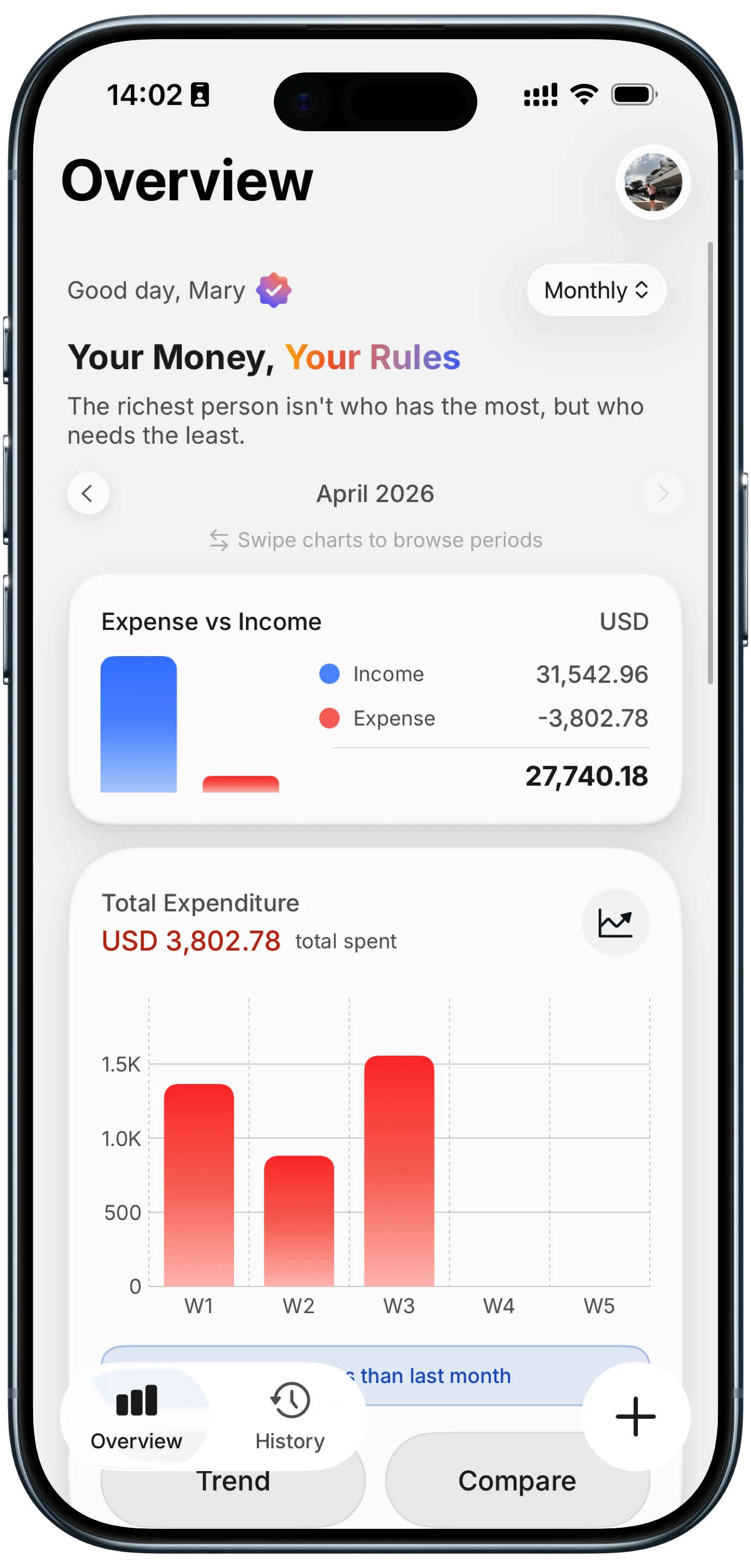
This is the question most blended families find hardest. To answer it calmly, start with real numbers: what each child actually costs across food, school, activities and clothes. In an app like Finny, you can set up categories that match how your family thinks about money, each with its own emoji, from the Categories screen in Settings.
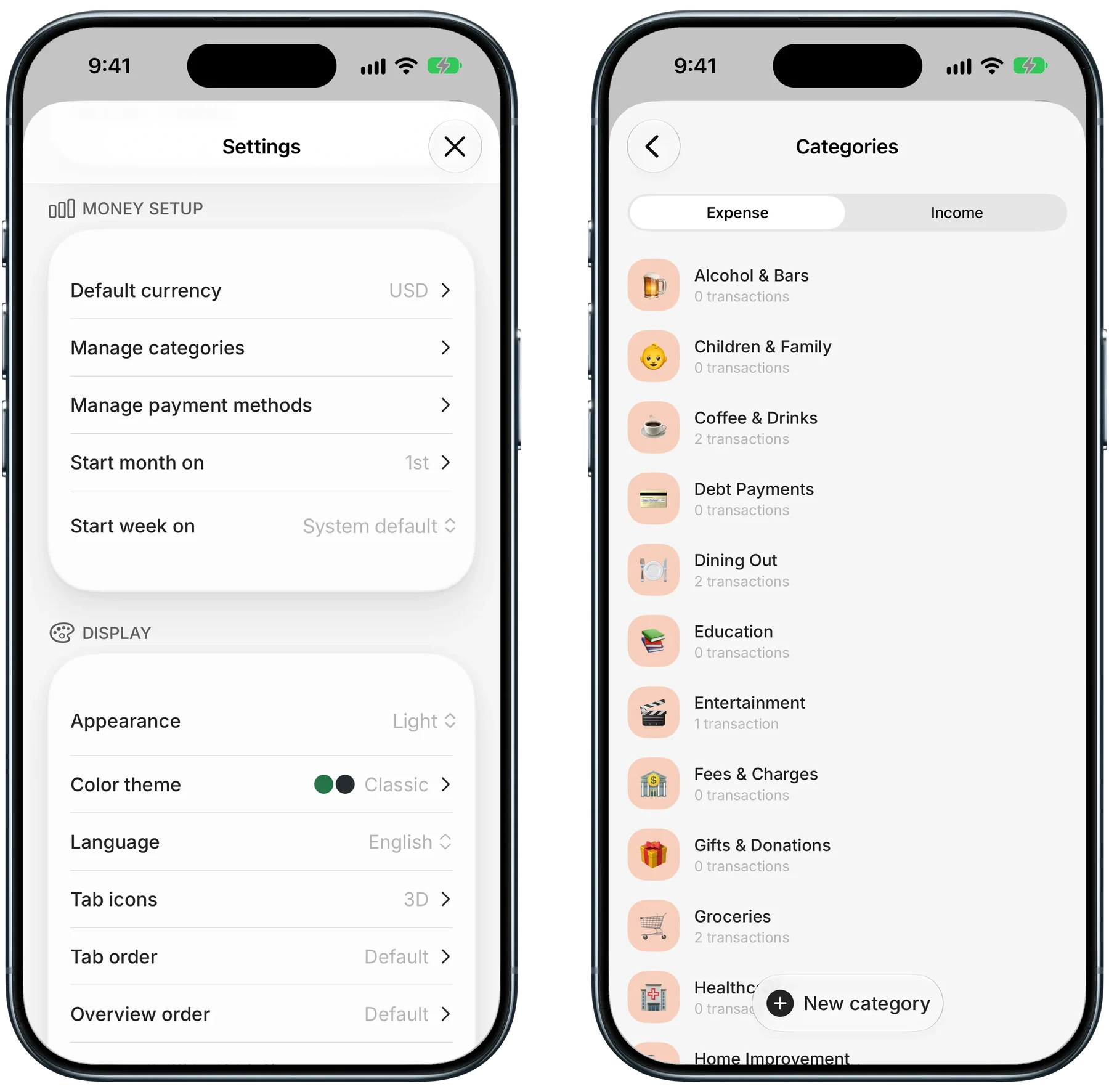
Finny app's categories feature
Categories answer "what kind of spending," but a child's costs cut across many of them. A hashtag per child, like #Maya or #Leo, groups everything for that child across categories without changing category totals. Search the tag and you see that child's total for the period, split by category. Adding and filtering tags needs Finny Pro; searching them is free.
With that picture, most families choose one of three approaches:
- Everything shared. All kids' costs come from the household pot. Simple and unifying, but it can feel uneven if one partner's children are home far more often.
- Each parent covers their own kids' extras. The pot covers food and housing for everyone under the roof; each parent pays for their own children's activities, phones and clothes, often using child support received.
- A defined shared list. The pot covers an agreed list (food, school supplies, family trips), and anything outside it stays with each parent.
Whether a stepparent has any legal duty to support a stepchild depends on state law. This section is about what feels fair in your home, not what is legally required.
Child Support: Budget It as It Actually Arrives
Child support is often one of the biggest lines in a blended family budget, going out or coming in. Amounts are set under each state's guidelines, and the federal Office of Child Support Services explains that every state has its own official guidelines, so the rules and calculations differ by state. This guide does not give legal advice. For questions about an order, start with your state's child support agency.
For budgeting, a few practical rules help:
- Treat support paid as a fixed bill. It comes off the paying parent's income before the household split, like rent.
- Budget support received as it actually arrives. If payments are reliable, plan with them. If they are irregular, build the budget without them and treat what arrives as a bonus for that parent's children.
- Keep a record. A simple log of every payment, in or out, with dates, is useful if an order is ever reviewed.
In Finny, child support works well as a recurring entry: an expense for the parent who pays, or income for the parent who receives it. Recurring rules are free and come with reminders. Since amounts, notes and categories of shared entries are visible to a household, each parent can decide whether to share these entries or keep them private.
Keeping It Fair Without Keeping Score
Fair and equal are different things in a blended family. One partner's kids may need braces this year; the other's may need a laptop next year. If every dollar is tallied against every other dollar, the budget turns into a ledger of grievances.
A few habits keep things fair without turning them into a scoreboard:
- Review monthly, not per purchase. Look at totals once a month instead of debating each receipt as it happens.
- Agree on house rules, not identical spending. Children can have different budgets from different parents while living under the same rules about chores, allowances and screen time at your home.
- Leave room for each parent's choices. A parent who wants to pay for a bigger birthday for their own child from personal money should be able to, without needing approval.
- Name the uneven parts openly. If one partner is covering more for a season, say so and agree on a time to rebalance.
If those conversations feel tense, our guide to what a money date is offers a calmer format: a short, planned check-in with the numbers in front of both of you.
A Household for the Adults, and Teens If You Want
Shared visibility helps a lot here, as long as nobody has to give up their privacy. In Finny, one adult creates a household from Settings, taps Invite someone, and sends the invite or lets the other person scan the QR code.
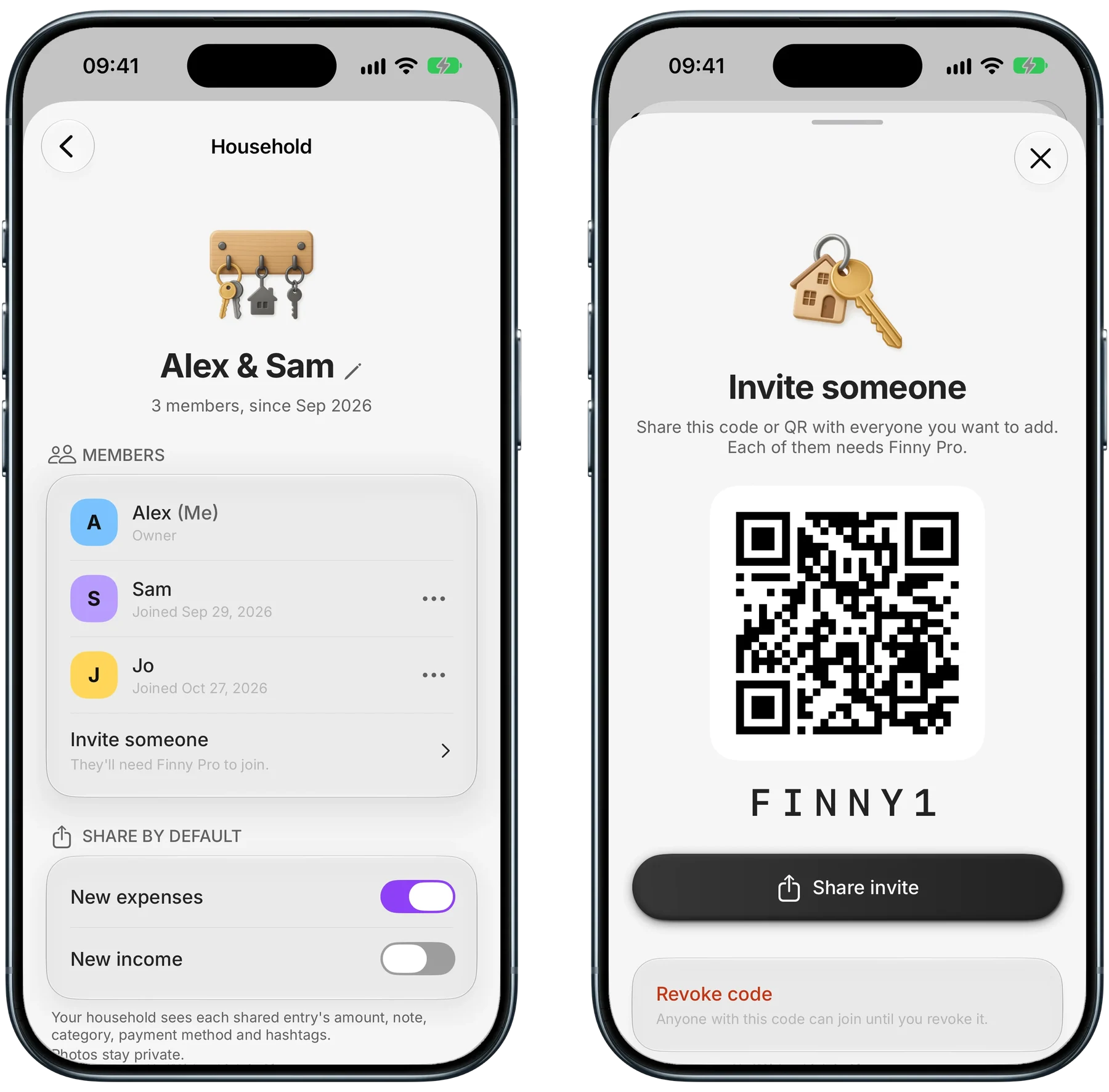
Finny app's Households feature
A household holds up to 6 people. Each person chooses what to share, and shared entries show up in everyone's History with the initial of whoever logged them. Photos and anything not shared stay private, and only the person who logged an entry can edit it. Because shared entries carry their hashtags, searching #Maya shows what both adults spent on Maya. Teens can join too and share the spending they choose. Anyone with the code can join until it is revoked, so send it only to people you trust.
Here is a quick look at Households in action:
Everyone in a household needs Finny Pro. If the household is also your Apple family, one family plan covers everyone through Apple Family Sharing; anyone outside it needs their own Pro. Finny shows who paid for what but does not calculate who owes whom. The Households launch post covers the details, and our guide to tracking a teen's spending has ideas for older kids.
Talking to Kids About Money Changes
Kids notice money changes even when nobody mentions them, like a new rule about phones or a stepsibling who seems to get more. A short, honest explanation usually helps more than silence.
Some guidelines that work across ages:
- Keep it age-appropriate. Young children need to know they are safe and cared for. Older kids can hear that the household is planning together and that some rules are changing.
- Explain rules, not adult details. Children do not need to know about support amounts or disagreements between households.
- Never speak badly about the other household's money. Kids move between homes and should not carry adult tensions with them.
- Make rules consistent at your home. Allowance amounts, chore expectations and gift budgets that apply to every child under your roof feel fairer, even if the other household does things differently.
Teens can be part of the conversation, and some families let them see the shared grocery or activity spending as a way to learn how a household budget works.
Common Questions About Budgeting as a Blended Family
Should stepparents pay for stepchildren's expenses?
It depends on what you agree as a couple. Many blended families share everyday costs like food and housing for everyone at home, while each parent covers their own children's extras, such as activities and phones. Others share everything. Whether a stepparent has a legal duty to support a stepchild depends on state law, so check your state's rules if that question matters for your situation.
How should child support fit into a blended family budget?
Treat support you pay as a fixed bill that comes off your income before the household split. For support you receive, budget it as it actually arrives: plan with it if payments are reliable, and treat it as extra if they are not. Many parents use support received for their own children's costs. Rules for setting support vary by state, so ask your state's child support agency about your order.
Should a blended family combine finances?
Most blended families do best with a partial combination: a shared household pot for housing, groceries and family costs, plus personal money for each adult. Full combination can work, but existing child support, debts and obligations from before the relationship often make a partial setup easier. Write down what the pot covers and revisit it once a year.
How do you keep spending fair between stepsiblings?
Aim for consistent house rules rather than identical spending. Children can receive different amounts from parents outside your home, but allowances, chores and gift budgets under your roof can apply equally to everyone. Review the kids' costs monthly as totals rather than comparing each purchase, and talk openly when one child needs more for a season, such as braces or a school trip.
One household budget, everyone's privacy intact.
Finny lets the adults share the costs they choose, tag each child's spending, and keep child support on a schedule, with no bank connection.