How to Save for a House as a Couple
Buying a home together usually starts as a vague wish: "someday, when we have enough saved." The trouble is that "enough" is rarely defined, and two people can carry very different numbers in their heads for years.
This guide is about how to save for a house as a couple with a number you both agree on. It covers what buyers actually put down today, the closing costs people forget, turning a target into a monthly figure, splitting contributions, where to keep the money, and freeing up room in shared spending. If you have only just combined finances, start with our guide to your first month of combined finances.
How Much Down Payment You Really Need
The old rule says you need 20 percent down. That figure is a threshold, not a requirement. The Consumer Financial Protection Bureau explains that if you put down less than 20 percent, lenders usually require private mortgage insurance, which adds to your monthly cost.
Many buyers put down far less. According to the National Association of Realtors 2026 Profile of Home Buyers and Sellers, released in November 2026 and covering purchases from July 2025 to June 2026, the median first-time buyer put down 9 percent, compared with 19 percent for repeat buyers. Personal savings was the top source, used by 62 percent of first-time buyers.
The minimums go lower still. Fannie Mae notes that a conventional loan can require as little as 3 percent down for eligible borrowers, and HUD says an FHA loan down payment can be as low as 3.5 percent. Each program has its own credit, income, and property rules, so confirm details with a lender.
On a $350,000 home, those options look like this: 3 percent is $10,500, 3.5 percent is $12,250, 9 percent is $31,500, and 20 percent is $70,000. A smaller down payment gets you in sooner; a larger one usually means a smaller loan, a lower monthly payment, and often no mortgage insurance. Neither path is wrong.
Closing Costs and a Cushion
The down payment is not the only cash you need on closing day. Closing costs cover things like lender fees, appraisal, title insurance, and prepaid taxes and insurance. The CFPB's planning guidance has long suggested budgeting roughly 2 to 5 percent of the home price for them, and your lender's Loan Estimate will give you the real figure for your loan. On a $350,000 home, that range is $7,000 to $17,500.
Then there are costs that never appear on a closing form: the inspection, moving, utility deposits, and the first trip to the hardware store. They add up faster than most first-time owners expect.
Keep your emergency fund separate from the house fund. Emptying every account to close leaves no room for a job change or a furnace that gives out in January.
Lenders also look beyond savings: your credit scores and debt-to-income ratio shape the rate and loan you are offered. Our credit score explainer covers the basics.
Set a Target and a Timeline
A savings goal becomes real when it has a number and a date. Here is a worked example you can adapt.
Say you are aiming for a $350,000 home in three years:
- Down payment (10 percent): $35,000
- Closing costs (about 3 percent): $10,500
- Moving and first-month costs: $3,500
- Total target: $49,000
Spread over 36 months, that is about $1,361 a month. If that number feels heavy, you have three levers: a longer timeline, a smaller down payment, or a lower price range. Pushing the timeline to 48 months brings it to about $1,021 a month. Choosing a 5 percent down payment instead of 10 percent cuts the target by $17,500.
Write the number and the date down somewhere you both see it, and revisit it every few months, because prices, rates, and incomes move. A target you adjust on purpose beats one that quietly drifts. When a raise or bonus lands, decide together how much goes to the fund.
Splitting Contributions: Equal or Proportional
Once you know the monthly figure, the next question is who puts in what. There are two common approaches.
An equal split means each of you contributes the same amount. Using the example above, that is about $681 each per month. It is simple and works well when your incomes are close.
A proportional split means each of you contributes the same share of your income. Say one partner brings home $5,000 a month and the other $7,000. The first earns about 41.7 percent of the combined income, so they put in about $567. The second puts in about $794. Both are saving the same percentage of their pay, even though the dollar amounts differ.
Proportional splits tend to feel fairer when incomes differ by 20 percent or more, because an equal split can leave the lower earner with little breathing room. Our guide on splitting bills fairly on different salaries walks through the same math for household bills.
Whichever you pick, automate it with a transfer on payday, and agree in advance on what happens if one of you has a lean month.
Where to Keep the House Fund
Money you plan to use in a few years generally belongs somewhere safe and easy to reach. For most couples, that means a savings account, often a high-yield one. Our explainer on high-yield savings accounts covers how they work and what to compare.
Check that the bank is FDIC insured, or that a credit union is insured by the NCUA. The FDIC insures deposits up to $250,000 per depositor, per insured bank, for each account ownership category, and joint accounts are a separate category from individual ones.
A separate account just for the house lets you see progress at a glance and keeps the money out of everyday spending. Some couples open it jointly; others keep it in one partner's name and log each contribution. A joint account makes ownership clearer, which matters more if you are not married. Investing part of the fund carries the risk of a drop right before you buy, so weigh that with a licensed professional.
Cutting Shared Spending to Fund It
The monthly target has to come from somewhere, and shared spending is often the easiest place to find it. The first step is seeing where the money goes now, so you trim what matters least to both of you.
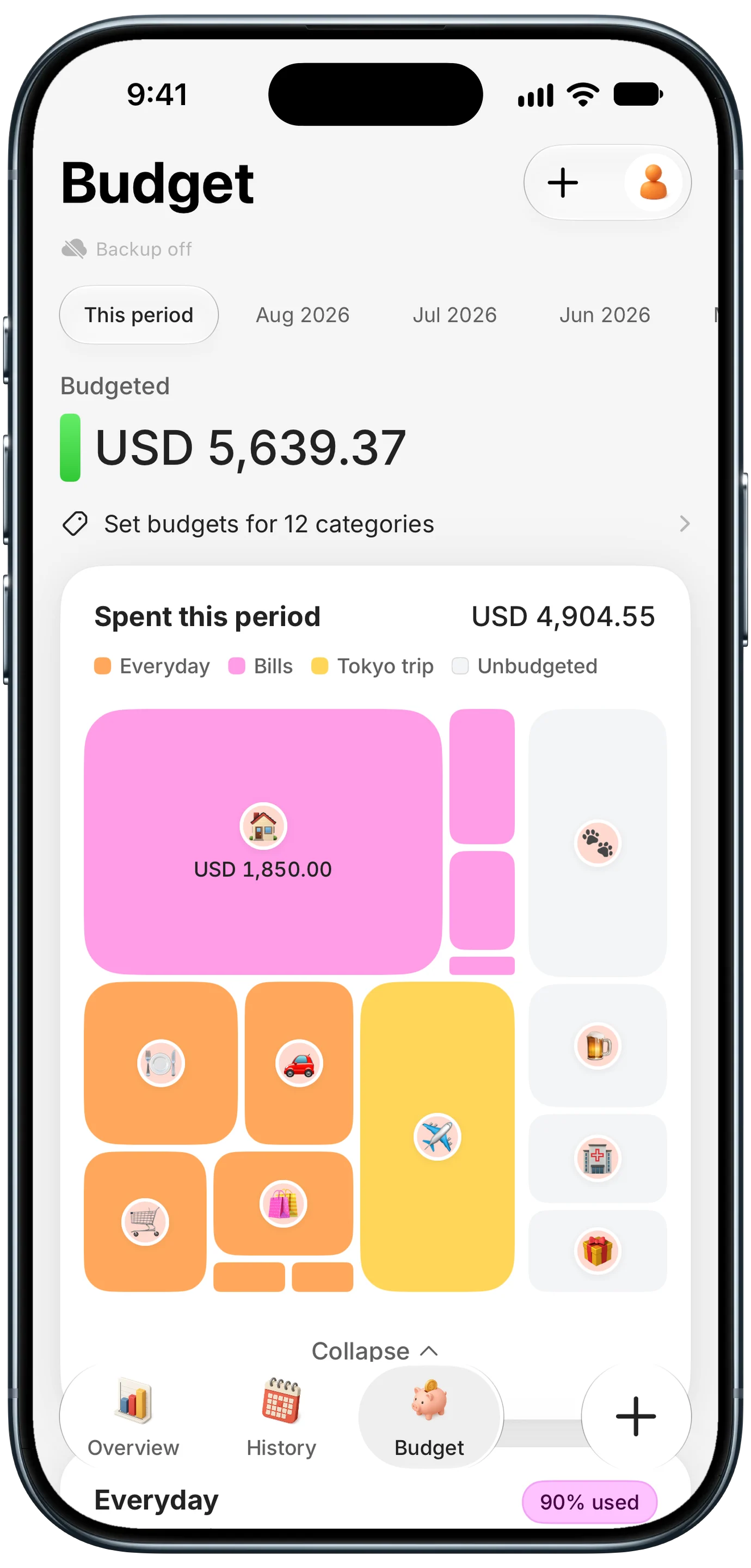
Finny app's budget map feature
In Finny, the Budget tab includes a spending map where each category is a box sized by how much you spent on it, so the biggest areas stand out without reading a chart. Couples often find a few large boxes, like dining out or delivery, where a modest cut adds up. Trimming $300 a month from dining out and $60 from unused subscriptions covers a large share of the $1,361 in the example above.
A few ideas that tend to work without making life feel joyless:
- Cap a category rather than banning it. "Dining out under $250" lasts longer than "no more restaurants."
- Audit subscriptions together. Two people often pay for overlapping services. A subscription cost calculator shows what the overlap costs you per year.
- Route windfalls first. Tax refunds, bonuses, and gifts can go straight to the fund.
- Celebrate milestones. Mark every $5,000 with something small and cheap.
For more ideas, our list of money saving tips that work is a useful companion.
Making the Plan Visible to Both of You
A house fund runs on two people's habits, so it helps if both of you can see how the cuts are going without one person acting as the household accountant. Any shared app works, and our list of free budget apps for couples covers options that cost nothing.
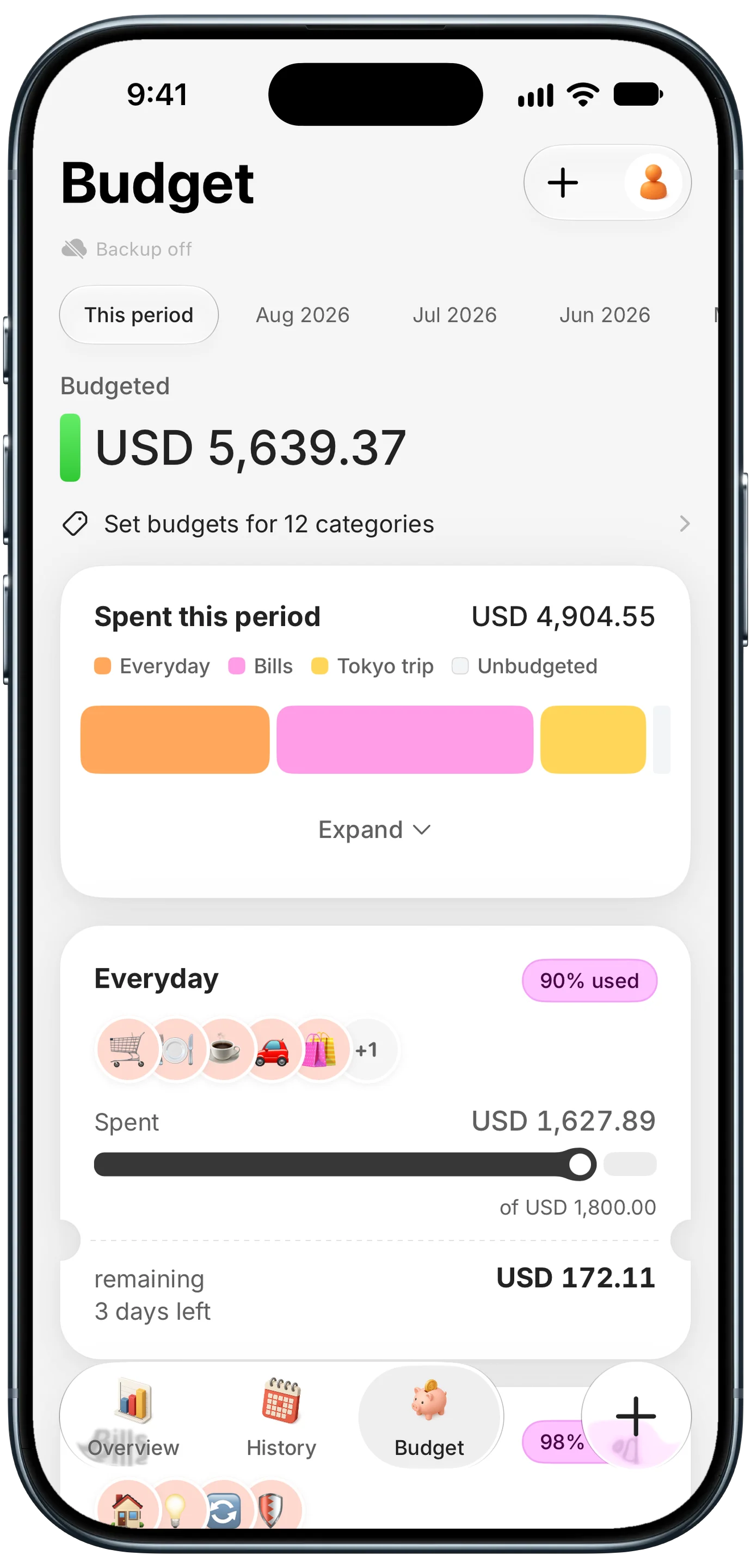
Finny app's Budgets feature
Finny budgets are free and can take an optional end month, which fits a savings push well. Set a budget for the categories you agreed to trim, give it the month you hope to buy as its last month, and turn on rollover if you want an underspent month to carry into the next. Each of you sets your own budget, since budgets only count your own entries.
To see each other's side, you can create a household in Finny and share the entries you choose, such as dining out and groceries. Shared entries show in History with the initial of whoever logged them. If you tag house-hunting costs, such as inspection or application fees, with a hashtag like #NewHome, shared entries carry the tag, so a search for it shows both partners' spending in one total. Households and adding hashtags need Finny Pro for each member. Finny tracks spending and budgets, not your savings balance.
Here is a quick look at Households in action:
The Households launch post covers setup and exactly what stays private.
Buying Together When You Are Not Married
Unmarried couples can buy a home together, but the law may not protect each partner the way it often protects spouses, so extra paperwork helps.
The first decision is how you hold title. The common forms include joint tenancy, which usually passes a partner's share to the other if one dies, and tenancy in common, which lets each partner own a defined share that can pass to their heirs. The options and rules vary by state, and the choice matters if you separate.
The second is a written agreement. Many unmarried couples put in writing who contributed what to the down payment, how the mortgage and upkeep will be split, and what happens to the home if the relationship ends. If you contributed unequally, that record matters.
Here general guidance runs out. A real estate attorney in your state can explain title options and draft an agreement that fits your situation.
Common Questions About Saving for a House as a Couple
How much should a couple save for a house?
Start with the down payment you are aiming for, then add closing costs and a cushion. In NAR's 2026 Profile, the median first-time buyer put down 9 percent, while some loans allow 3 or 3.5 percent. Closing costs are often budgeted at 2 to 5 percent of the price. On a $350,000 home, a realistic target might land between roughly $25,000 and $50,000, plus an emergency fund kept separate.
Should couples save for a house in a joint account?
A joint savings account makes ownership clear and lets both partners see progress, which is why many couples choose one. Others keep the fund in one partner's name and record each contribution. Either can work. If you are not married, a joint account or a written record of who contributed what becomes more important, since it can matter if you later separate or need to prove each person's share.
How long does it take to save for a house as a couple?
It depends on your target and how much you can set aside. A couple aiming for $49,000 and saving $1,361 a month would get there in about three years. Saving $1,021 a month stretches it to four. You can shorten the timeline by choosing a smaller down payment, a lower price range, or by directing windfalls like tax refunds and bonuses straight into the fund.
Ready to see where your shared spending goes?
Finny helps couples set budgets with an end date and share the expenses they choose, so both of you can see the cuts that fund your house, with no bank connection.